From midday on Tuesday 3 November 2026, having a clinical will stops being good practice for BACP members and becomes a professional requirement. The BACP Ethical Framework for the Counselling Professions 2026 asks members, at point 4.5(e), to ensure they have a clinical will in place and have appointed an executor who, bound by confidentiality, can communicate with clients and service users if the member cannot contact them, or has died.
If you have been meaning to sort this out and never quite got to it, you are not alone. A clinical will asks you to plan for the two things nobody wants to think about, your own death or sudden incapacity, and then do a fair amount of paperwork on top. So it gets put off. The deadline takes that choice away, and for good reason.
This article explains what a clinical will is, what belongs in one, who does what, and where people most often get it wrong. It is written for practitioners who need to comply, though the thinking applies to anyone holding client records. One note before we start: this is general professional guidance, not legal advice. A clinical will can raise legal and data-protection questions, so take appropriate advice on your own circumstances.
What BACP Actually Requires
It helps to separate the rule from the good practice around it. The rule itself is short. Point 4.5(e) sits under the core responsibility to deliver services to high professional standards, in the section on managing breaks and endings. It asks members to:
The requirement: point 4.5(e)
- have a clinical will in place, and
- have appointed an executor who, bound by confidentiality, can communicate with clients and service users if the member cannot contact them, or has died.
That is the specific clinical will requirement. Other duties in the framework, on confidentiality, records, data protection, digital tools and professional endings, still apply. Everything else in this article, the backup executor, the review schedule, who tells your executor, what goes in each section, is good practice: how to make that requirement work well in the real world. Where something is a recommendation rather than a BACP rule, we say so.
At a Glance
- A clinical will names someone you trust to step in if you die or become unable to work, so your clients are contacted and your records are handled properly.
- It is not a substitute for a legal will. It covers your clinical and professional affairs only; your personal estate belongs in your ordinary will.
- BACP makes a clinical will mandatory for members from midday on 3 November 2026, at point 4.5(e) of its 2026 Ethical Framework.
- Other professional bodies publish their own guidance on continuity of care, and their requirements differ, so check what your own body asks.
- BACP requires one appointed executor. Naming a backup, and arranging who will alert your executor, are sensible additions rather than express rules.
- A common failure is not a missing will, but one that has quietly gone out of date, usually the client contact details.
Learning Outcomes
After reading this article, you will be able to:
- Explain what a clinical will is, and how it differs from a legal will
- Describe what point 4.5(e) of the BACP Ethical Framework 2026 requires, and when it applies
- Identify who carries out a clinical will, and who is a good fit for the role
- List the elements a clinical will should contain
- Recognise the common ways a clinical will fails, and how to keep yours current
Your Clinical Will Checklist
It’s the task everyone puts off. This free checklist breaks it into tickable steps, so you can get yours in place before the November deadline.
What a Clinical Will Is, and What It Is Not
A clinical will is a set of written instructions that names a trusted colleague to step in if you die or become unable to work, so that your clients are contacted and your records are dealt with properly. It is an act of continuity of care. Nobody enjoys the thought that they might die or become incapacitated, but both are possible, and a clinical will means that if either happens, your clients are treated with care rather than left wondering why their therapist has gone silent.
It also helps to be clear about what a clinical will is not. It is not a substitute for your legal will. It covers your clinical and professional affairs only. Your business assets, debts and wider estate belong in your personal will, dealt with by your personal executor, and the two executors are usually different people. Each should know the other exists, so that nothing falls down the gap between them. Because a clinical will can still carry legal and data-protection consequences, depending on what it contains and how it is used, particularly around access to records and authority to act, it is worth taking legal advice on your own arrangements rather than assuming it sits entirely outside the law. Some probate lawyers even prefer to talk about a “letter of wishes” kept alongside a proper will, though the profession has settled on “clinical will” as the working name.
Why It Matters Now
The BACP Ethical Framework 2026 raises the bar. The 2018 framework only asked members to have “appointed someone”. The 2026 version names the document: point 4.5(e) expects a clinical will to exist, with an appointed confidential executor. A vague intention to ask a colleague is no longer enough.
Two dates are worth keeping straight. The 2026 framework states that it takes effect from 1 November 2026. BACP’s implementation guidance says it becomes mandatory for all members at midday on Tuesday 3 November 2026. Until that point, members remain committed to the 2018 framework. So the date to work towards is 3 November 2026.
BACP is not the only body thinking about this. Other professional bodies also publish guidance on continuity of care, illness, death, and professional or clinical wills, and their requirements are worded differently from BACP’s and from each other. If you belong to a body other than BACP, or to more than one, check its current rules rather than assuming they all say the same thing.
Who Carries Out a Clinical Will
The role BACP names is the executor. This is the person who carries out your wishes: the qualified colleague who steps in, follows your instructions, communicates with your clients where appropriate, and helps make sure your records are safeguarded and dealt with lawfully as your practice is closed down in an orderly way. Because they will be handling confidential client information, they need to understand confidentiality and data protection, and it is sensible for them to be a member of a professional body themselves. It does not have to be the same body as yours. This is a substantial piece of work, so agreeing a fee for their time is reasonable, and their agreement to act should be in writing, not a casual conversation. BACP requires you to appoint an executor; naming a backup, or an additional executor, is a sensible option, as long as the order in which they act is clear.
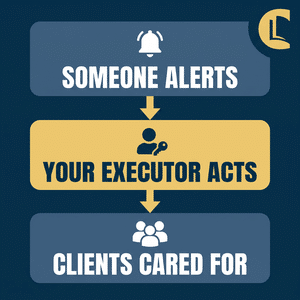
Alongside the executor, it helps to think about who will alert them. Your family may not understand counselling or know who your clients are, but they will know you see a supervisor regularly, and they know their name and how to reach them. Nominating that person, often your supervisor, to contact your executor without delay means the process actually starts when it needs to. This person is sometimes called the “initiator”. It is not a formal BACP role, just a practical arrangement, but a useful one.
Keeping the circle complete matters. If you choose a trusted peer as your executor, your supervisor should still know who that peer is and how to contact them, so that everyone understands the part they play.
What Goes in a Clinical Will
A clinical will pulls together, in one place, everything the executor will need. It is a substantial document, and the detail is the point. The elements below are drawn from good practice and from the clinical will template used in TherapyLock. They are recommendations for making the document workable, rather than a checklist BACP prescribes.
You, and the people carrying out your wishes
- Your identity, qualifications, professional memberships and registration numbers
- Your executor, and a backup, with their profession, professional body and contact details
- Their written consent, given before you name them
- Who will alert your executor that something has happened, usually your next of kin or your supervisor
Your clients
- Where the current client list lives, and how to reach it
- Any risk or safeguarding flags, so the executor knows who to contact first
- Each client’s safe contact method, since revealing the therapeutic relationship to a third party is the obvious hazard to avoid
- What the executor should say, and where to signpost clients for ongoing support
- Whether any former clients should be told
Your records
- Where your paper records are, and where your digital records are
- How access is obtained, without writing passwords directly into the document
- Retention periods, and instructions for secure destruction afterwards
Records also raise data-protection, contractual and regulatory duties. Clients may have rights in relation to the personal data you hold about them, including rights of access in some circumstances, but the position depends on the situation and on who is acting as controller. Rather than rely on a fixed rule, your executor should take current legal and data-protection advice before accessing, transferring, disclosing, retaining or destroying records, bearing in mind that a contract cannot override the legal, regulatory or professional requirements that apply. Our guide to GDPR for therapists covers the data-protection side in more detail.
Everyone else to tell
- Your supervisor, professional body, insurer, referral sources, room hire, and accountant
- Your digital footprint: website, directory listings, professional email and social media
Money
- Fees owed to you, and any prepaid sessions not yet delivered
- Whether your executor is paid for their time, and by whom
If you supervise
- Your supervisees need their own list and their own instructions, separate from your client arrangements
Keeping the Client List Live: How TherapyLock Helps
One part of a clinical will is hard for a paper document to do well, and it is the part that matters most in the moment: an accurate, current list of who your clients are and how to reach them safely. Paper is good at holding the things that rarely change, such as who to notify and where the original records are kept. It is poor at holding a client list, because a caseload changes week to week, and a list written once and filed away is out of date almost immediately.
This is one reason we built TherapyLock, our own practice management app, with a clinical will built in. Because it holds your client records as a living list, your executor can see your current client list, with no separate paper list to fall out of date. It is also designed to handle executor access without the risky workaround of writing passwords into a document. Your executor requests access through their own account; you are notified across a waiting period that you set, and can cancel the request during that time; and access opens only if you cannot respond, or if you approve it. Once it does, their access is read-only, so they can see your records and contact details but cannot change anything, and every action they take is logged.
None of this removes the thinking a clinical will asks of you. Any system that stores or shares client information, TherapyLock included, needs assessing for confidentiality, UK GDPR compliance and security, and BACP’s 2026 framework expressly asks members to understand how their digital tools handle data and to be transparent with clients about them. TherapyLock is our own product, so treat this as us describing what it does rather than an independent review, and check its privacy and security information to decide whether it suits your practice. What a live system changes is the maintenance problem: it keeps the one part of your clinical will that goes stale fastest permanently up to date.
TherapyLock
An encrypted vault for UK counsellors and psychotherapists. Write your session notes, keep client records, and manage appointments in one secure place – built around UK GDPR and the ethical standards of the counselling profession, by the team behind Counselling Tutor.
Where Clinical Wills Go Wrong
Most clinical wills do not fail because they were never written. They fail because they were written once and then left to rot. Three practical problems are worth guarding against.
The first is stale contact details. The document is created, filed, and forgotten. By the time it is needed, the executor has moved, the supervisor has changed, and the insurer is different. Everything in it is technically present and practically useless.
The second is an executor who was named but never properly asked, or who never saw what they were agreeing to. Naming someone is not the same as securing their informed consent. This is why the agreement should be in writing, and why the executor should sign.
The third is a client list that exists only on paper and is out of date by the time anyone opens it. A live system like TherapyLock is designed to prevent exactly this, and it deserves a deliberate fix rather than hoping your paper list happens to be current on the day it is needed.
The remedy for all three is the same: review the document regularly, at least once a year, and keep the client list refreshed far more often than that. A clinical will is not a document you write and forget. It is one you keep alive.
The Practicalities
A few points on getting it done:
- Sign it and date it, and have your executors sign too. Their signature is a good way to record that they have read the document and agreed to act.
- Take legal advice on the formalities that apply to your own arrangements, particularly anything touching access to records, authority to act, or your estate.
- Give your executors full copies.
- Make sure your next of kin at least know it exists and who to call. The last thing a grieving partner needs is a stranger knocking at the door asking for someone who is no longer there, especially if you work from home.
- Consider explaining in your contract or privacy information what will happen if illness, incapacity or death stops you continuing, and the confidentiality safeguards that would apply. Whether to name your executor is a judgement to weigh against privacy and the nature of the service, rather than a fixed rule.
- Review at least annually, and refresh the client list far more often.
Your supervisor is a good person to work through all of this with, whether you are setting up a clinical will for the first time or checking that the one you have still holds together.
Your Clinical Will Checklist
It’s the task everyone puts off. This free checklist breaks it into tickable steps, so you can get yours in place before the November deadline.
Frequently Asked Questions
Is a clinical will a legal document?It is not a substitute for a statutory will, and it covers your clinical and professional affairs only, but it can still carry legal and data-protection consequences depending on what it contains and how it is used. Your personal assets and debts belong in your ordinary will, which is usually handled by a different executor. Because the legal position depends on your own arrangements, take appropriate advice rather than assuming a clinical will sits entirely outside the law.
When does the BACP requirement start?The 2026 Ethical Framework takes effect from 1 November 2026 and becomes mandatory for all members at midday on Tuesday 3 November 2026. Until then, members remain committed to the 2018 framework. The requirement for a clinical will sits at point 4.5(e).
Who should I choose as my executor?A qualified colleague who understands confidentiality and data protection, and who is ideally a member of a professional body. It does not have to be the same body as yours. Because the role involves real work, it is reasonable to agree a fee, and their consent should be in writing before you name them. BACP requires one executor, though many practitioners also name a backup.
Do I have to appoint someone to alert my executor?No. BACP names the executor, not a separate role. But arranging for someone, often your supervisor, to contact your executor without delay is a practical way to make sure the process actually starts when it needs to.
How often should I update my clinical will?Review the whole document at least once a year, and after any change to your executors, supervisor, insurer or practice arrangements. The client list needs updating far more often, because a caseload changes constantly and stale contact details are a common reason a clinical will fails when it is finally needed.
Final Reflections
A clinical will is a big piece of work, and there is no pretending otherwise. But it is the kind of work that only ever feels urgent in hindsight, when it is too late to do it. The deadline of 3 November 2026 is, in that sense, a useful push: it turns a good intention into a task with a date on it.
If you already have a clinical will, treat this as the prompt to open it and check that everything in it is still true. If you do not have one, the practical advice is simple: start today. You never know what the future holds, and a well-made clinical will is the last piece of care you give your clients, and the first kindness you do the colleague who would step in for you.
References and Further Reading
Sources accessed 25 August 2026. This article is general professional guidance, not legal advice. Professional body requirements change over time, so check your own body’s current framework before acting on this article.
Transparency note
This article was written and reviewed by human contributors. AI was used as a supportive tool to assist with formatting, layout clarity, and language refinement. All content, interpretations, and ethical positions were created and checked by the authors.
💡 About Counselling Tutor
Counselling Tutor provides trusted resources for counselling students and qualified practitioners. Our expert-led articles, study guides, and CPD resources are designed to support your growth, confidence, and professional development.
👉 Meet the team behind Counselling Tutor
Notice any broken link or issues with this resource? Kindly let us know by email
Email us