Addiction rarely walks into the room wearing a label. A client comes for help with anxiety, low mood or a relationship that is coming apart, and only later does the drinking, the gambling or the hours lost online come into view. Because addiction receives little attention in most core training, many counsellors meet it feeling they are on unfamiliar ground.
The reassuring part is that you are not starting from nothing. The skills that already define your work – empathy, unconditional positive regard, a belief in the client’s capacity to change – are the same foundations the main evidence-based addiction approaches are built on. What tends to be missing is not competence but a set of frameworks and some addiction-specific knowledge.
This guide brings that knowledge together. It looks at what we mean by addiction, how to make sense of it through the models counsellors use, the close link between trauma and addictive behaviour, how addiction shows up across substances and behaviours, and the practical approaches for working with it – motivational methods, relapse prevention, sensitive presentations such as sex and porn addiction, and knowing when and how to refer.
At a Glance
Addiction has no single agreed definition. It spans both substances and behaviours (often called process addictions), which affect similar reward pathways in the brain.
The biopsychosocial and trauma-informed models shift the question from “what is wrong with you?” to “what happened to you?”
Core counselling skills transfer directly. Motivational Interviewing grows out of the person-centred tradition.
Addiction and mental health difficulties very often appear together, and the behaviour usually serves a purpose for the client.
Relapse is best understood as part of the recovery process, not a failure.
Harm reduction and, where there is no physical dependence, controlled use are recognised goals alongside abstinence.
Never advise a client who is dependent on alcohol to stop suddenly on their own – abrupt withdrawal can cause seizures. Involve a GP.
Work within your competence, keep good supervision, and refer on when a client needs more than you can safely offer.
Your Free Addiction Quick-Reference Guide
A one-page desk aid: the key frameworks, the alcohol-safety rules, and when to refer.
Learning Outcomes
After reading this article, you will be able to:
Describe how addiction is defined and understood, including the main models counsellors draw on
Explain the relationship between trauma and addictive behaviour
Recognise both substance and behavioural (process) addictions, and how they commonly present
Apply motivational approaches and relapse-prevention thinking in your work
Approach stigma, shame and sensitive presentations with confidence and care
Judge when to work alongside other services and when to refer on
What Do We Mean by Addiction?
Addiction has no single, universally accepted definition. Different organisations describe it in ways that reflect their own perspective. The NHS describes addiction as not having control over doing, taking or using something to the point where it could be harmful. The US National Institute on Drug Abuse frames it as a chronic, relapsing brain disorder marked by compulsive seeking and use despite harmful consequences. Between them, these descriptions point to addiction as a behaviour with serious consequences and a strong neurobiological element.
In diagnostic terms, DSM-5 does not use “addiction” as a formal diagnostic label. It refers instead to substance use disorder, assessed through features such as impaired control over how much and how often a substance is used, the time taken up obtaining and recovering from it, the strength of cravings, and the activities given up in its favour. Its broader chapter title, Substance-Related and Addictive Disorders, reflects the recognition of gambling disorder alongside substance-related conditions. A helpful distinction here is between substance misuse, which can be a voluntary pattern of use, and dependency, where the person feels a strong internal compulsion to use.
Substance and behavioural addictions
Addiction is not only about substances that are ingested. Behavioural or process addictions – such as gambling, gaming, compulsive shopping, internet use and sexual compulsivity – involve a powerful compulsion to engage in a behaviour despite its costs to the person and those around them. These can be as damaging as substance addictions, though their diagnostic status differs: gambling disorder is recognised alongside substance-related disorders in DSM-5, gaming disorder appears in the World Health Organization’s ICD-11, and compulsive sexual behaviour disorder is classified by the WHO as an impulse-control disorder rather than an addiction. Research points to important overlaps in reward-related brain circuitry and clinical presentation, particularly for gambling, though the evidence and diagnostic status vary across different behaviours.
Two patterns are worth holding in mind. First, addiction and mental health difficulties almost always travel together; which came first is often unclear, and clients may have used substances or behaviours to manage anxiety, depression or the effects of trauma. Second, a client may present as functional – holding down work, keeping up appearances – while their use is far from under control. Taking time to explore how much, how often, and with what consequences matters more than how organised a life looks from the outside.
How to Understand Addiction: The Main Models
How society has understood addiction has changed considerably over time, and the shift matters because it shapes how clients expect to be treated. In the 1930s and 1940s addiction was often seen as a moral failing, met with punitive responses. The post-war period brought the disease model, framing it as a progressive illness. From the 1960s the biopsychosocial model broadened the picture to include psychological and environmental factors, and the 1980s and 1990s saw harm reduction gain ground, notably during the AIDS crisis. More recent neurobiological research has developed the brain disease model.
The brain disease model
This model treats addiction like other chronic illnesses, emphasising long-term changes in the brain, particularly in the prefrontal cortex. It stresses that while addiction may not be curable, it is treatable, and it has helped reduce stigma by recognising addiction as a medical issue rather than a weakness. Its main criticism is that it can underplay the causes of addiction in a person’s life.
The biopsychosocial model
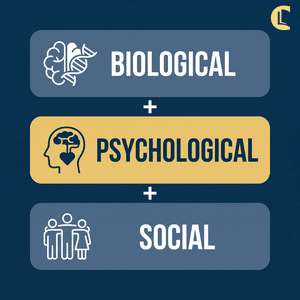
A more holistic approach, the biopsychosocial model considers biological factors (genetic predisposition, brain chemistry), psychological factors (mental health history, trauma, coping), and social factors (family, culture, economic conditions) together. It encourages the counsellor to understand the client’s whole context, and it is captured in the move from asking “what is wrong with you?” to asking “what happened to you?”
The neurobiology, in brief
Dopamine sits at the centre of the brain’s reward pathways, where it drives motivation and helps the brain learn to seek and repeat rewarding experiences. Drug use, gambling or gaming drive this reward signalling, but repeated exposure dulls the response, so more of the substance or behaviour is needed to feel the same effect. Over time, a person may continue simply to feel normal rather than to feel good, which is part of what makes addiction compulsive. Anna Lembke’s idea of a pleasure-pain balance describes how the brain compensates for pleasure with later discomfort, feeding the cycle.
Trauma and Addiction
For many clients, addiction makes most sense as a response to pain. A trauma-informed view treats addictive behaviour as a survival strategy rather than a character flaw. Trauma here is understood less by the event itself than by its effect on the person: Gabor Maté describes trauma as what happens inside a person as a result of what happens to them, and Bessel van der Kolk points to the way trauma stays held in the body long after the event has passed.
The link is well evidenced. The Adverse Childhood Experiences (ACE) study showed a strong association between early-life trauma and later difficulties including substance use, poor emotional regulation and mental ill health. Trauma affects the developing brain, including the prefrontal cortex and amygdala, disrupting the systems that handle emotion and reward and increasing vulnerability to addiction.
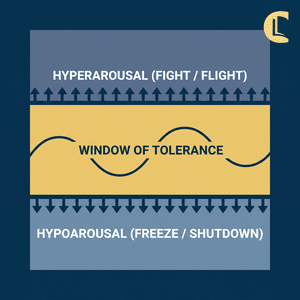
Dan Siegel’s window of tolerance is a useful idea to hold. It describes the zone in which a person can manage their emotions well. Trauma narrows that window, so clients move more readily into hyperarousal (fight or flight) or hypoarousal (freeze or shutdown). Substances and behaviours are often used to modulate these states: alcohol to sedate and dampen anxiety, stimulants to lift and energise, opioids to relieve pain, and behaviours such as gambling or sex to restore a sense of control or aliveness. Dr Anita Johnston’s image of clinging to a log in a river captures it well – a coping mechanism that once kept the client afloat can, in time, be the thing that stops them reaching the shore.
Clients may not disclose addiction early. Asking how they have coped with difficult experiences can open the conversation more gently than asking directly about use.
Recognising the protective role the behaviour has played reduces shame and builds trust.
Grounding, breath work, mindfulness and naming emotions help clients stay within their window of tolerance.
Help clients explore what the behaviour was originally for, what it helped them regulate, and what else might meet that need.
Where there is a risk of unsafe withdrawal, combine compassionate work with referral to medical or specialist support.
Stigma and Shame
Despite how much understanding has advanced, addiction remains heavily stigmatised, and that stigma is often turned inward as shame. It can stop people seeking help at all, and it shapes how they talk about themselves when they do. Disclosing an addictive behaviour takes courage, and it helps to meet such disclosures with empathy and unconditional positive regard, and to use non-pathologising language. With alcohol in particular, moving away from fixed labels such as “alcoholic” towards seeing use on a continuum can lower the barrier to asking for support before things reach crisis point.
Alcohol and Problem Drinking
Alcohol is the substance counsellors meet most often, partly because it is legal, widely available and woven through social life. That same acceptability makes problems easy to overlook and hard to admit to. Thinking of alcohol use on a continuum – from occasional regret through to serious harm – rather than as a simple divide between “alcoholics” and everyone else reduces stigma, validates a range of experiences, and encourages earlier help-seeking.
Some straightforward psychoeducation and assessment can support this work. The UK low-risk drinking guideline is 14 units a week, and many clients are unaware of how much they are actually drinking. The AUDIT (Alcohol Use Disorders Identification Test) is a widely used screening tool: its first three questions (AUDIT-C) cover quantity, and the rest cover impact and behaviour. As a broad guide, scores of 8 to 15 suggest hazardous use, 16 to 19 harmful use, and 20 or more possible dependence.
Important: never advise abrupt cessation in alcohol dependence
If a client is physically dependent on alcohol, stopping suddenly and unsupported can be dangerous and can trigger a seizure. Do not advise a dependent drinker to simply stop. Withdrawal may need to be managed medically, so involve a GP or alcohol service. As a rule of thumb, an AUDIT score of 16 or above warrants recommending a referral, and 20 or above points to possible physical dependence. Other reasons to refer include withdrawal risks, risks to others (for example parenting or driving), or a client asking for detox or rehab. You can continue your therapeutic work alongside that external support, and framing referral as a strength rather than a failure helps.
Recovery does not have to mean abstinence for everyone. Harm reduction and, for people without physical dependence, controlled drinking can be legitimate goals, and reductions in use can bring real improvements even where some use continues. Where there is dependence, withdrawal risk or significant harm, goals should be agreed alongside medical or specialist alcohol support. Client-defined, flexible goals, mindfulness and urge surfing, tracking units and spending, and delaying or substituting drinks all have a place. Several UK organisations support this work, including SMART Recovery, Alcoholics Anonymous, Drinkaware and Alcohol Change UK.
Working with Addiction: The CPD Bundle
Feel ready when addiction shows up in the room. Seven specialist CPD lectures from three practitioners — covering substance and behavioural addictions, Motivational Interviewing, trauma-informed practice, relapse prevention, and harm reduction. 8.5 hours of certified CPD, with lifetime access.
The therapeutic relationship does the heavy lifting here, as it does elsewhere. Meeting clients where they are, using the core conditions of empathy, congruence and unconditional positive regard, gives them room to be honest about behaviours they may feel deep shame about. Defensiveness, minimisation and denial are common, and are better met with collaboration than confrontation.
Boundaries and self-awareness matter especially in this work. Counsellors with their own experience of addiction, whether personal or in the family, need to notice their emotional responses and keep them in view through supervision. The behaviour a client describes can stir strong reactions, and recognising those reactions is part of staying useful to the client.
Motivational Approaches
Motivational approaches moved addiction work away from confrontational, abstinence-only methods towards collaboration, empathy and client autonomy. They draw directly on Carl Rogers’ person-centred tradition, and two frameworks are central.
The Stages of Change
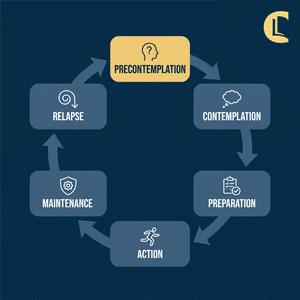
The Transtheoretical Model, developed by James Prochaska and Carlo DiClemente, describes the stages a person may move through: pre-contemplation, contemplation, preparation, action, maintenance and relapse. The process is not linear – people move forwards and backwards, and spend different amounts of time at each stage. Knowing where a client is helps you pitch your response, and meeting them where they are, rather than pushing for change they are not ready for, builds trust.
Motivational Interviewing
Motivational Interviewing (MI), developed by William Miller and Stephen Rollnick from their work with problem drinkers, is a collaborative, client-centred style for helping people resolve ambivalence about change. Its core principles are to express empathy, develop discrepancy between current behaviour and the client’s own values, roll with resistance rather than meet it head-on, and support self-efficacy. The counsellor stays neutral and avoids directing or persuading, using open questions and reflective listening instead.
A central skill in MI is noticing the difference between sustain talk (language defending the status quo) and change talk (language signalling a desire, ability, reason or need to change), and gently amplifying the latter. The DARN and CAT frameworks – Desire, Ability, Reason, Need; Commitment, Activation, Taking steps – offer a simple way to listen for it.
Treat ambivalence as normal; a client can want to change and resist it at the same time.
Use a decisional balance sheet to weigh the costs and benefits of both changing and staying the same, and revisit it as motivation shifts.
Draw out change talk with scaling questions, imagining life without the problem, or looking back at life before the behaviour took hold.
When readiness is there, move to specific, achievable goals, identify triggers and coping strategies, and mark small wins.
MI sits well alongside other approaches, preparing clients for the more structured work of CBT or supporting engagement with a 12-step group.
Relapse and Relapse Prevention
Relapse is best understood as a predictable, teachable part of recovery rather than a failure. Treating it this way reduces shame and helps clients learn from a setback instead of being defeated by it. The Relapse Prevention Model, developed by Alan Marlatt and Judith Gordon in the 1980s and grounded in cognitive behavioural therapy, reframed relapse as part of the process, focused on identifying high-risk situations, and built coping skills and self-efficacy. Mindfulness-Based Relapse Prevention, developed by Sarah Bowen, Neha Chawla and colleagues building on Marlatt’s work, later brought mindfulness practices into relapse-prevention approaches.
It helps to distinguish between a blip (a one-off use followed by a return to recovery), a lapse (repeated or increasing use) and a full relapse (a return to old patterns), because each calls for a different response. High-risk situations may be emotional (shame, grief, boredom), environmental (certain people or places), relational (conflict) or physiological (fatigue, hunger, pain). The HALT check – Hungry, Angry, Lonely, Tired – is a quick way for clients to assess their vulnerability.
One pattern worth naming with clients is the abstinence violation effect: when a single lapse triggers guilt and a sense of total failure, which then tips into full relapse. Reframing the lapse, reducing shame and emphasising what can be learned helps counter it. So does building self-efficacy by highlighting past successes and setting small, achievable goals.
Co-develop a relapse-prevention plan: known triggers, protective factors and coping tools, recovery goals, and strategies for difficult moments. Update it regularly.
Map what happened before, during and after any lapse to build self-awareness and inform the plan.
Teach craving management – cravings are temporary and pass. Distraction, grounding and urge surfing all help.
Watch for seemingly insignificant decisions – small choices that quietly set up a high-risk situation.
Hold a stance of curiosity and compassion rather than judgement when a client returns after a setback.
Recognising Sex and Porn Addiction
Sex and porn addiction is one of the presentations counsellors find hardest to raise, and clients often carry it in silence for years. “Sex addiction” is not itself a formal diagnosis; the closest recognised framework is the World Health Organization’s compulsive sexual behaviour disorder. It is classified in ICD-11 as an impulse-control disorder, and its features include being preoccupied with the behaviour and feeling out of control of it, continuing despite serious harm to relationships, work, finances or health, and repeated unsuccessful attempts to stop over a sustained period.
Knowing what it is not matters just as much. Distress that comes purely from moral judgement or disapproval about one’s own sexual behaviour is not, in itself, an addiction. A high sex drive, unusual preferences, or a behaviour that offends others are not addiction if the person enjoys it, is not preoccupied, and is not using it to manage difficult emotions. As with alcohol, it is not the frequency or the specific activity that defines the problem but the person’s relationship with it – whether it has become the main way they escape or regulate unbearable feelings such as loneliness, anxiety or shame.
Because shame runs so deep here, how the counsellor holds themselves is central. Clients may fear being seen as a “pervert” or a “monster”, and strong feelings can surface in the room for client and counsellor alike, which belong in supervision. A non-judgemental, steady presence, and the reassurance that the client will be met rather than condemned, makes disclosure possible. Gentle, generalised openings – noting that people often use the internet or sexual behaviour to cope with stress, and asking whether that fits – can invite a conversation without putting the client on the spot.
A note on competence
Working therapeutically with sex and porn addiction calls for significant post-qualification experience and substantial specialist training. For most counsellors, the realistic and ethical role is to recognise the possibility, open the conversation with care, and support the client towards appropriate assessment and specialist referral – not to attempt to treat it unqualified.
Working as Part of a Team: When and How to Refer
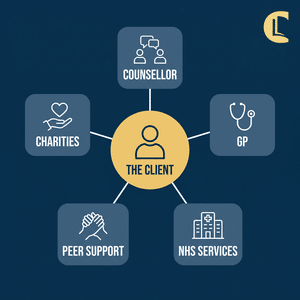
Addiction work is rarely a one-person job. The most effective support usually comes from a team around the client, and your part in it may be one piece of a larger whole. Coordinating with GPs, psychiatrists and community services helps ensure care is comprehensive, and for anyone who is physically dependent, medical monitoring and a properly managed detox are not optional extras.
Knowing your limits is an ethical requirement, not a lack of confidence. Be clear about what you are qualified to offer and what you are not, and if addiction is not an area you wish or are equipped to work in, it is right to refer on. Beyond formal services, a good deal of support sits in the community, and it helps to know what is available locally so you can point clients towards it:
The GP, often the first stop, who can advise and prescribe to ease withdrawal safely.
NHS addiction services, including residential rehabilitation, and private rehabilitation where a client can fund it.
Specialist charities such as GamCare for gambling and Change Grow Live for drugs and alcohol.
The national drugs information service Talk to FRANK for clients and counsellors alike.
The aim is to be part of a client’s support, not their only source of it. Laying a wide foundation of support around the work you do together tends to serve the client far better than trying to hold it all yourself.
Therapist Self-Care and Supervision
Working with addiction can be emotionally demanding. Progress is often non-linear, relapse is common, and the material clients bring can be heavy to sit with. Looking after yourself is part of practising responsibly, not a luxury. Regular supervision, peer support, mindful and reflective practice, and honest attention to your workload and the complexity of your caseload all help. Vicarious trauma is a real possibility in this work, and noticing it early and addressing it is central to staying well over the long term. Our guide to burnout in counselling looks at how to protect your practice for the long run.
Your Free Addiction Quick-Reference Guide
A one-page desk aid: the key frameworks, the alcohol-safety rules, and when to refer.
Do I need to be an addiction specialist to work with addiction?
Not for much of this work. The core counselling skills you already have – empathy, the therapeutic relationship, and approaches such as Motivational Interviewing that grow out of the person-centred tradition – transfer directly. What you add is addiction-specific knowledge and frameworks. What matters is to work within your competence, keep good supervision, and refer on where a client needs medical support or specialist treatment, for example in complex dependence or sex and porn addiction.
Is addiction a disease, or a choice?
There is no single agreed answer, and different models frame it differently. The brain disease model highlights long-term changes in the brain and has helped reduce stigma; the biopsychosocial and trauma-informed models set addiction in the context of a person’s biology, psychology and life experience. Most counsellors find it most useful to understand addictive behaviour as a response to pain rather than a moral failing.
What should I do if a client is dependent on alcohol?
Never advise a dependent drinker to stop suddenly on their own, as unsupported withdrawal can cause seizures. Involve a GP or alcohol service so that withdrawal can be managed safely. The AUDIT screening tool can guide you: a score of 16 or above warrants recommending a referral, and 20 or above suggests possible physical dependence. You can continue your therapeutic work alongside that medical support.
Is relapse a sign that therapy has failed?
No. Relapse is widely understood as a part of the recovery process, not a failure. Setbacks carry useful information about triggers and high-risk situations. Watch for the abstinence violation effect, where a single lapse triggers guilt and tips into full relapse, and respond with curiosity and compassion rather than judgement.
Can counselling help with behavioural addictions like gambling or gaming?
Yes. Behavioural or process addictions can involve overlapping reward-related brain circuitry and similar presentations – most clearly with gambling – and approaches such as Motivational Interviewing, relapse-prevention work and exploring the underlying emotional drivers all apply. Specialist charities such as GamCare can support gambling specifically, and sex and porn addiction is an area best referred for specialist assessment.
Final Reflections
Addiction is shaped by biology, psychology and the circumstances of a person’s life, which is why no single model holds all of it. For counsellors, the task is less about becoming an expert in every substance or behaviour than about bringing the skills you already have – empathy, a steady relationship, a belief that change is possible – to a client who may expect judgement and find acceptance instead.
Much of this work sits more comfortably within ordinary counselling than it can first appear, provided you know your limits, keep good supervision around you, and work as part of a wider team when a client needs more than you can safely offer. Understanding addiction as a response to pain is not a departure from your values as a counsellor. It is an expression of them.
Further reading mentioned in the source lectures: Gabor Maté on trauma and addiction; Bessel van der Kolk, The Body Keeps the Score; Dan Siegel on the window of tolerance; Anna Lembke, Dopamine Nation; David Nutt, Drink? The New Science of Alcohol and Your Health; and Annie Grace, This Naked Mind.
Transparency note This article was written and reviewed by human contributors. AI was used as a supportive tool to assist with formatting, layout clarity, and language refinement. All content, interpretations, and ethical positions were created and checked by the authors.
💡 About Counselling Tutor
Counselling Tutor provides trusted resources for counselling students and qualified practitioners. Our expert-led articles, study guides, and CPD resources are designed to support your growth, confidence, and professional development.