Are you closer to burnout than you think?
Free warning signs checklist + self-care compass from this article.
Burnout in counselling is a state of emotional, physical and professional depletion brought on by the sustained demands of therapeutic work, and it is far more common than most practitioners realise. It is not unique to counsellors and therapists, but the way it develops and shows up in this profession is distinct. Sitting with other people’s pain, managing complex client material, and navigating ethical responsibilities creates conditions that can quietly erode even the most committed practitioner.
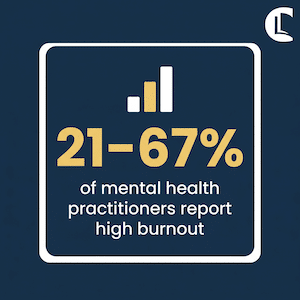
Burnout is also widespread. Studies cited in Vivolo et al. (2024) found that between 21% and 67% of mental health services reported high levels of burnout among staff, and Canady (2023) found that more than half of counsellors, social workers and psychologists surveyed were experiencing it, with nearly half saying it had worsened since the first wave of COVID-19.
Burnout does not just affect the practitioner. It affects the quality of care clients receive. Understanding what it looks like in therapeutic work, why therapists are especially vulnerable, and what can be done about it matters for another reason too: the ethics frameworks that govern counselling practice treat self-care as a professional obligation, not a personal luxury.
After reading this article, you will be able to:
Free warning signs checklist + self-care compass from this article.
Most practitioners can name the general signs of burnout: exhaustion, changes in sleep or appetite, feeling overwhelmed. These are real, but they are not the whole picture for therapists, whose burnout often looks different in its early stages, which is part of why so many do not notice it until it is well established.
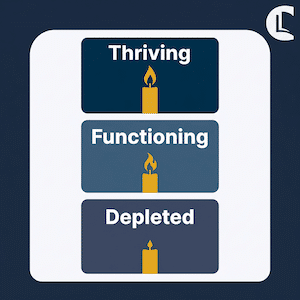
It helps to think of burnout not as on/off but as a continuum, like three candles at different stages. The first burns steadily: you feel regulated and present with clients. The second is still alight but dimmer: you are functioning, with a flatness or mild irritability that takes more effort to push through. The third is barely a flicker: you are present in body only, going through sessions on autopilot, disconnected from the work and from yourself. Sitting honestly with these images, rather than reassuring yourself you are fine, is a useful place to start.
Certain patterns can signal burnout in counselling work specifically:
Vivolo et al. (2024) identified several factors that leave therapists particularly susceptible to burnout, spanning organisational conditions and more personal, internal drivers.
Therapists in employed settings face caseload complexity, insufficient resources and training, and ethical or administrative ambiguity, with less control over who they see and under what conditions. Private practitioners face a different version of the same pressure: financial need can push caseloads beyond clinical capacity without this being fully realised at the time.
Many practitioners carry unexamined beliefs about what a good professional looks like: always available, always working hard, never saying no. Helper-oriented roles such as fixer, rescuer or people-pleaser can make boundary-setting feel like a threat to professional identity, especially if self-worth is tied to being needed. Comparison with colleagues who appear to manage more adds further pressure, and Vivolo et al. (2024) found less professional experience, often linked to younger practitioners, was itself a contributing factor.
There is a cumulative cost to sitting with other people’s material day after day. Therapists can experience vicarious trauma, absorbing the psychological weight of clients’ experiences, but also vicarious resilience: an awe at what clients endure that can create its own pressure to keep pushing. Processes within sessions, such as mirroring, transference and countertransference, and absorbing client projections, take a physical and emotional toll that the body often registers, through tension, disrupted sleep or numbness, before it reaches conscious awareness. Therapists also bring their own lives into the room: caring responsibilities, financial pressure, illness and relationship difficulties do not stop because the work demands presence.
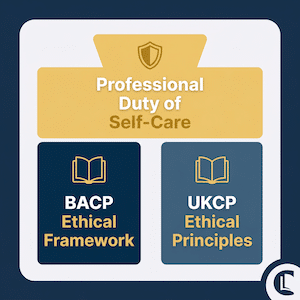
Self-care has become something of a professional buzzword, which risks it being dismissed as optional. The frameworks that govern counselling and psychotherapy practice say otherwise. Both the BACP Ethical Framework for the Counselling Professions (2018) and the UKCP Code of Ethics and Professional Practice (2019) treat maintaining your own health and wellbeing as a prerequisite for safe, effective practice: a professional duty rather than a personal benefit, and part of what membership of either body commits you to.
Vivolo et al. (2024) found that burnt-out practitioners are less able to provide adequate empathy and emotional support, drawing on defence mechanisms to protect their remaining capacity. That is not only a loss of therapeutic effectiveness. It is a matter of fitness to practise. Practising while burnt out, without acknowledgement or steps to address it, is an ethical issue, not just a personal one.
Shame is an underrated obstacle to addressing burnout. Knowing that self-care matters but not managing to prioritise it generates shame, and that shame then makes it harder to act, because acting means acknowledging the gap between what you know and what you have been doing. Many practitioners will recognise the dynamic from client work: understanding what needs to change but not quite managing the move. The version that shows up in practitioners themselves runs on the same mechanism, just quieter. Self-critical dialogue can also activate older patterns, tied to caregivers or schooling, of not being enough, and that is unlikely to create the conditions needed to actually change anything.
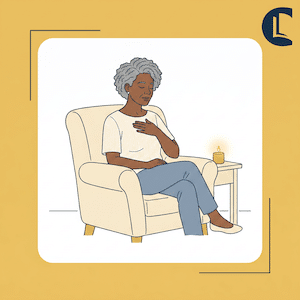
A more useful reframe is to treat signs of burnout as information rather than failure: a signal to attend differently to something, not an indictment of who you are as a practitioner. Reducing shame reduces the brake on action.
Knowing burnout is a risk is the starting point, not the destination. The strategies below are grounded in what the research and good clinical practice identify as protective.
How you organise your working week has a direct bearing on burnout risk. A practice built only around session time, with no protected space for admin, process notes and self-regulation, slowly erodes capacity.
A caseload audit is a useful starting point: how many clients are you seeing, and how does that compare with what you can genuinely manage? If financial pressure is pushing you beyond sustainable limits, that is worth a direct conversation in supervision.
Self-monitoring is a clinical skill, and applying it to yourself is part of responsible practice. Useful prompts, ideally revisited monthly at minimum: which parts of your practice take the most from you? What do you have in place to release tension during the day, and is it working? What are you avoiding, and why? How tired or energised are you at the end of a working day?
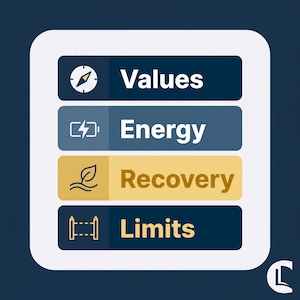
A simple compass check can help when things feel overwhelming:
Vivolo et al. (2024) found good-quality supervision was consistently identified as a key protective factor: a space to process difficult feelings without judgement. Peer and group supervision were rated as equally significant for managing work-related stress. But supervision only protects if it is working well, and a poll of practitioners found that 90% had never reviewed whether theirs was meeting their needs.
Self-care only works if it actually fits the person practising it. A routine borrowed from someone else’s version, or built around what self-care is “supposed” to look like, is unlikely to stick, and when it does not stick, it generates more shame. The more durable approach is to identify honestly what you have been neglecting, then attach the smallest possible step to something you already do.
Some practical anchors: a brief, honest check-in before and after each session; a weekly review of where you are losing energy; a monthly inventory of what is growing and what is shrinking in your practice; short physical movement between sessions; and non-negotiables such as a weekly reset, exercise or real time off, put in the diary, because what is not scheduled rarely happens.
Free warning signs checklist + self-care compass from this article.
Emotional exhaustion, depersonalisation and a reduced sense of accomplishment are core features that appear across many professions. But therapists are in continual close contact with others’ emotional pain, subject to transference, countertransference and vicarious trauma, and often carry a strong professional identity that makes it harder to admit the work is depleting them.
Emotional flatness in sessions, dreading client work or hoping a session cancels, withdrawing from supervision, letting process notes slip, and losing the internal sense that the work is meaningful. These are quieter than general burnout signs, which is partly why they go unnoticed for so long.
Both the BACP Ethical Framework and the UKCP Code of Ethics and Professional Practice treat fitness to practise as an ongoing obligation. Vivolo et al. (2024) found burnt-out practitioners are less able to provide adequate empathy and support. The ethical response to concern is to seek support through supervision, personal therapy or your GP, rather than continue unaddressed.
Shame is a major factor: knowing self-care matters and not managing it generates self-criticism that blocks action. Professional identity plays a role too, particularly for those drawn to the work partly through an internal role as helper or carer, alongside practical concerns around finances or caseload. Supervision and personal therapy are the most direct routes.
No. Self-care that fits your personality, energy and circumstances is more likely to stick than a routine borrowed from someone else or built around what self-care is supposed to look like. Start with the smallest honest change from where you are now.
Burnout in counselling is not a sign of weakness or a failure of commitment. It is common, the structure of therapeutic work makes practitioners particularly vulnerable to it, and there is a great deal that can be done, both preventatively and once symptoms have begun.
Honest self-awareness is the foundation: knowing where you sit on the continuum, recognising your own warning signs, and seeing where your practice protects you and where it does not. Self-care is not something to add once everything else is running smoothly. The ethical frameworks say plainly that it is part of practising responsibly. Starting does not require an overhaul. It requires the smallest honest step in the right direction.
Transparency note
This article was written and reviewed by human contributors. AI was used as a supportive tool to assist with formatting, layout clarity, and language refinement. All content, interpretations, and ethical positions were created and checked by the authors.
Counselling Tutor provides trusted resources for counselling students and qualified practitioners. Our expert-led articles, study guides, and CPD resources are designed to support your growth, confidence, and professional development.
👉 Meet the team behind Counselling Tutor
Notice any broken link or issues with this resource? Kindly let us know by email
Email us