Every counsellor makes ethical decisions. A client discloses something that sits close to the limits of confidentiality, a boundary is tested, a dual relationship appears on the horizon, a piece of work needs to end sooner than planned. Deciding what to do, and why, has always been part of the job.
The BACP Ethical Framework 2026, which takes effect on 3 November 2026, keeps ethical decision-making at the heart of practice but changes what you have to be able to show. It is no longer enough to reach a sound decision. You need to be able to give a rationale that explains your reasoning, accounts for the factors that shaped it, and shows how you arrived at what you did.
This article sets out that shift. It compares how the 2018 and 2026 frameworks treat ethical decision-making, explains the framework’s new rationale and the six questions it asks you to answer, walks through the collaborative process and what happens when collaboration is not possible, and shows how all of this connects to supervision and record-keeping. Where something is good practice rather than a framework rule, we say so.
At a Glance
- The 2026 framework is built around three sections: Working ethically within relationships, Ethical principles, and Core responsibilities. Members use them to inform decisions, explain the reasons behind those decisions, and work in practice.
- Ethical decision-making moves from a shorter, less structured treatment spread across the 2018 framework to a named section in 2026, with a defined rationale and a set of questions.
- You must be able to give a rationale that explains your reasoning and accounts for the internal and external factors behind your decisions and actions.
- Your rationale needs to answer six questions, covering the ethical issues, who was involved, the internal and external factors, the decision and its outcome, and how it was reviewed.
- Collaboration with the person affected is now central, with a five-step process and clear guidance on when collaboration might not be possible.
- The duty connects directly to supervision: consulting your supervisor on ethical dilemmas is a stated requirement, and you must be able to demonstrate your reasoning.
Key Dates
- The BACP Ethical Framework for the Counselling Professions 2026 takes effect on 3 November 2026.
- It becomes mandatory for all BACP members from midday on Tuesday 3 November 2026.
- Until then, members remain committed to using the 2018 framework to support all aspects of their practice.
Learning Outcomes
By the end of this article, you will be able to:
- describe how the 2018 and 2026 frameworks each treat ethical decision-making
- explain what the 2026 framework means by a rationale for ethical decision-making
- list the six questions your rationale should answer
- recognise the difference between internal and external factors in a decision
- understand when collaboration might not be possible, and what to record when it is not
- see how ethical decision-making connects to supervision and your record-keeping duties
Your Free Ethical Decision-Making Record
The 2026 framework now expects a rationale for the calls you make. This free six-question record helps you capture your thinking in minutes — so you are never left reconstructing it later.
Why the 2026 Framework Puts Ethical Reasoning at the Centre
The 2026 framework is made up of three sections: Working ethically within relationships, Ethical principles, and Core responsibilities. BACP describes these as the three parts members use to inform decisions, explain the reasons behind their ethical decisions, and work in practice in their professional role.
The framework is explicit about where its emphasis now lies. It names three things: working ethically within relationships, ethical decision-making, and being able to give ethical reasoning for any decisions you have made. Accountability runs through all three. The framework commits members to working collaboratively with the people using their services, wherever possible and appropriate, and to accounting for their decision-making by providing reasons for the decisions they make.
This is the heart of the change. The 2026 framework does not just ask you to act ethically. It asks you to be able to demonstrate your reasoning for how you got there, and to record that rationale where a record is required.
From “Ready to Explain” to a Rationale You Can Show
Ethical decision-making was part of the 2018 framework too, but it was handled differently and more briefly. Under the heading “Responding to ethical dilemmas and issues”, the 2018 framework set out three short commitments: that ethical issues, problems and dilemmas are an unavoidable part of practice; that members would use supervision and other professional resources to support and challenge how they respond, giving careful consideration to the best approaches to ethical problem-solving; and that members would take responsibility for how they act and “be ready to explain why we decided to respond in the way we did”.
The 2018 framework valued a structured approach. In its section on ethics it stated that the use of an ethical problem-solving model and discussion about ethics were essential to good practice. It did not, however, set out a particular model or a defined set of questions in the framework itself. The expectation was that you would use a model, draw on supervision, and be ready to explain your thinking if asked.
The 2026 framework goes further. In 2018, ethical decision-making was addressed across the Ethics and Good practice sections, including the guidance on responding to ethical dilemmas and issues; it was integrated into the wider framework rather than set out in one place. In 2026 it has its own named section, a defined rationale, a set of questions to answer, and a duty under the core responsibilities to demonstrate your reasoning. The move is from being ready to explain why you acted as you did, towards giving a structured account of your reasoning that you can show, and that others may sometimes ask to see.
What a Rationale for Ethical Decision-Making Means
At the centre of the 2026 approach is the idea of a rationale. The framework says you must be able to give a rationale that explains your reasoning and gives an account of the internal and external factors that informed the decisions you made and the actions you took.
The distinction here matters. The framework requires you to be able to give a rationale for ethical decisions. It does not ask you to produce a lengthy written account of every routine professional choice. It asks you to be able to explain the reasoning, factors, decisions and actions involved, and to record that rationale appropriately when a record is required, or where recording is necessary for accountability.
The framework splits those factors into two kinds, and understanding the difference is useful when you come to set your reasoning out.
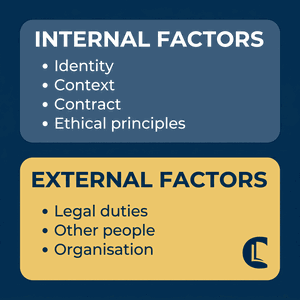
Internal factors are the things inside the work and the relationship. The framework gives examples: aspects of identity such as age, culture, gender, disability, sexuality, religious belief, race or ethnicity; the nature of the work you are doing; the context for that work; and the contract you have agreed. Internal factors also include the ethical principles underpinning the work, such as transparency and honesty, and any actions taken or agreed as part of collaborative decision-making.
External factors sit outside the relationship but can still affect it, or be affected by the decisions made within it. The framework’s examples include the legal obligations and duties you are generally bound by, the context of the work, other people involved such as family, friends or other services, and organisational expectations and requirements.
The framework is realistic about the nature of this work. It acknowledges that counselling, psychotherapy, coaching, supervision and training are often uncertain and unpredictable, and that there is often no single right or wrong answer. What matters is that your decisions and actions are made with the intention of fairness, equality and justice, and that you can account for how you reached them.
The Six Questions Your Rationale Should Answer
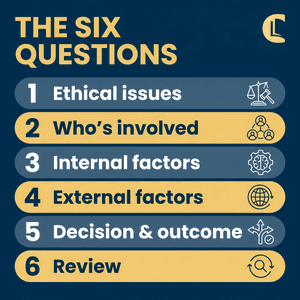
The framework sets out six questions that your rationale needs to answer. They are not a mandatory form or a rigid, linear model, and the framework is explicit that a rationale can be developed using “these and other relevant questions”. Working through them is how a rationale takes shape, and they map onto any ethical decision, from a confidentiality dilemma to an unplanned ending. The versions below are plain-language paraphrases of BACP’s wording.
- What are the ethical issues? Naming the issue clearly is the starting point.
- What steps, if any, will be taken to engage the person affected in the decision-making process? The person affected might be a client, a supervisee, a trainee, an organisation or a research participant. If you are not engaging them, or cannot, the framework asks you to say why not.
- What are the relevant internal factors, and how will they affect the decision?
- What are the relevant external factors, and how will they affect the decision?
- What decisions were made and actions taken, what was the outcome, and were they consistent with the Ethical principles and Core responsibilities? This ties your decision back to the rest of the framework.
- How was the process reviewed, and with whom?
The framework notes that developing a rationale using these and other relevant questions can help inform discussions with others, such as supervisors and managers. In other words, the six questions are not only a record after the event. They are a way of thinking a decision through, and a structure for the conversations you have about it.
Working Collaboratively: A Five-Step Process
Collaboration runs through the 2026 framework. It describes a collaborative process as a fundamental part of all ethical practice and decision-making, one that takes account of identity and diversity and involves deliberate steps to reduce potentially harmful power dynamics and inequalities between people.
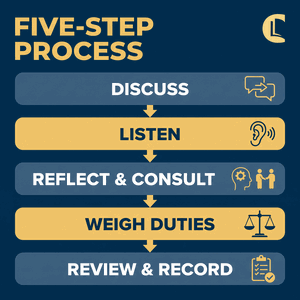
Alongside the six questions, the framework offers five steps to support collaborative ethical decision-making:
- Consider whether you can and should discuss the ethical issue with the person who may be affected, including the key factors of any actions you may need to take.
- Listen to the person’s perspective and any concerns they have.
- Reflect personally on the ethical issue, discussing it with your supervisor or colleagues as appropriate and if time allows.
- Consider any legal, contractual or organisational duties you may have, and how the Core responsibilities and Ethical principles should be applied.
- Review and identify what you have learned, including recording the decisions made, with reasons, and the actions taken.
The framework adds that discussions about shared decision-making between you and others involved must be clearly recorded and agreed. In practice, recording the discussion, the reasons and the agreed actions helps make the collaborative process visible, supports transparency and accountability, and helps you articulate a rationale for what was decided and done.
When Collaboration Might Not Be Possible
Collaboration is the starting point, but the framework recognises it is not always possible. It sets out several situations where it might not be, and asks you to handle them thoughtfully.
The framework lists these under temporary factors: issues around a person’s capacity, including mental health distress, risk, age, understanding, and their willingness to engage in a collaborative dialogue. Note that these capacity-related matters sit under temporary factors, so they should not be treated as a permanent judgement about a person. Permanent factors might include a context where a person’s actions or decision-making are constrained by law, or statutory responsibilities where there is a legal requirement to report concerns, for example for safeguarding reasons. There are also occasions where the people you work with simply do not want to work collaboratively, and occasions where the contract or context of your work specifically excludes collaborative working.
Even where a statutory or legal duty applies, this rarely removes collaboration entirely. Where it is lawful and safe to do so, you can still explain what is happening, hear the person’s perspective, and involve them as far as possible. Where the contract or work context specifically excludes collaborative working, the framework says the reasons must be documented clearly. In other situations where collaboration is not possible, your rationale should explain why the person could not be engaged and how the decision was reviewed.
How This Connects to Supervision
Ethical decision-making and clinical supervision are tied closely together in the 2026 framework. Two duties under the core responsibilities make the link explicit.
Under building appropriate relationships, point 1.4 asks members to work collaboratively to resolve ethical dilemmas or challenges, and to be able to demonstrate several things: that they engaged in collaborative decision-making where appropriate, that they dealt with ethical issues promptly, that they consult regularly with their supervisor about ethical dilemmas or challenges, and that they can show their ethical rationale and reasoning, including the steps taken to resolve the issue. Consulting your supervisor regularly is written in as an expectation rather than simply an option, alongside the discussion with supervisors or colleagues “as appropriate and if time allows” that the collaborative process describes.
Under supervision itself, point 4.3(d) requires that you collaborate with your supervisor on ethical dilemmas and challenges arising through your work. Point 4.3 covers supervision as a whole, not only ethical dilemmas: it requires supervision that enables reflection in depth on all aspects of practice, and addresses matters such as supervisor competence, frequency, and independence from line and case management. Ethical dilemmas and challenges are one explicit part of that wider requirement. In practice, supervision will often be an important place in which a rationale is developed, tested and reviewed, and the sixth of the six questions, how the process was reviewed and with whom, will often be answered in the supervision room. For more on what the 2026 framework changes here, see our guide to how the BACP Ethical Framework 2026 changes supervision.
Recording Your Rationale
Because the framework asks you to be able to give and sometimes show a rationale, record-keeping matters. The framework is careful about how a rationale should be recorded.
When you keep a record of your rationale, you must be mindful of your duties around confidentiality and data protection more broadly. The framework also notes that there may be occasions when a rationale is required by others. Where that is the case, it must be recorded in line with good practice on record-keeping, and in enough detail to give an account of the decisions made and the actions taken.
The framework does not prescribe a lengthy written account for every routine choice, nor does it set a “significant decisions only” rule in those words. In practice, proportionate recording will be particularly important for significant, contested or potentially high-risk ethical decisions, and whenever a rationale is required by an appropriate person or body. Records should contain enough detail to account for the decisions made and actions taken, held securely and in keeping with your confidentiality and data protection obligations, so that your reasoning can be accounted for if it is ever needed.
TherapyLock
An encrypted vault for UK counsellors and psychotherapists. Write your session notes, keep client records, and manage appointments in one secure place. Built around UK GDPR and the ethical standards of the counselling profession, by the team behind Counselling Tutor.
Your Free Ethical Decision-Making Record
The 2026 framework now expects a rationale for the calls you make. This free six-question record helps you capture your thinking in minutes — so you are never left reconstructing it later.
Frequently Asked Questions
What is a rationale for ethical decision-making under the 2026 framework?It is an account that explains your reasoning for an ethical decision, including the internal and external factors that informed it. The framework sets out six questions your rationale should answer, covering the ethical issues, who was involved, the factors considered, the decision and outcome, and how it was reviewed.
Do I have to write down every ethical decision I make?No. The framework requires you to be able to give a rationale, but it does not prescribe a lengthy written account of every routine decision. Where a rationale needs to be recorded, the record should be proportionate, secure, consistent with your confidentiality and data protection duties, and detailed enough to account for the decisions made and actions taken. There may be occasions when a rationale is required by others.
What is the difference between internal and external factors?Internal factors sit inside the work and the relationship, such as aspects of identity, the nature and context of the work, the contract, and the ethical principles involved. External factors sit outside the relationship but can still affect it, such as legal obligations, other people involved, and organisational requirements.
What if I cannot work collaboratively with the person affected?The framework recognises this. Collaboration might not be possible because of temporary factors such as capacity or risk, permanent factors such as legal constraints or statutory duties to report, a person’s own preference, or the context of the work. Where your contract or context excludes collaboration, document the reasons clearly.
How does ethical decision-making relate to supervision?Closely. The framework expects you to consult your supervisor regularly about ethical dilemmas, to collaborate with your supervisor on challenges arising in your work, and to be able to demonstrate your rationale and reasoning. Supervision under the framework is required for reflection on all aspects of practice, with ethical dilemmas and challenges specifically identified within that broader requirement, and it is often a key place where your reasoning is developed, tested and reviewed.
Final Reflections
For experienced practitioners, much of what the 2026 framework describes will feel familiar. Good ethical decision-making has always involved naming the issue, weighing the factors, involving the people affected where you can, and using supervision. What changes is the expectation around all of it. The framework now asks you to be able to give a rationale for your decisions, to answer a defined set of questions, and to show your reasoning where it is needed.
None of this needs to be elaborate. Get familiar with the six questions, use them to think decisions through rather than only to record them afterwards, keep proportionate and secure notes of the significant ones, and take your dilemmas to supervision. Do that, and the framework’s expectation to account for your ethical reasoning becomes part of how you already work, rather than something extra bolted on.
References and Further Reading
The information in this article reflects the BACP Ethical Framework 2026 as published. The framework takes effect and becomes mandatory for all BACP members at midday on Tuesday 3 November 2026; until then, the 2018 framework applies. Professional body requirements change over time, so check the linked official BACP sources for the latest details before acting on them.
Transparency note
This article was written and reviewed by human contributors. AI was used as a supportive tool to assist with formatting, layout clarity, and language refinement. All content, interpretations, and ethical positions were created and checked by the authors.
💡 About Counselling Tutor
Counselling Tutor provides trusted resources for counselling students and qualified practitioners. Our expert-led articles, study guides, and CPD resources are designed to support your growth, confidence, and professional development.
👉 Meet the team behind Counselling Tutor
Notice any broken link or issues with this resource? Kindly let us know by email
Email us