The following article is taken from our Autism-Informed Practice course.
Autism-Informed Practice Course
Gain the Knowledge & Skills to Support Autistic Clients with Confidence & Compassion
Many autistic individuals engage in masking – the act of suppressing natural behaviours, emotions, and traits to conform to neurotypical expectations. Unlike typical social adaptation, masking requires significant cognitive effort and can lead to exhaustion, anxiety, and even suicidal ideation in extreme cases.
Understanding masking is crucial to providing practical support as a counsellor or psychotherapist. This article explores why autistic individuals mask, the consequences of masking, and practical therapeutic interventions to encourage authenticity and well-being in neurodivergent clients.
Your Free Handout
Understanding Autism Masking
Key Learning Outcomes for Practitioners
By reading this article, you will:
- Understand what autism masking is and why individuals engage in it.
- Recognise the emotional and psychological toll masking takes.
- Learn practical strategies to help clients reduce the need for masking.
- Explore ways to create a neurodivergent-informed therapeutic environment.
What Is Autism Masking and Why Does It Happen?
Masking is more than adjusting behaviour for different social situations. It is a survival strategy where autistic individuals consciously suppress traits such as stimming, direct communication, or sensory sensitivities to fit into neurotypical environments.
It is important to note that masking is not the same as acting. Acting involves adopting a character, often with some degree of separation from your real identity. In contrast, masking requires rewriting every fibre of your being to fit perceived societal norms. It is not a performance, but a survival mechanism driven by a need to be accepted and avoid negative consequences.
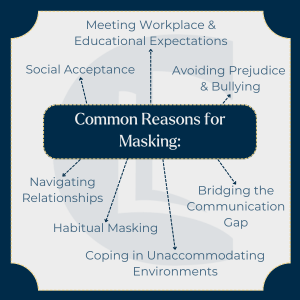
Common reasons for masking include:
- Social acceptance – To avoid rejection and feel included.
- Avoiding prejudice and bullying – Many autistic individuals have experienced exclusion, making masking feel necessary.
- Meeting workplace and educational expectations – Masking helps maintain employment or avoid punishment in school settings.
- Navigating relationships – Many mask to form and sustain friendships or romantic relationships.
- Coping in unaccommodating environments – Many autistic individuals mask to avoid appearing ‘difficult’ in spaces that do not support their needs, such as workplaces or schools with rigid structures.
- Bridging the communication gap – Due to differences in how autistic and neurotypical individuals communicate, some autistic people use masks to avoid misunderstandings or social conflict. This is linked to the ‘double empathy problem,’ where autistic and non-autistic individuals may struggle to interpret each other’s social cues.
- Habitual masking – For some, masking becomes second nature, occurring automatically rather than deliberately.
However, the long-term effects of masking can be severe.
The Consequences of Autism Masking
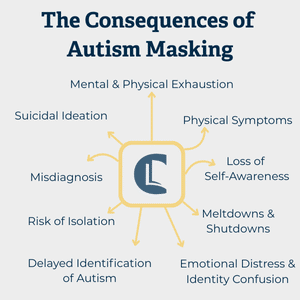
The constant effort to suppress natural behaviours can result in:
- Mental and physical exhaustion – The ongoing cognitive load can lead to burnout.
- Physical symptoms – Prolonged masking can lead to headaches, muscle tension, digestive issues, and chronic fatigue, as the stress of constant self-monitoring takes a toll on the body.
- Emotional distress and identity confusion – Continually hiding one’s true self can lead to anxiety and depression.
- Loss of self-awareness – Long-term masking can cause individuals to lose touch with their authentic identity, making recognising their preferences, emotions, and natural behaviours difficult.
- Meltdowns and shutdowns – When masking becomes unsustainable, distress behaviours can occur.
- Self harm or Suicidal ideation – In extreme cases, the pressure to mask can contribute to thoughts of self-harm.
- Masking as a factor in misdiagnosis – Due to successful masking, autistic individuals may be mistakenly diagnosed with anxiety, depression, or personality disorders, while the underlying autism remains unidentified.
- Increased risk of isolation – Masking can lead to a deep sense of loneliness, as individuals cannot show their true selves in social interactions.
- Delayed identification of autism – Many individuals who mask effectively go undiagnosed for years or even decades, resulting in a lack of access to support and accommodations.
As therapists, recognising these consequences is vital in supporting clients to unmask safely and authentically.
Therapeutic Strategies to Support Autistic Clients Who Mask
Building a Trusting Relationship
- Create a safe, non-judgemental space where clients feel accepted as they are.
- Validate their experiences and acknowledge the emotional toll masking takes.
- Recognise the energy cost of masking – Many autistic individuals experience what is known as “spoon theory,” where they have a limited amount of mental and emotional energy (spoons) available each day. Masking rapidly depletes this energy, leading to exhaustion. Acknowledging this in therapy can help clients explore ways to manage their energy levels and reduce the need for masking.
Creating a neurodivergent-friendly therapy space can significantly help autistic clients feel comfortable unmasking. Simple adjustments include:
- Allowing movement, such as pacing or fidgeting, without discouragement.
- Offering sensory-friendly options like soft lighting or noise-reducing elements.
- Accepting different communication styles, such as using written responses instead of verbal ones, when preferred.
Exploring the Impact of Masking
- Encourage clients to reflect on when and why they mask.
- Help them identify the emotional and physical costs they may have normalised.
Free Handout Download
Understanding Autism Masking
Developing Alternatives to Masking
- Help clients embrace assertiveness skills, enabling clients to communicate their needs in social and professional settings.
- Interventions mustn’t reinforce masking. Instead, the focus should be on self-expression, self-advocacy, and helping clients find environments where they feel safe being themselves.
Reducing the Need for Masking
- Encourage clients to build relationships where they can be themselves, such as within the autistic community.
- The value of peer support – Connecting with other autistic individuals can be profoundly validating. Peer support groups allow clients to share experiences, discuss challenges, and explore their identities in a safe environment.
- Support self-acceptance through counselling and psychotherapy.
- Encourage self-advocacy – Support clients in developing the confidence to express their sensory, emotional, and communication needs in various settings. This may involve role-playing real-life scenarios in therapy.
- Use guided self-exploration – Some autistic clients may not immediately recognise their masking behaviours. Using reflective exercises can help uncover patterns of masking and their emotional impact.
Facilitate Coping and Self-Regulation Strategies
- Promote self-compassion – Many autistic individuals feel shame about their natural behaviours due to lifelong masking. Encouraging self-compassion exercises can help counteract this, encouraging self-acceptance and reducing internalised stigma.
- Introduce mindfulness and relaxation techniques to manage anxiety and stress.
- Help clients develop energy management and boundary-setting skills to prevent burnout.
Final Thoughts: A Call for Change in Therapeutic Practice
As therapists and counsellors, our role is to support autistic clients in embracing their authentic selves while navigating a society that often demands conformity. Therapy should not reinforce the need for masking but instead provide tools to help autistic individuals express themselves safely and comfortably.
By building trust, validating experiences, and offering practical interventions, we can help clients reduce the burden of masking and improve their overall well-being.
Adopting a neurodivergent-informed approach, therapists can profoundly impact the lives of autistic individuals, helping them thrive without constant pressure to conform. If you’re interested in becoming Autism-Informed, have a look at Counselling Tutor’s course, Working Therapeutically with Autistic Clients.
Research indicates that autistic individuals value therapists who go beyond textbook knowledge and show a genuine understanding of lived experiences. This is especially true for parents of autistic individuals, who often seek professionals who grasp the real-world impact of autism rather than just theoretical concepts.
Free Handout Download
Understanding Autism Masking
Frequently Asked Questions
What is autism masking and why does it happen?Autism masking is when an autistic person hides their natural traits to fit into neurotypical environments, often to avoid judgement or feel accepted. It can be conscious or unconscious and is shaped by early social learning.
How does long-term masking affect autistic people?Sustained masking can lead to exhaustion, anxiety, depression and even burnout, as it demands constant self-monitoring and emotional labour. Over time, it may also cause identity confusion and loss of self.
How can therapists support clients who mask?Therapists can support autistic clients by creating a safe, accepting space where masking isn’t needed. This includes adapting communication, recognising masking behaviours and validating the client’s authentic self.
Further Learning & Resources
💡 About Counselling Tutor
Counselling Tutor provides trusted resources for counselling students and qualified practitioners. Our expert-led articles, study guides, and CPD resources are designed to support your growth, confidence, and professional development.
👉 Meet the team behind Counselling Tutor
Notice any broken link or issues with this resource? Kindly let us know by email
Email us