Your Free Handout
Mastering Motivational Interviewing
Motivational Interviewing (MI) is an evidence-based counselling approach that enhances clients’ motivation to change by exploring and resolving ambivalence. Developed by William Miller and Stephen Rollnick in 1983, MI is rooted in person-centred counselling but incorporates more directive elements to facilitate behavioural change.
MI was initially designed to promote behavioural change in individuals struggling with substance use disorders. However, its applications have expanded significantly to include a wide range of client presentations, including addiction, prenatal smoking, eating disorders, risky sexual behaviour, and various other behavioural health concerns.
For counsellors and psychotherapists, MI is an invaluable tool for navigating client resistance, encouraging engagement, and evoking meaningful change talks. Whether working with addiction, mental health challenges, or lifestyle changes, MI provides structured yet flexible techniques that align with various therapeutic approaches.
Mastering Motivational Interviewing
By mastering MI, you will:
MI is effective because it acknowledges that people are often ambivalent about seeking support and changing their lives. Interpersonal interactions strongly influence the likelihood that a client will engage in therapy. An empathic communication style encourages engagement, whereas a lack of empathy can deter it. When practitioners believe they can help, clients are more likely to share that belief, increasing the probability of engagement and behaviour change.
A key observation in MI is that pushing a client to engage may increase resistance. People are often ambivalent about seeking support, and their likelihood of engaging in therapy is strongly influenced by how they perceive the interaction. If a therapist is overly directive or confrontational, the client may become defensive rather than motivated to change. An empathic, client-centred approach helps mitigate resistance and promotes engagement.
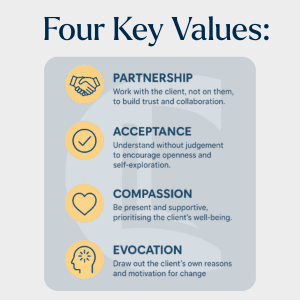
The foundation of MI lies in its four key values:
MI is a collaborative process rather than a directive one. You work with the client, not on them. This approach creates trust and enhances the therapeutic alliance.
Acceptance does not equate to approval. Instead, it means understanding and validating the client’s perspective without judgement, which encourages openness and self-exploration.
Compassion in MI involves prioritising the client’s welfare and recognising their struggles. It means being fully present and supportive without imposing solutions.
Rather than instilling motivation externally, MI focuses on identifying the client’s strengths and reasons for change. This strengths-based approach helps clients take responsibility for their decision-making process.
These four processes are not always linear. While engagement typically comes first, therapists may need to switch back and forth between stages depending on the client’s readiness. For example, if a client encounters unexpected challenges during the planning phase, it may be necessary to return to evoking motivation before proceeding again.
The engagement process is essential in establishing a working relationship. Research highlights that rapport and collaboration are critical factors in client progress. A well-engaged client is more likely to stay committed to the process and explore changes.
Establishing rapport is the foundation of MI.
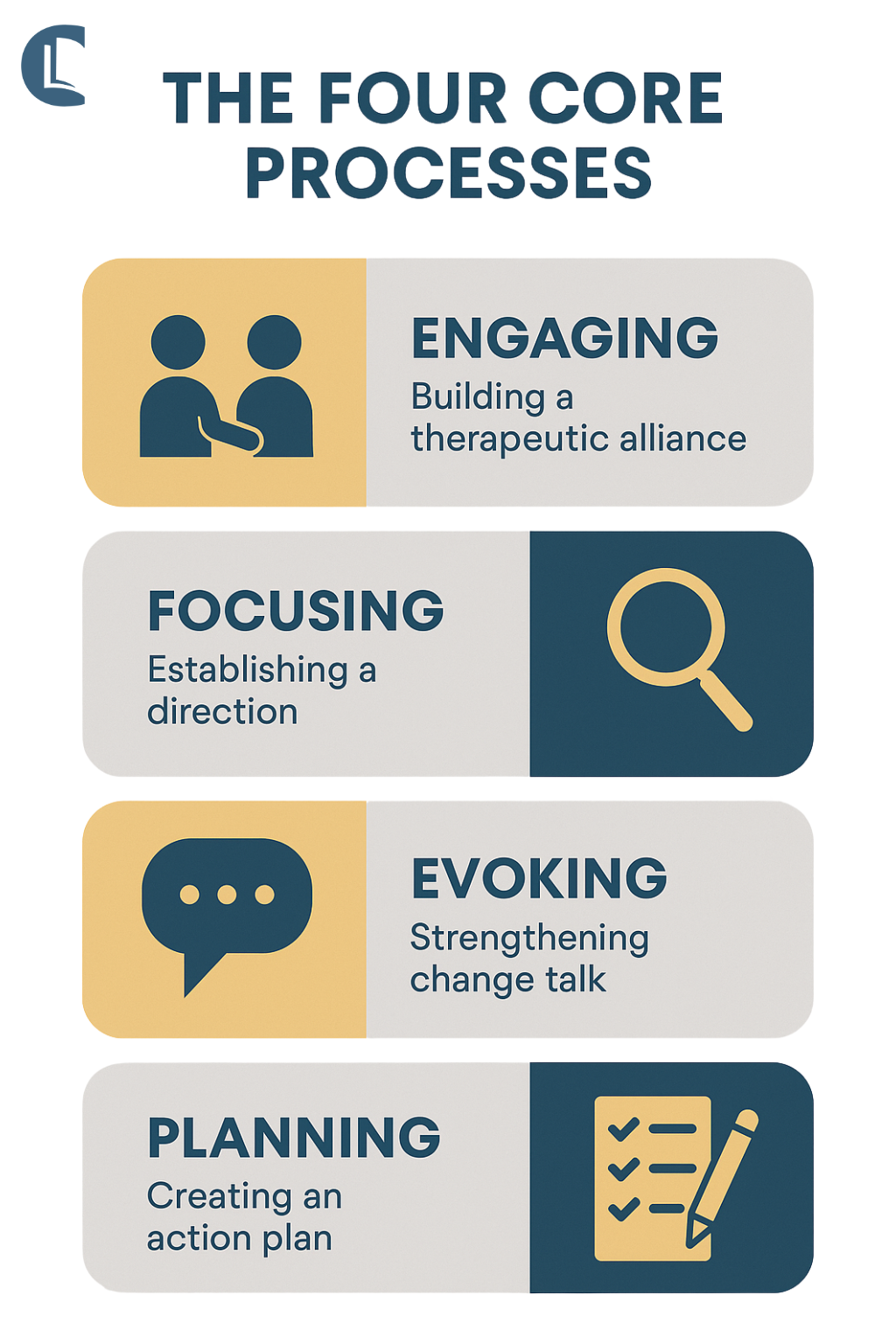
Focusing requires sensitivity, as the therapist’s perception of the problem may not align with the client’s. Letting the client determine their priorities is crucial, even if you see other pressing concerns. If a client is not ready to address a particular issue, the focus should remain on what they are willing to explore.
The conversation should move towards a meaningful goal. The client, not the therapist, should guide the focus.
One of the most challenging aspects of MI is evoking change talk while resisting the urge to “fix” the client’s problems. The counsellor should avoid pushing too hard or moving too quickly. Instead, it is helpful to elicit the client’s own arguments for change through strategic questioning.
Encouraging “change talk” is the heart of MI. This involves helping clients articulate their motivation for change rather than imposing advice.
Effective planning involves setting small, achievable steps. A common mistake is assuming clients are immediately ready to act once they express motivation. Planning should gradually reinforce the client’s autonomy in determining their next steps.
A well-structured plan should be specific, achievable, and based on the client’s own ideas. It’s also important to check in on the client’s confidence level. Scaling questions such as “On a scale of 1 to 10, how confident are you in following through with this step?” can help assess readiness. If confidence is low, revisiting evocation may be necessary to explore barriers.
Once motivation is established, the next step is planning.
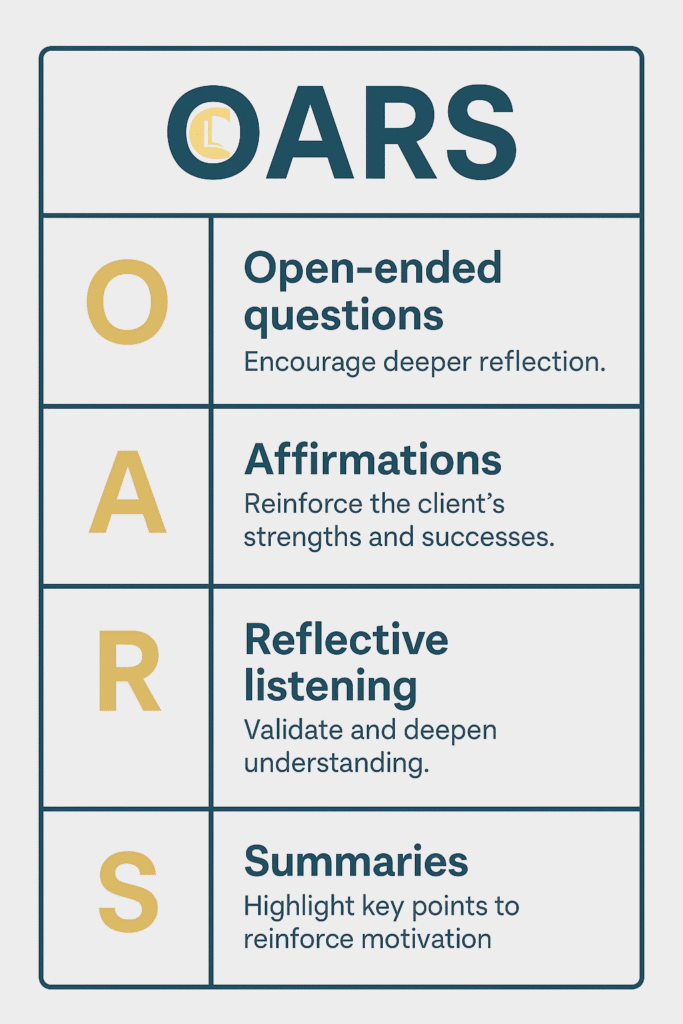
A crucial set of tools in MI is the OARS technique:
While MI is highly effective, certain therapist behaviours can inadvertently create resistance.
Common traps include:

MI categorises change talk into preparatory and mobilising language:
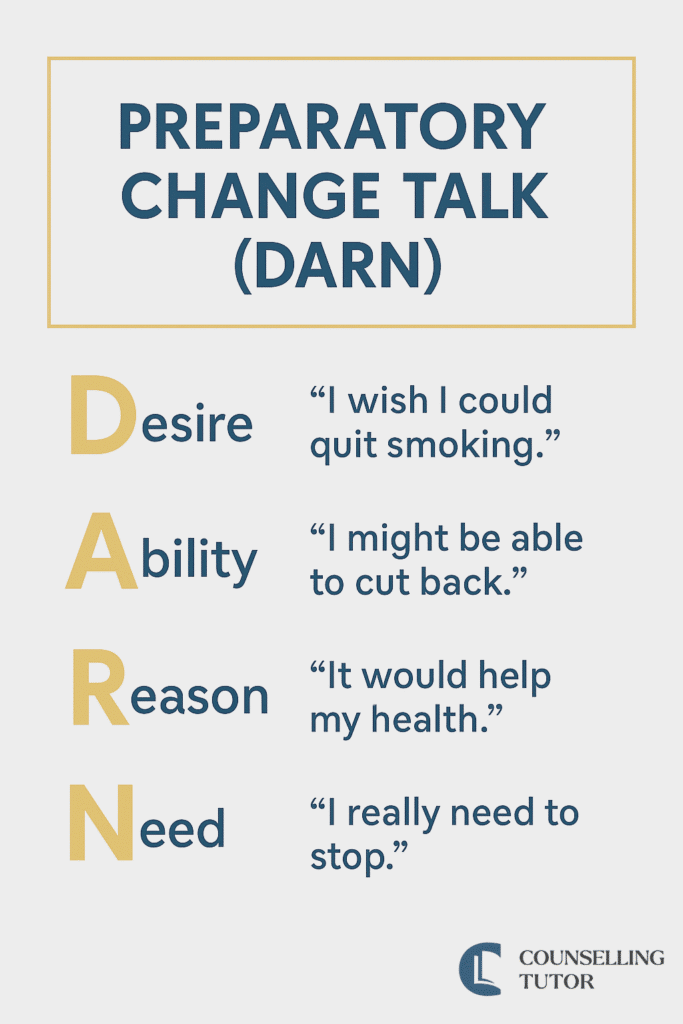
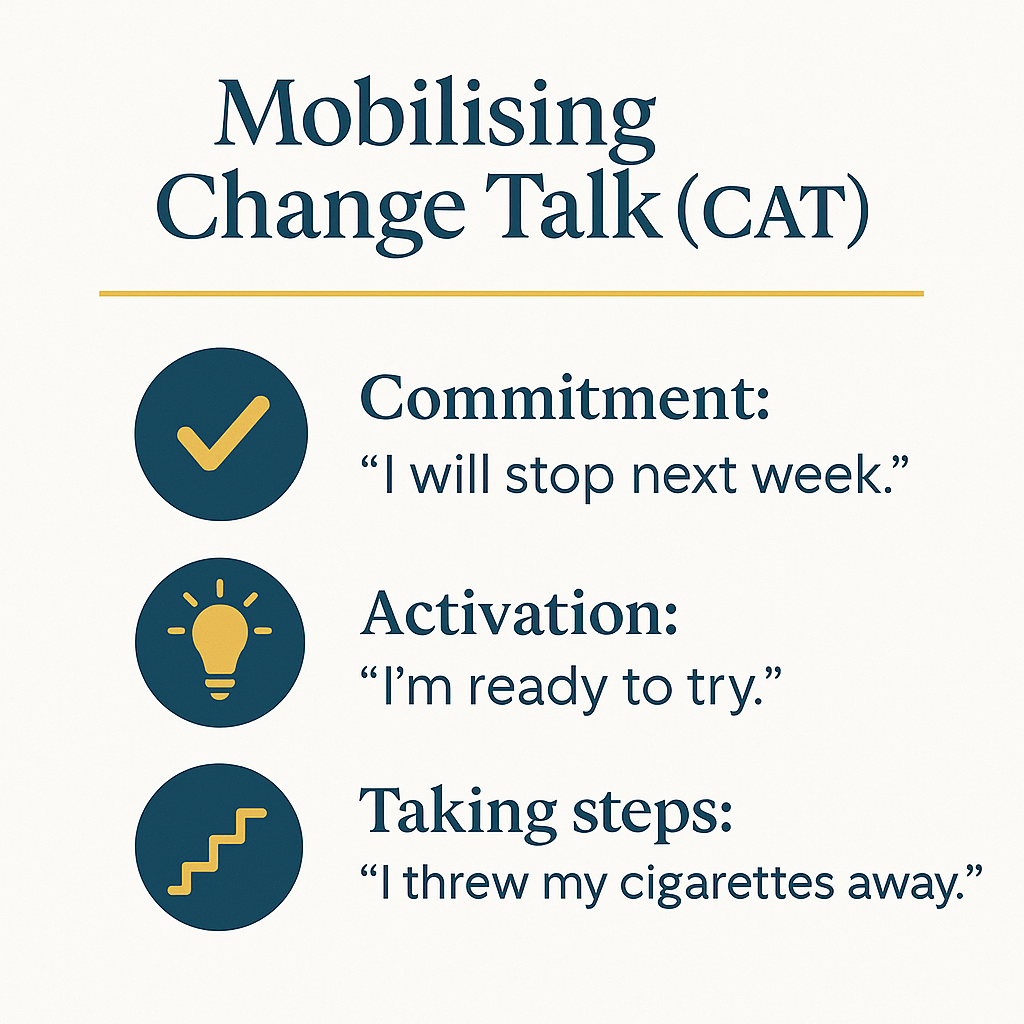
Recognising and amplifying these statements helps shift the client towards action.
Not all clients are immediately ready for change. MI distinguishes between sustain talk (maintaining current behaviour) and discord (resistance to the therapist).
Avoiding the Righting Reflex: One of the biggest challenges for therapists is resisting the urge to correct clients or tell them what to do. The righting reflex – the natural tendency to fix the problem – often leads to increased sustain talk. Instead of arguing for change, MI encourages therapists to ask open-ended questions that guide the client toward their own reasons for change.
Recognising the difference between sustain talk and discord helps therapists respond appropriately. Sustain talk is about the behaviour itself, whereas discord signals a rupture in the therapeutic relationship.
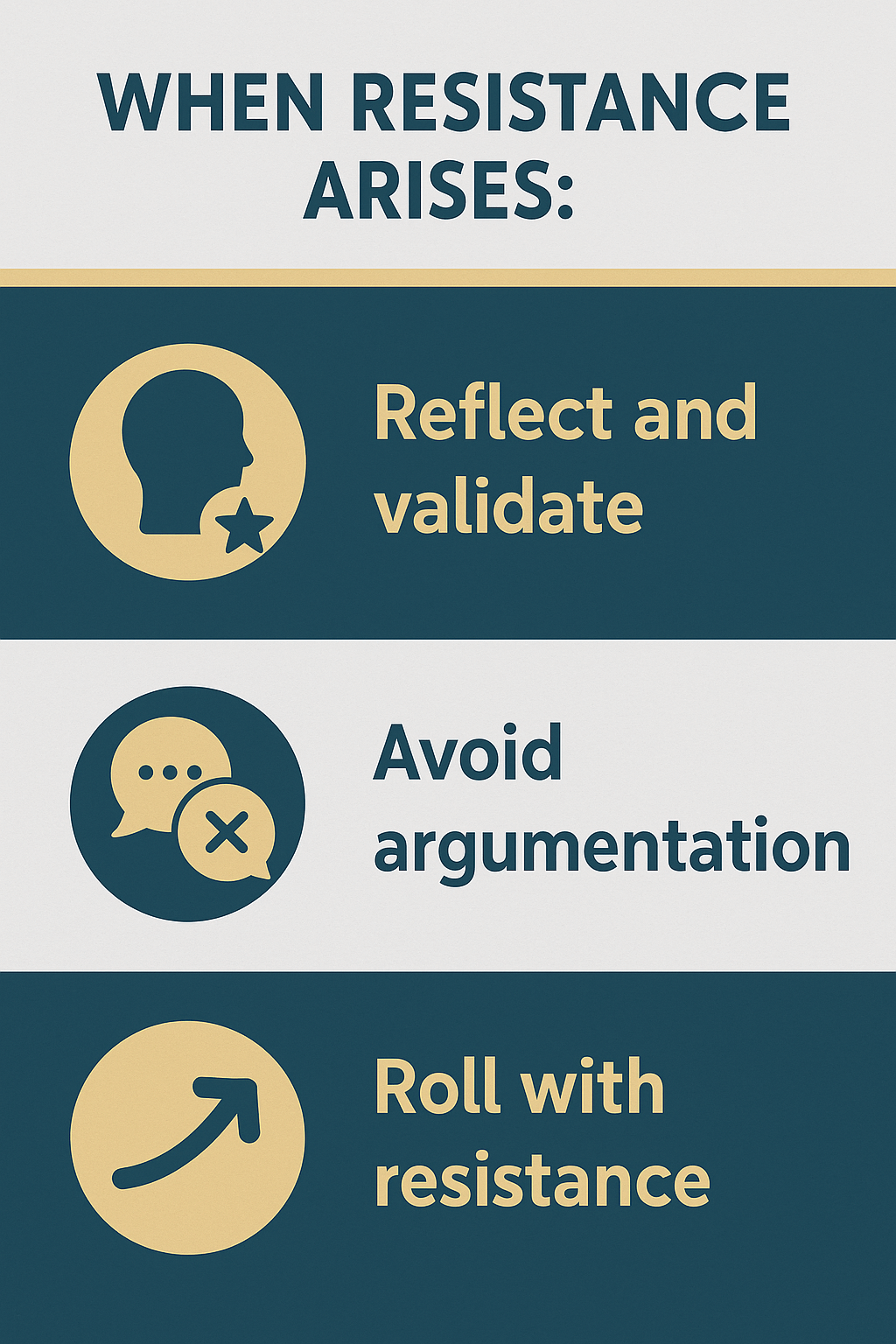
When resistance arises:
Mastering Motivational Interviewing
Motivational Interviewing is grounded in four core principles: partnership, acceptance, compassion, and evocation. These values create a respectful, collaborative environment that helps clients explore their own reasons for change.
Motivational Interviewing avoids direct confrontation and instead uses empathy, reflective listening, and open-ended questions to reduce resistance. Therapists are encouraged to “roll with resistance” and elicit the client’s perspective rather than impose solutions.
Change talk refers to a client’s own statements about wanting, needing, or planning to change. Encouraging and reinforcing change talk helps build motivation and moves the client closer to taking action.
Motivational Interviewing (MI) is a powerful tool for counsellors and psychotherapists. It offers a structured yet adaptable approach to enhancing motivation and change. Practitioners can effectively guide clients through ambivalence toward meaningful transformation by adopting the MI spirit – partnership, acceptance, compassion, and evocation – and using core techniques like OARS and DARN-CAT.
A helpful tip for practitioners is to listen carefully for subtle signs of change talk. Even minor expressions like “I wish I could change” or “Maybe I could try something different” can be amplified. Small shifts in language indicate that the client is moving toward motivation, and the therapist should reflect and reinforce these moments.
One of MI’s strengths is that it does not require abandoning other therapeutic approaches. Whether you practice CBT, psychodynamic therapy, or an integrative model, MI can be incorporated as a complementary technique. The emphasis on collaboration, open-ended questioning, and reflection makes it a versatile tool that enhances client engagement across different frameworks.
Mastering MI requires practice, reflection, and flexibility. Refining your MI skills enhances your ability to encourage client autonomy, strengthen engagement, and facilitate lasting change.
Counselling Tutor (2024). Understanding and Using Motivational Interviewing. Available at counsellorcpd.com
Miller, W. & Rollnick, S. (2012). Motivational Interviewing: Helping People Change (3rd ed.). Guilford Press.
Rosengren, D. (2009). Building Motivational Interviewing Skills: A Practitioner Workbook. Guilford Press.
Seligman, L. (2006). Theories of Counseling and Psychotherapy: Systems, Strategies, and Skills. Pearson Prentice Hall.
Thorpe, C. (2014). Motivational Interviewing Training for Health Professionals: Supporting Patients Toward Behavior Change. CreateSpace Independent Publishing Platform.
Counselling Tutor provides trusted resources for counselling students and qualified practitioners. Our expert-led articles, study guides, and CPD resources are designed to support your growth, confidence, and professional development.
👉 Meet the team behind Counselling Tutor
Notice any broken link or issues with this resource? Kindly let us know by email
Email us