Ethical AI Practice for Counsellors and Psychotherapists in the UK
Kenneth Kelly’s practical framework for counsellors and psychotherapists — navigate AI ethically, protect your clients and practise with clarity.
This article explains what the Expert Reference Group on the use of Artificial Intelligence in Counselling and Psychotherapy is: why it was formed, who is involved, and how its work supports ethical, safe, and professional engagement with AI. It outlines the group’s purpose, key milestones, strategic focus, and practical outputs, including the Shared AI Charter and the AI and Therapy Critical Thinking Matrix.
Artificial intelligence is becoming increasingly visible in counselling and psychotherapy. Practitioners are encountering AI through administrative tools, note-writing support, supervision aids, digital platforms, and wider discussions about mental health technology. Alongside this, counsellors and psychotherapists are raising important questions about ethics, confidentiality, client safety, professional responsibility, and the limits of technology in relational work.
The Expert Reference Group on the use of Artificial Intelligence in Counselling and Psychotherapy exists to help the profession respond to these questions in a thoughtful, collaborative, and ethically grounded way.

The Expert Reference Group on AI in Counselling and Psychotherapy held its first meeting on 30 January 2024. This meeting marked the starting point of a coordinated, cross-sector response to the growing influence of AI within the counselling and psychotherapy professions in the UK.
From the outset, there was shared recognition that AI was already affecting practice, training, assessment, and public expectations of emotional and mental health support. Members agreed that fragmented or purely reactive responses would risk confusion for practitioners and inconsistency in ethical standards.
At its first meeting, the group agreed a collective starting position focused on four core intentions:
These principles continue to shape the work of the group.
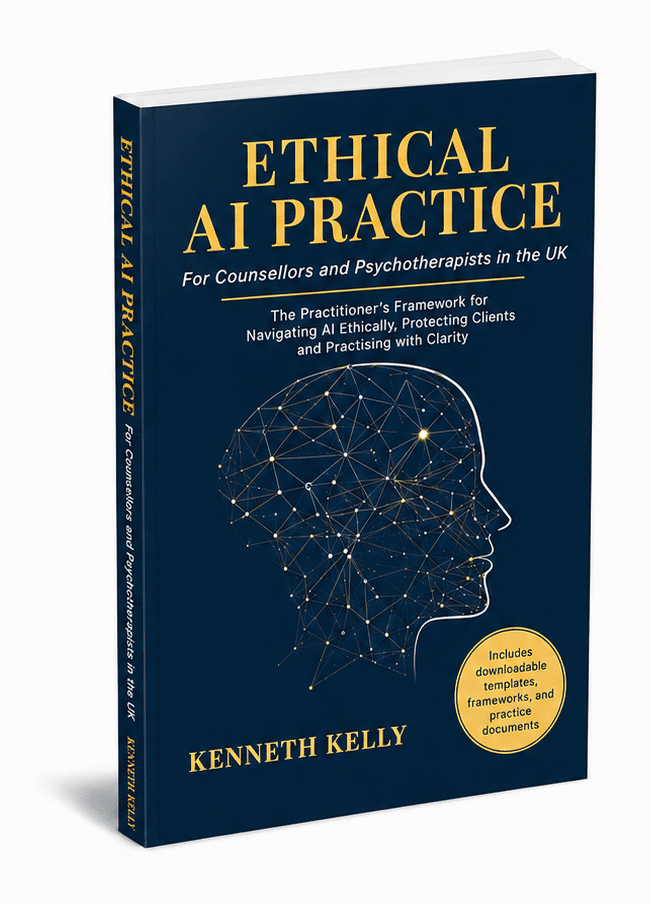
Kenneth Kelly’s practical framework for counsellors and psychotherapists — navigate AI ethically, protect your clients and practise with clarity.
The Expert Reference Group is dedicated to exploring the potential impact of artificial intelligence on the counselling and psychotherapy profession. This includes addressing ethical considerations, safeguarding client welfare, and supporting the development of ethical policies or frameworks within participating organisations.

The group’s aim is to ensure that any integration of AI into counselling and psychotherapy is carried out thoughtfully and responsibly. This means supporting improvements in practice and service delivery where appropriate, while ensuring that human connection, professional judgement, and therapeutic integrity are never compromised.
The ERG does not promote specific technologies or tools. Its role is to support ethical understanding, shared learning, and principled decision-making across the profession.
The work of the Expert Reference Group is guided by several strategic actions.
A central focus is shared learning and resources. The group works to establish ways of collecting, aggregating, and reflecting on learning from across professional bodies, awarding organisations, and education providers. This supports a more coherent professional response to AI and reduces duplication of effort.
The ERG also discusses measures needed for the integration of AI into the profession, including ethical boundaries, professional accountability, and areas where guidance or clarification may be required as technologies evolve.
Education and training form a key strand of the group’s work. This includes exploring how learning about AI can be incorporated into counselling and psychotherapy curricula, as well as into ongoing professional development for qualified practitioners.
Finally, the group recognises the importance of public awareness. This includes raising understanding among practitioners and the wider public about both the potential benefits and the limitations of AI in talking therapy and emotional and mental health support.
For counsellors and psychotherapists, questions about AI are often practical rather than theoretical. Common concerns include ethical use, confidentiality and data protection, professional responsibility, and whether particular tools are appropriate within therapeutic work.
The work of the Expert Reference Group supports practitioners by encouraging critical thinking and ethical reflection rather than offering simplistic approvals or prohibitions. It helps create shared language and principles that practitioners can draw on in supervision, training, and day-to-day decision-making.

One of the first formal outputs of the Expert Reference Group was a Consensus Statement setting out a shared professional position on AI. The statement reflects collective agreement on the need to engage proactively with AI while prioritising public protection, ethical practice, and collaborative learning across the profession.
Building on this work, the ERG supported the development of the 2025 Shared AI Charter for UK Counselling and Psychotherapy Organisations. The Charter articulates five shared principles that guide ethical and pragmatic engagement with AI:
Together, these principles provide a shared ethical foundation for organisations, educators, and practitioners navigating AI-related decisions.
As part of the wider work emerging from the Expert Reference Group, a practical ethical evaluation tool known as the AI and Therapy Critical Thinking Matrix was developed by Kenneth Kelly. The matrix was informed by discussions within the ERG, alongside shared documentation, professional guidance, and emerging evidence explored through the group’s meetings.

The matrix was created in response to a recurring challenge raised by counsellors and psychotherapists: how to make ethically sound decisions about AI tools in the absence of clear, consistent guidance. Rather than offering prescriptive rules, it provides a structured framework that supports reflective, practitioner-led ethical judgement.
The Critical Thinking Matrix helps practitioners consider areas such as confidentiality and data protection, informed consent, the therapeutic relationship, bias and discrimination, professional accountability, regulatory alignment, and ongoing review. It reinforces that responsibility for ethical decision-making always remains with the counsellor or psychotherapist, supported by supervision, organisational policy, and professional standards.
The AI ERG is intentionally cross-sector and collaborative. It includes representation from professional membership organisations, awarding bodies, education providers, and independent practitioners across the UK counselling and psychotherapy profession.
This breadth of representation ensures that discussions about AI are informed by real-world practice, training requirements, and regulatory responsibilities, while supporting ethical alignment across the sector.
Counselling Tutor is actively involved in the Expert Reference Group and supports the wider Ethical AI Practice initiative. This work focuses on helping counsellors and psychotherapists engage with AI in ways that are ethical, safe, and aligned with UK professional standards.
Through articles, training, and reflective resources, Counselling Tutor aims to translate complex ethical discussions into clear, practice-relevant guidance for both students and qualified practitioners.
Artificial intelligence will continue to develop, and its influence on counselling and psychotherapy is likely to grow. The role of the Expert Reference Group is to ensure that the profession remains thoughtful rather than reactive, grounded rather than speculative, and ethically coherent rather than fragmented.
By working collaboratively, the ERG supports a future in which technology is critically evaluated, human connection remains central, and counsellors and psychotherapists are supported to make informed, ethical decisions in a changing digital landscape.
Transparency note
This article was written and reviewed by human contributors. ChatGPT 5.2 was used as a supportive tool to assist with formatting, layout clarity, and language refinement. All content, interpretations, and ethical positions were created and checked by the authors.
Counselling Tutor provides trusted resources for counselling students and qualified practitioners. Our expert-led articles, study guides, and CPD resources are designed to support your growth, confidence, and professional development.
👉 Meet the team behind Counselling Tutor
Notice any broken link or issues with this resource? Kindly let us know by email
Email us