Download My Free ABCDE Case Study Template
Structure your assignment clearly and confidently with pre-labelled sections and sentence starters.
In this article, you will learn the ABC model as it is used in cognitive behavioural therapy (CBT) and rational emotive behaviour therapy (REBT). We cover the origins of the model, the key theorists behind it, how each component (A, B, and C) works in detail, the extended ABCDE framework, how the model is applied in the therapy room, common irrational beliefs identified by Ellis, criticisms and limitations, and modern developments. We also include a practical example, assignment tips, and key references.
Structure your assignment clearly and confidently with pre-labelled sections and sentence starters.
The ABC model is a framework developed by Albert Ellis in the 1950s as part of Rational Emotive Behaviour Therapy (REBT). It proposes that our emotional and behavioural responses are shaped not by events themselves, but by the beliefs we hold about those events.
The three components are:
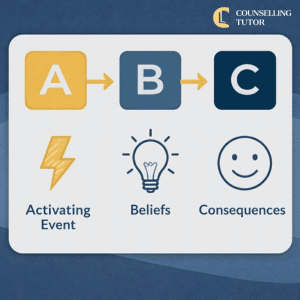
The central principle of the model is that it is not A that causes C. It is B. Our beliefs about what happened are what drive our emotional and behavioural responses, not the event itself. This principle has its roots in Stoic philosophy, particularly in the work of Epictetus (c. 50-135 AD), who wrote: “It is not things that upset us, but our judgements about things.” Ellis took this ancient insight and turned it into a structured, teachable framework for therapeutic work.
You can read more about the History of CBT in our dedicated article.
The ABC model is most closely associated with Albert Ellis, an American psychologist who developed REBT in the 1950s. Ellis had originally trained as a psychoanalyst, but he grew increasingly frustrated with the approach. He felt that spending years exploring a client’s childhood and unconscious mind was slow, indirect, and often left people no better off. He once described psychoanalysis as leaving patients “polished but impotent.”
Ellis wanted something more direct. He began focusing on what his clients were telling themselves in the present moment, and he noticed a pattern. The clients who were most distressed were not the ones facing the worst circumstances. They were the ones holding the most rigid, extreme beliefs about their circumstances. From this observation, the ABC model was born.
Ellis published his foundational ideas in Reason and Emotion in Psychotherapy (1962), and continued to develop REBT throughout his career. His later works, including a revised edition of that book in 1994 and Rational Emotive Behavior Therapy: A Therapist’s Guide (co-authored with Catharine MacLaren in 2005), remain essential reading for anyone studying this approach.
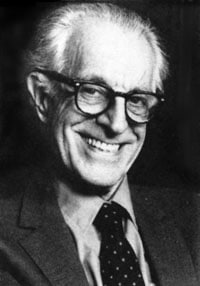
While Ellis was developing REBT, the American psychiatrist Aaron Beck was working on his own cognitive approach. Beck’s cognitive therapy, which he began developing in the 1960s, shares the same core principle: that our thoughts shape our emotions and behaviour. Beck placed particular emphasis on what he called “automatic thoughts” and the cognitive distortions that can keep people trapped in cycles of anxiety and depression.
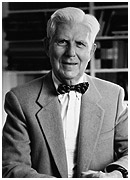
Beck and Ellis worked alongside each other rather than together, and their approaches differ in style and emphasis. REBT tends to be more direct and philosophical, while Beck’s cognitive therapy is often more collaborative and evidence-focused. But both rest on the same foundation, and the ABC model sits comfortably within both traditions.
For further reading, Beck’s Cognitive Therapy: Basics and Beyond (2011) offers a clear introduction to his approach and its relationship to Ellis’s work.
Let’s break each component down more carefully, because each one carries more nuance than it first appears.
The activating event is whatever sets the whole chain in motion. In training, you will often see simple examples used, like “a friend walks past you without saying hello” or “your boss criticises your work.” These are helpful starting points, but it is worth understanding that activating events are not always external.
An activating event can be:
In therapy, one of the first skills you learn is how to help a client identify the specific activating event. This matters because people often come into sessions talking about a general feeling (“I just feel anxious all the time”) rather than a specific trigger. Helping them pinpoint the A is the starting point for understanding the rest.
This is the heart of the model. Ellis argued that it is our beliefs about an event, not the event itself, that determine our emotional response. He distinguished between two main types of belief:
Rational beliefs are flexible, realistic, and helpful. They allow for nuance, uncertainty, and the messiness of real life. For example: “I would prefer my friend to say hello, but there could be many reasons she didn’t.”
Irrational beliefs are rigid, extreme, and unhelpful. They tend to involve absolutes and demands. For example: “She must have ignored me on purpose. Nobody likes me. I am always rejected.”
Ellis identified several common patterns of irrational thinking that come up again and again in clinical work:
If you can recognise these patterns in your own thinking (and you almost certainly will), you are already starting to understand how the model works from the inside out. That personal connection is not a weakness. It is actually one of the strengths you bring to this work.
The consequences are what follow from the beliefs. These include:
A crucial point for your assignments: Ellis distinguished between healthy negative emotions and unhealthy negative emotions. Feeling sad when something sad happens is healthy. Feeling devastated and hopeless because you believe you will never recover is not. The difference is not in the event; it is in the belief.
Let’s walk through a full example to see how these three components connect.
The situation: You are walking home from work after a difficult day. You pass a friend on the street, and she walks straight past you without acknowledging you.

Notice that the activating event is identical in both scenarios. What changed was the belief. And the belief changed everything that followed.
This is where CBT and REBT do their work. The therapist supports the client to notice their automatic thoughts, examine whether those thoughts are accurate and helpful, and consider alternative interpretations. It sounds straightforward, but in practice it takes skill, patience, and a solid therapeutic relationship.
In REBT, the ABC model is often extended to include two more stages, making it the ABCDE model:
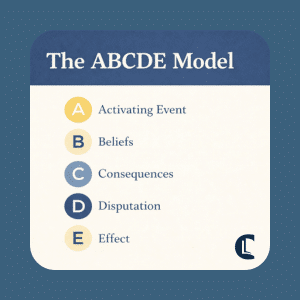
The ABCDE extension is important for assignments, because it shows the model not just as a way of understanding problems but as a framework for change. If you are ever asked to demonstrate the ABC model in a case study or formulation, including D and E shows a deeper level of understanding.
You can read more about CBT and the ABCDE Model in our dedicated article.
Structure your assignment clearly and confidently with pre-labelled sections and sentence starters.
In practice, therapists use the ABC model to help clients make sense of their experiences. Rather than asking “why do you feel this way?” (which can lead to circular or overwhelming answers), the therapist works with the client to map out specific situations using the ABC framework.
This might look like:
This structured approach helps clients see the connection between their thinking and their emotional experience. For many people, this is genuinely revelatory. They have never considered that their feelings might be connected to specific thoughts, because those thoughts happen so fast they feel like facts rather than interpretations.
Many CBT and REBT therapists teach the ABC model directly to clients as part of psychoeducation. They might draw it out on a whiteboard, use a worksheet, or simply explain it in conversation. The goal is to help clients become their own therapists over time, able to spot unhelpful thinking patterns and challenge them without needing to be in a session.
CBT is well known for using between-session tasks, often called homework (though many therapists prefer the term “practice” or “experiments”). Clients might be asked to:
This is where the real change tends to happen. Sessions create awareness; practice between sessions creates lasting change.
Linked to the ABC model is the use of graded exposure, particularly for anxiety-based difficulties. If a client believes “crossing busy roads is almost certain to kill me” (an irrational belief), disputation alone may not be enough. The client may also need to gradually test that belief through experience, starting with quiet roads and working up to busier ones.
This combination of cognitive restructuring (challenging the belief) and behavioural experiments (testing it in reality) is central to how CBT works in practice.
One of the things that makes CBT and REBT effective is their attention to how clients talk to themselves. The internal dialogue we carry around has a direct impact on how we feel and what we do.
Consider the difference between:
The situation is the same. But the first statement creates paralysis, while the second introduces agency, planning, and choice. Helping clients notice and shift their language is a practical skill that sits right at the heart of working with the ABC model.
Ellis was known for being quite direct and sometimes humorous in his approach. He believed that humour, used sensitively, could help loosen the grip of catastrophic thinking. Laughing at an exaggerated fear does not trivialise distress. It can help a client step back and see their thinking from a different angle.
Ellis outlined a number of core irrational beliefs that he saw repeatedly in his clinical work. These are worth knowing for your studies, because they appear in textbooks, assignments, and exam questions regularly.
You might notice some of these in your own thinking. Most people do. That recognition is not a problem. It is actually a useful bridge between theory and practice. Understanding the ABC model from the inside gives you a richer, more authentic foundation for working with clients.
Here is something that catches a lot of students out, so it is worth flagging early.
There is another version of the ABC model used in applied behaviour analysis (ABA) and functional behaviour assessment (FBA), which has a completely different meaning:
This behavioural ABC comes from a different theoretical tradition. It focuses on observable behaviour and environmental reinforcement rather than cognition and beliefs. If your course or textbook references the ABC model, make sure you know which one they mean. In counselling training, it is almost always the cognitive version (Ellis’s model), but if you are studying an integrative course or covering behavioural approaches, you may encounter both.
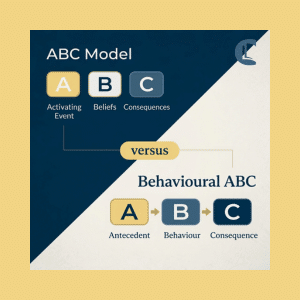
No model is perfect, and good academic work engages with limitations as well as strengths. Here are some of the main criticisms of the ABC model that are worth including in your assignments.
The ABC model works well for straightforward situations, but human experience is rarely that neat. In cases involving trauma, personality difficulties, or severe depression, the relationship between thoughts, feelings, and behaviours is often far more complex and interconnected than the model suggests. Biological factors, relational dynamics, and cultural context all play a role that the basic ABC framework does not fully capture.
If used carelessly, the ABC model can come across as telling clients that their problems are all in their head. “Just think differently” is a dangerous oversimplification, particularly for clients dealing with oppression, poverty, discrimination, or other structural inequalities. Good therapists use the model as a collaborative exploration tool, not as a way of placing responsibility for systemic problems onto individual thinking.
Some contemporary therapists and researchers question whether labelling beliefs as “irrational” is always helpful. A belief that seems irrational in one context might be perfectly adaptive in another. For example, hypervigilance around safety might look irrational on paper but could have been a survival strategy in an abusive environment. More recent approaches prefer terms like “unhelpful” or “dysfunctional” rather than “irrational,” and assess beliefs in relation to the client’s values, goals, and life context rather than against an abstract standard of rationality.
It is worth noting that Ellis himself acknowledged these limitations over time. In his later work, he moved towards a more integrative position, incorporating experiential and emotive techniques (such as role-play and imagery) alongside cognitive disputation. He also embraced concepts like unconditional self-acceptance (USA) and unconditional other-acceptance (UOA), which move beyond simply challenging beliefs and towards a deeper shift in how people relate to themselves and others.
The ABC model has not stayed frozen since the 1950s. It has evolved and been integrated with other approaches in ways that are relevant to contemporary counselling practice.
Aaron Beck and later therapists like Jeffrey Young (who developed Schema Therapy) recognised that underneath our day-to-day automatic thoughts lie deeper core beliefs, or schemas. These might include beliefs like “I am unlovable,” “The world is dangerous,” or “I am incompetent.” In ABC terms, these schemas sit at the deepest level of B and shape the more surface-level automatic thoughts that we notice in specific situations.
Understanding this layered structure helps explain why some beliefs are so resistant to change. A client might intellectually accept that one friend ignoring them does not mean they are universally rejected, but if their core schema is “I am unlovable,” that deeper belief will keep generating the same kinds of automatic thoughts across different situations.
More recent developments in CBT have integrated ideas from acceptance and commitment therapy (ACT) and mindfulness-based approaches. Rather than always disputing unhelpful beliefs, these approaches sometimes focus on changing the client’s relationship to their thoughts. Instead of arguing with the belief “I’m not good enough,” the client learns to notice the thought, acknowledge it, and choose to act in line with their values regardless.
This represents a shift from “change your thinking” to “change your relationship with your thinking,” and it has expanded how the ABC model is understood and applied in modern practice.
The ABC model has also been adapted for use outside the therapy room. School-based mental health programmes use it to help young people understand the connection between their thoughts and feelings, build resilience, and develop healthier ways of responding to stress. For counselling students, this is a useful reminder that the ABC model is not just a clinical tool. It is a framework for understanding human experience that has applications well beyond the consulting room.
If you are writing about the ABC model for an assignment, here are some practical tips.
Reference the original sources. Citing Ellis directly (particularly Reason and Emotion in Psychotherapy, 1962, and the revised 1994 edition) shows that you have engaged with the primary literature, not just a textbook summary. You can also reference Beck (2011) and Ellis and MacLaren (2005) for more applied and contemporary perspectives.

Use a clear, specific example. Tutors and markers want to see that you understand how the model works in practice, not just that you can define it. Choose a realistic scenario and walk through each component (A, B, C, and ideally D and E) with enough detail to show genuine understanding.
Engage with the limitations. Strong assignments do not just describe a model. They evaluate it. Mention the criticisms (oversimplification, risk of blaming, cultural limitations) and explain why the model is still useful despite them. This shows critical thinking.
Connect it to your own experience or practice. If your course encourages reflective writing, the ABC model is a brilliant one to connect to personal experience. You do not need to disclose anything deeply personal, but showing that you have applied the model to your own thinking demonstrates a level of understanding that goes beyond textbook knowledge.
Know the difference between CBT and REBT. While the ABC model is common to both, REBT and CBT are not identical. If your assignment asks specifically about one approach, make sure your answer reflects the right one. REBT emphasises disputation and philosophical change; Beck’s CBT emphasises collaborative empiricism and testing thoughts against evidence.
Structure your assignment clearly and confidently with pre-labelled sections and sentence starters.
The ABC model is a framework used in CBT and REBT which explains that emotional and behavioural responses are shaped by beliefs about an event, rather than the event itself. It helps clients understand how their thinking influences how they feel and act.
A stands for the activating event, B for the beliefs or interpretations about that event, and C for the emotional and behavioural consequences. The model highlights that it is the belief (B) that drives the outcome, not the situation alone.
The ABC model is used to help clients identify specific triggers, uncover the beliefs behind their reactions, and explore the resulting emotions and behaviours. This process supports greater awareness and enables clients to develop more balanced and helpful ways of responding.
The ABC model is one of those frameworks that seems simple at first glance but reveals more depth the longer you work with it. At its core, it offers a clear and practical way of understanding how thoughts shape feelings and behaviour. But it also opens up bigger questions about how we make meaning, how rigid thinking creates suffering, and how people can change.
If you are early in your training, this model gives you a solid foundation for understanding CBT and REBT. If you are further along, it remains a useful tool for formulation, psychoeducation, and reflection.
Beck, A. T. (2011). Cognitive Therapy: Basics and Beyond. New York: Guilford Press.
Ellis, A. (1962). Reason and Emotion in Psychotherapy. New York: Lyle Stuart.
Ellis, A. (1994). Reason and Emotion in Psychotherapy (revised edition). New York: Birch Lane Press.
Ellis, A., & MacLaren, C. (2005). Rational Emotive Behavior Therapy: A Therapist’s Guide. Washington, DC: American Psychological Association.
Transparency note
This article was written and reviewed by human contributors. AI was used as a supportive tool to assist with formatting, layout clarity, and language refinement. All content, interpretations, and ethical positions were created and checked by the authors.
Counselling Tutor provides trusted resources for counselling students and qualified practitioners. Our expert-led articles, study guides, and CPD resources are designed to support your growth, confidence, and professional development.
👉 Meet the team behind Counselling Tutor
Notice any broken link or issues with this resource? Kindly let us know by email
Email us