The Counselling Placement Search Planner
A free planner to track every agency you approach and prep for every interview — so nothing slips.
Finding a counselling placement is, for many students, the most stressful part of training. Tutors see it every year: capable, committed learners who have sailed through the theory suddenly stuck, anxious and convinced they are the only one without a placement. Almost always the problem is not the student. It is that nobody has explained how the process actually works.
A placement is where your training becomes real. It is the point where skills practised in the classroom meet a person sitting opposite you who has come for help. Getting there involves more moving parts than most students expect: awarding-body requirements, insurance, supervision, DBS checks, application forms and interviews, and each one has its own timeline.
This guide pulls together everything a student needs to find a placement, apply well, get through the interview, and make the most of the experience once you are in. Treat it as a map. If you understand the terrain before you set off, the whole thing becomes far less daunting.
By the end of this guide you will be able to:
A free planner to track every agency you approach and prep for every interview — so nothing slips.

A counselling placement is a supervised setting where student counsellors see real clients as part of their training. It is where you accumulate the face-to-face client hours your course requires, working under supervision and within an organisation’s policies and procedures.
Most placements are provided by charitable organisations. Understanding why tells you a lot about how to approach them.
Many counselling charities are funded by commissioners: people employed by local government to identify and bridge gaps in health provision. A commissioner has both access to funding and a picture of what the local area needs.
When a charity approaches a commissioner and there is a gap to fill, a contract follows. The commissioner will visit the organisation, check that policies, procedures, staffing and practice are professional, ethical and legal, and then fund the service against agreed outcomes.
This is why placements often ask you to complete outcome measures such as GAD-7 or similar forms with clients: the organisation has to evidence its outcomes to keep its funding. Other charities are self-funded through donations, which can make them less predictable because they depend on public generosity rather than a government contract.
The practical takeaway: a placement is not just somewhere to rack up hours. It is a working organisation with obligations of its own, and it wants people who understand and respect that.
In England, placements are usually required from Level 4 and above (in Scotland, Level 7). Below that level you are building the foundational skills that a placement will later expect you to have.
A few things generally have to be true before a placement will consider you:
This depends entirely on your course, so check your handbook, but the common benchmarks are:
Exact requirements vary by course and organisation, so always confirm what your placement needs. That said, most placements expect you to arrive with several things sorted, or clearly in progress, and getting these organised early removes a lot of last-minute panic.
Evidence that you are ready to practise. Many providers ask for confirmation of readiness from your training provider, often in the form of a fitness-to-practise letter. This usually follows a skills assessment at college, sometimes a recorded session, sometimes observed, often called clinical competencies. Your tutor takes a view, based on that assessment and on knowing you in class, on whether you are ready to sit in front of clients at student level.
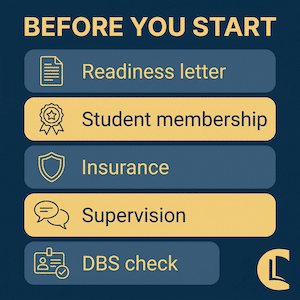
Student membership of a professional body. This often means student membership of a body such as NCPS or BACP, though what a placement accepts can depend on your course and the organisation. Both offer student membership, and it signals that you are working within a professional ethical framework.
Indemnity insurance. Trainees working with clients are expected to be covered by adequate insurance, which protects you against complaints. The BACP Ethical Framework states members will be covered by adequate insurance when providing services directly or indirectly to the public. If a complaint is made and ends up in court, your insurance may fund a legal defence.
Supervision in place, or genuinely in progress. You cannot start seeing clients until you have a supervisor, because until then you are unsupervised. You would typically meet a supervisor, contract with them, and then meet regularly once you are in practice. Some students arrange this just before starting, others after their first few hours, but you cannot begin counselling without it. The question to ask yourself is simple: if something goes wrong in your first session, who do you go to?
A DBS check where the role requires it. Many placements will ask for a Disclosure and Barring Service check before you start, though whether one is needed, and at what level, depends on the role and setting rather than being automatic for every placement. The placement will also usually take up references.
Some placements provide indemnity insurance, which sounds reassuring. But if you rely solely on the organisation’s cover, it is the organisation that decides whether to activate it. As an illustration, a story that circulates in training circles rather than a documented case, a student had a serious complaint made against them and asked the placement to activate its insurance so the case could be defended, and the placement declined, siding with the client, leaving the student with no cover.
Your own policy is relatively inexpensive, it belongs to you, and you can activate it yourself. It is one of the cheapest pieces of peace of mind in your whole training.
Timing is one of the most important and least understood parts of getting a placement. Many placements recruit on an annual cycle, and if you miss it you can effectively lose a year. This pattern is common in a lot of services rather than a fixed industry rule, and some organisations recruit year-round, so treat the dates below as a guide and check with individual placements.
In many services the cycle runs roughly like this:
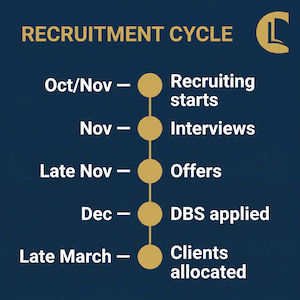
From starting your search in October to sitting in front of your first client can therefore be around five months. Part of the reason for the lag is that outgoing students usually finish around October, sometimes overrunning as they complete their final hours, and Christmas sits in the middle of everything. DBS checks are also variable: some come back in a fortnight, others take months, and the hold-up is not always on the government’s side, sometimes an organisation simply forgets to send the paperwork off.
There is a smaller second cycle in the summer for students who have just completed, but it is brief. The main opportunity is the autumn cycle, so if you are starting a placement in the new academic year, begin thinking about it a couple of months ahead.

This is the question that causes the most anxiety, so here are the strategies that work for finding a counselling placement.
Ask your tutor first. Your training organisation will usually keep a list of placements that current and past students have used. This is the easiest starting point, and your tutor can tell you which ones are genuinely good, the ones that support and mentor students rather than simply providing a room and a client.
Google charities in your area. A search as simple as “charities” plus your town or city will surface local organisations. Then look at which ones offer counselling.
Volunteer first. One of the best inside routes is to volunteer at a charity that offers placements, as a support worker, for example, once you have your Level 3. You learn how the organisation works, you know who to talk to, and when a placement opportunity comes up you are already part of the furniture. Nothing beats starting somewhere you are effectively already doing the job.
Use Facebook groups. Post in relevant groups, including the Counselling Tutor Facebook group, asking whether anyone knows of placements in your area. The responses can surprise you.
Write, don’t just email. A well-written letter to an agency stands out far more than a voicemail or a generic email. It signals effort and seriousness.
Think beyond your street. Students who limit their search to a few minutes from home are often disappointed. Be realistic about how far you can travel and still get back, but be prepared to widen the net, people have travelled considerable distances for the right placement.
Get into a job-hunting mindset. This is the shift that changes everything. Applying for a placement is applying for a job, an unpaid one in money terms, but one where you are paid in experience, learning and contacts. The same principles that apply to job hunting apply here: research, presentation, persistence.
Be persistent. Rejection is part of the process, not a verdict on you. Keep going.
Rather than firing off scattered enquiries, plan your search:
Once you apply, the selection process for a counselling placement interview usually has up to three stages: an application form, sometimes a group interview, and a one-to-one interview.
The form is the first sift, and it is designed to test your knowledge. Expect questions on:

If a placement works with survivors of domestic abuse, for example, the form might ask what you understand about safeguarding and confidentiality in that context, and what issues those clients commonly face. What is being assessed is whether you understand the client group and the organisation, not whether you have memorised textbook definitions.
Not every placement runs one, but many do. You might be put in a group and asked an ethical question, a classic is “Is touch appropriate in therapy?” What matters here is not your answer but how you handle it. Interviewers watch how you interact with others, whether you can hold two opposing ideas in mind and reason between them, an ability to hold nuance and ambiguity, and whether you can take a balanced view rather than a polarised one.
The person who calmly explores the nuance does well. The person who reacts strongly, dominates, or has a blazing row about being asked the question at all does not, and interviewers remember them for the wrong reasons.
This is where they assess you as a person: your commitment, your self-awareness, and your knowledge of the client group. Questions often include:
From the interviewer’s side of the table, the strong candidates share a pattern. Providers are looking for:
Just as telling is what interviewers actively avoid. They tend to rule out:
Availability deserves a closer look, because it sinks more applications than students realise. If you offer clients Mondays, they expect you on Mondays. A pattern of “Monday one week, Thursday the next, then a couple of weeks off” is no good to anyone. Clients build trust around consistency, and part of the commitment of being a counsellor is turning up on the same day, every week. Life does occasionally get in the way, whether through illness, holidays or emergencies, but the baseline expectation is reliability.
A placement interview is a two-way process. You are assessing whether the organisation is right for you as much as they are assessing you, and asking good questions signals exactly the seriousness they are looking for. Strong questions to ask include:
Beyond these, ask about the counselling contract, and always clarify the supervision arrangements, which brings us to one of the most important decisions you will make.
Supervision is central to ethical practice throughout your working life; the BACP Ethical Framework describes it as essential to how practitioners sustain good practice. Requirements vary by professional body: BACP, for instance, sets out supervision requirements for student members of a minimum of 1.5 hours of supervision per calendar month, at a ratio of one hour of supervision to every eight hours of client work, and does not accept peer supervision for students. Placements offer supervision in different ways, and each arrangement has trade-offs worth thinking through before you accept.
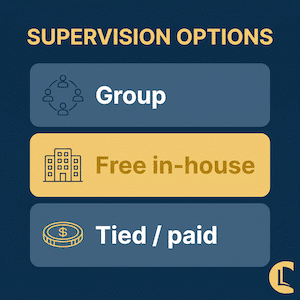
The three arrangements you are most likely to meet are set out below. Expand each to see how it works and what to weigh up.
This is usually compulsory at hospices, bereavement services and organisations working with trauma such as women’s refuges. It is in addition to one-to-one supervision, not a replacement for it, and it takes up time, as you attend to be counselled and again to be supervised. Depending on your awarding body and professional body, you may be able to count some group supervision towards your hours, but this is course-specific and the rules for students differ, so check what yours allows before you rely on it. Well-facilitated group supervision can be a rich source of ideas and insight; poorly timed, it can become an unmanageable drain on your week. Always ask about the time commitment and frequency at interview.
Free supervision provided by a member of the organisation’s own staff sounds like a gift, and it can be. But ask yourself honestly: how would you feel about critiquing the organisation to someone who is, by definition, a senior member of that same organisation? Can you bring all of yourself to supervision, including your doubts about the agency and about your own practice, knowing your supervisor works for them? Part of the value of supervision is being able to explore and critique every aspect of your practice freely.
Some placements require you to pay for in-house supervision as a condition of the placement. Before agreeing, ask:
There is a practical sting in the tail, too. If you later take a second placement, can you bring those clients to your tied supervisor? If not, you will need another supervisor, and then the question becomes who signs off your supervision log. Many awarding bodies want your entire supervision portfolio, from your first hour to your last, signed off coherently. Splitting it across supervisors makes that awkward. Where you can, arranging your own external supervision keeps your independence and your paperwork clean.
Securing the placement is the beginning, not the end. The students who get the most from a placement treat it as far more than an hours factory.
Being open about your student status is an ethical requirement. The BACP Ethical Framework is explicit that trainees on a practitioner-qualifying course working with clients will inform clients, or ensure that clients have been informed, that they are trainees. Some counsellors prefer the phrase “placement counsellor” to “student counsellor” as a way of reflecting the advanced stage of training they have reached, though that is a matter of wording rather than a formal rule. Ideally the organisation allocates appropriate clients and tells them in advance, and you confirm it during contracting, including how anonymised discussion of the work in supervision or peer groups fits in. Far from undermining you, transparency models the honesty and congruence that good therapy depends on.
Recording client hours accurately matters for qualifying, and the rules catch people out. In general:
Check your awarding body’s specific requirements, as the detail varies.
A placement is a working mental health organisation, and it is full of learning if you look for it:
The placement process can stir up feelings that catch competent people by surprise. It is entirely common to feel as though you are back at school, to experience the interviewer as a teacher, to feel incompetent, to wonder whether everyone else is cleverer than you, and to doubt whether you are up to the task at all.
These reactions are normal, feelings of incompetence are so common in trainees that they have a name. Interview panels understand this and should be attuned to it. If anything, mild nerves are reassuring; the candidate who breezes in certain they have nothing to learn tends to worry an experienced interviewer more than the honest, slightly anxious one.
The single best piece of advice for the whole process is also the simplest: be yourself. Placements are looking for real, genuine people. That is what the work requires, and it is what they are trying to find.
A free planner to track every agency you approach and prep for every interview — so nothing slips.
It depends on your course, but most counselling diplomas require a minimum of 100 hours of supervised, face-to-face client work. Always check your course handbook, as the exact requirement varies.
Start early. In many services the main recruitment cycle runs from October/November through to clients being allocated in late March, so begin your search a couple of months before you want to start. Where a placement follows that pattern, missing the autumn cycle can mean waiting close to a year for the next main opportunity, apart from a smaller summer cycle. Not every service recruits this way, so check.
It is well worth having your own. Even where a placement offers indemnity insurance, it is the organisation that decides whether to activate its cover. Your own professional indemnity policy is relatively inexpensive, belongs to you, and can be activated by you.
Often not. Many placements prefer classroom-based training and may not offer hours to students on fully online courses, though this is an organisational preference rather than a universal rule. Placements are typically available from Level 4 upwards (Level 7 in Scotland), through recognised awarding bodies, so check the requirements of both your course and the placements you approach.
Think carefully before agreeing to tied-in paid supervision. Ask whether it represents value for money, whether you could freely criticise the organisation to a supervisor it pays, and how it affects your autonomy and the sign-off of your supervision log. Where you can, arranging your own external supervision protects your independence.
A placement can feel like a mountain to climb, but almost all of the stress comes from not knowing how the process works. Once you understand why placements exist, what you need in place, when to apply and what interviewers are really looking for, the path becomes far clearer.
Approach it as you would a job you genuinely want. Do your research, sort your insurance and supervision early, apply in good time, and choose a placement that will support you rather than simply use you. Ask as many questions as they ask you. And when you are in, treat it as the rich learning environment it is, the relationships and understanding you build there can stay with you for the rest of your career.
Transparency note
This article was written and reviewed by human contributors. AI was used as a supportive tool to assist with formatting, layout clarity, and language refinement. All content, interpretations, and ethical positions were created and checked by the authors.
Counselling Tutor provides trusted resources for counselling students and qualified practitioners. Our expert-led articles, study guides, and CPD resources are designed to support your growth, confidence, and professional development.
👉 Meet the team behind Counselling Tutor
Notice any broken link or issues with this resource? Kindly let us know by email
Email us