My Free Handout
How to Start a Counselling Session
How you begin a counselling session sets the emotional and relational tone for the therapeutic work that follows. Whether you are meeting a client for the first time or welcoming them back for an ongoing session, the opening moments carry considerable clinical weight.
For many clients, the first session marks the culmination of a long, often distressing journey. They may have waited weeks or months, undergone assessments, and retold painful experiences to multiple professionals. By the time they sit in front of you, they may feel anxious, uncertain, relieved, guarded – or all at once.
As a practitioner, your task is not to deliver a perfectly scripted opening. Rather, it is to create a psychologically safe space that honours the client’s frame of reference, protects their autonomy, and communicates your steady presence. The way you start a session is less about technique and more about relational attunement.
How to Start a Counselling Session
By engaging with this article, you will be able to:
Ken Kelly: Start a counselling session with a client. Now, I just wanna understand this, Rory, are you saying how to start a very first counselling session with a client? You’ve never seen this client before, or is it third time they’re visiting and how you begin the counselling session?
Rory Lees-Oakes: I think it’s how we start. How we start would be the first session, but it could be a follow on sessions as well. And what I’m coming to is that when we are thinking about how to start our session off, client walks in, sits down, we’ve done our contracting. How do we start, what do we say to clients, do we say anything at all?
And I think the best thing to think about is thinking about this from the client’s frame of reference. If you’re a student, your client will have had to go to an agency, will have had to sit in front of someone, be assessed, talk about the very difficult things in their lives. Then they’ll be told they’ll get a counselling session, but it could be in the future.
So then they have to sit and wait and what’s going on in their lives will be playing out around them or what’s troubling them will still be with them. And then eventually they’ll get a text or an email or a letter or a phone call to say, come in and see you. And here’s the thing, generally speaking, they’ve not done a counselling course, they’re seeing a counsellor. And it doesn’t matter if you’re a student counsellor, you are their counsellor. So when they come in, they may be unsure or unsettled or not quite understanding what happens next.
How do you start? Client sits down, you’ve done your contract, what do you say to them? And it’s a question I asked one of my tutors many years ago when I was studying. Because I wanted to be respectful and thoughtful and not get it wrong. And it was quite interesting what my tutor said to me.
She said you’ve got a number of paths, you can say, how can I help you today? Where do we start? Or sometimes you’ll just sit up and take a breath and your clients will just start telling you their story. They’re so eager to get all this pain out and to have someone hear them that they might start without any kind of prompts.
But I think it’s very different to skills practice. The transition from using skills as a student with your peers in a classroom, it’s a massive step change to sitting in front of a client who doesn’t know the rules of therapy, who’s not studied to be a therapist, who has real pain and real difficulty. So it’s really a bit of a chat about how we start therapy.
What do we say Ken?
Ken Kelly: Yes. I like it, I think it’s a really good topic. Doing your skills is so different to when you are in a real therapeutic contact and the client doesn’t have the rules of engagement. In your simulated skill sessions when you break out and you’ve got 20 minutes to practice skills, you sit down and you say to the person, what do you wanna bring today? And bam, they’re off and they’ll bring a narrative.
With clients it is not always that way. Your first sessions with clients are gonna be as different and as unique as the clients that you see. And I think that’s a really good starting point, to not have any expectations of what the beginning may be like.
Because it can vary, and it can be vary from, I don’t really know what to bring, and a client being at a loss of how to describe what’s going on for them. To the other side of the coin, which you mentioned, Rory, and that’s that immediate sharing, almost like a champagne cork coming off, and you just have this narrative that flows at you.
And you would handle both situations differently. And we’ll maybe get to how we might handle those in a moment. But the place I go with this is, I think about what you mentioned, Rory, the frame of reference, the mindset, how it is for the client coming in.
So I think of it this way, if you’re going through some trouble in your life and it’s really difficult, very often, and this is doesn’t apply to everyone, but very often it’s hidden away inside. We don’t tell people about it, we don’t tell our work colleagues about it. It affects our day to day, but it’s something that we keep internally.
And it can often be that when a client sits in front of you, they’re speaking about this for the very first time. And not only that, they’re speaking about it for the very first time with someone they’ve never met before, someone that they are viewing maybe as someone that can help. So they’re going through this process, which is a painful process. Thinking about what the mindset of that person may be before going in, the night before when they’re considering, oh, I’m gonna be seeing my counsellor tomorrow, and they might be reviewing what material they’re bringing in, and I just see it as a privileged position to be there to receive that information. But also we need to recognise that.
We need to perhaps allow time to build up trust and not rush a client into a narrative. So if a client does come and say, I’m really nervous, I don’t really know what to say, we can be kind, understanding, and just there for the client in a warm way. Sometimes people will need a relationship to develop first before they feel that they can share.
And then, like I started with on the other side of the coin, there is that instant narrative where, I guess as a placement counsellor, you might feel, ooh, I better stop them so that I can get some skills in here, and a quick reflection, yes, and oh, I did this. And sometimes it’s just about letting the client vent, letting them vent and get the whole story out.
So from my side it is always different, and the clients will teach us. But gently, not expecting. And when I say not expecting, you can have a referral through, and I remember this and taking it to my supervisor back in the day when I was in placement. I was in a GP practice, and the doctor would make the referrals and would give me an indication of what the referral was for.
This person wants to see you for this reason. And thanks to my supervisor, I stopped looking at this reason after a while because I didn’t want to have the expectation, when are they gonna start talking about this? I was almost maybe wanting them to rush to something they’d shared with the doctor where they weren’t ready.
Because they maybe had a relationship with the doctor and I was this stranger that they just met. So there’s just some thoughts, Rory, from my side.
Rory Lees-Oakes: Yes. Thank you for that, Ken. And I think it’s interesting you touched on referrals and in my early career I was very much, I don’t want to read the referral unless there’s an element of risk, harm to self or harm to others,I want to hear this from the client.
And as I matured in my practice, I took a slightly different view. And my view is that I always read the referrals, because if a client came to you and they had maybe a history of sexual abuse, maybe a history of domestic violence, they may say do you know my background?
And if you say no, they may have to tell you all over again and recount that pain. So in my later career, I would say yes I’ve read the referral, and is it about that, is that why you’re here?And they may say no, actually I’ve come about something else. But nine times out of 10 it was, yes.
So I think being thoughtful of saving the client the trauma of retelling another professional, because they may have had to tell their story a number of times. People forget this, but the times someone sees a counsellor, they may have had to go through a number of professionals.
In cases of sexual assault and sexual abuse, they may have had to speak in court. They may have had to speak to a solicitor, they may have had to speak to a doctor, they may have had to speak to the police. And every time they rediscuss this or re-bring this up, it’s re-traumatising. So my observation would be, read the referral, but I’m definitely with you, Ken, don’t have an expectation that what’s in the referral is what’s going to be discussed in the therapy room.
Ken Kelly: Yeah, yes. And the opening line of, what is it that you would like to bring today? Worked well for me. So you’ve done your contracting, you’ve said who you are, you’ve spoken about your modality. So with that said, we have about 50 minutes left for this session, and I wonder what it is that you’d like to bring today? Is a beautiful invite. Yeah, it just lays a little welcome mat out. And it’s a very clear indicator that it’s your turn as the client. And then it really is just about going where the client goes. Well, for me, when I was in practice, it was person-centred modality, so I would be going with the client wherever they chose to go as opposed to directing that. And it would be different every time, it really would.
I want to just touch on future sessions. So we’ve spoken about this being the first session, but when the client comes back in, you see them for the next week. Let’s say week one, you say, I wonder what it is that you’d like to bring today. And they speak for 35 minutes nonstop, giving you a narrative of what’s been going on for them, and how it’s been, and a whole lot of narrative. Where do you pick up the next session? How do you open that next session when you have all of this information that they brought in the last session?
My thought on it is that I don’t, I just lay out the same welcome mat and I wonder what it is that you’d like to dive into today. And the reason for that is I don’t wanna set the agenda. So I don’t wanna say, last time you said this, and this, and this, so let’s dig deeper.
Because they might have had a terrible morning with somebody on the bus who took their seat, and they’re really angry about that. So it’s what are they coming in with and where do they find themselves in that moment. Somebody might mention something as they’re leaving therapy, they might mention next time I come I might want to speak to you about my relationship with my mother and then in the next session, I might say, as you checked out last week, you mentioned that you’d like to at some stage speak to your mother, but that’s up to you when you choose to bring it, I wonder what it is that you’d like to bring today.
And again, just handing it softly over to them. No expectations from my side, but at least linking together what they may have mentioned in the last session.
What’s your thoughts, Rory?
Rory Lees-Oakes: Yeah, I’m with you, Ken. I think let the clients set the agenda. I used to say in subsequent sessions, it’s good to see you, make sure they settled, and say so where would you like to begin? Or where would you like to start? And that is usually an interesting invitation for clients to then talk about what they wanted.
You might have on the first session someone who brings something incredibly heavy, incredibly powerful, and you think, this has to be what the therapy is about.
They come the next week and they talk about something different. And what you have to do, certainly as a person centred therapist, is put the first session to one side, bracket it and work with what is being presented today.
Because that first session could have been a test to make sure that you are resilient enough to hear the story. The times I’ve had clients say to me, I don’t want to tell you my story because I’m afraid it might upset you.
My story is so bad, it’s devastated me and I don’t want it to do that to anybody else. And on that point, I think I would say, I really appreciate that and I really understand that, but it’s fine, share when you are ready. Give them the impression that you’re robust enough.
It’s always useful to think about if someone’s brought something in the first session and they not talk about it in the second, just be patient, just wait. Because it may be they’re just waiting for the time where they’re feeling comfortable to be able to talk about the real issue that’s going on for them.
It’s a bit of a waiting game sometimes.
Ken Kelly: Yes. You mentioned having to repeat a story many times over, and I’ve worked in services where certainly we would be seeing service users who went through that process of having to tell their stories many times over.
And there can be, in some cases, almost a rehearsed narrative. And it can come across without emotion. It can almost seem like a removed story.
So there’s another first presentation that you might see, and it’s a protection mechanism.
But now, for the first time, this person is in your therapeutic setting where you are receiving that information with kindness, openness, and seeing the whole of that person with a deep level of empathy.
And I wanna speak about counselling skills for a moment. In that first session, I think the two counselling skills that are most often used are active listening and silence. Often, not always, but often. I think that the true mastery of active listening sits in a seasoned counsellor, we mature into active listening, and it is incredibly powerful.
So that’s my thoughts on the skills in that first session, Rory?
Rory Lees-Oakes: Yeah, it’s beautifully put, Ken. And I think I’d add to that by saying that also it’s about the counsellor being present.
You know that they are giving a hundred percent attention to the person sat in front of them. That person can get a sense of that, they can feel it. Just to listen to them and I think there’s no better service one human being can offer another.
Ken Kelly: Yes. I just wanted to circle back to one more thing. Good note-taking. Good note-taking skills become quite important because you’re right, Rory, we wouldn’t go into session two expecting that they’re now gonna recover some of that ground, they may bring something completely different.
But if they do start recovering some of the ground, if we’ve taken good notes, then we’re able to show that we listened actively the first time by being aware of what the person is bringing.
Before considering what to say, consider what it may have taken for the client to arrive.
Clients often enter therapy carrying material that has been privately endured for months or years. For some, this is the first time they have spoken aloud about their difficulties. For others, particularly those with histories of trauma, it may be the latest in a series of retellings to doctors, police officers, solicitors, or court officials. Each retelling can reawaken distress.
This context invites a stance of humility. You are meeting someone at a vulnerable threshold.
After contracting and explaining the framework of your work together, a simple and respectful invitation is often sufficient:
Such openings function as a relational “welcome mat”. They signal that the session belongs to the client. You are not imposing direction; you are offering space.
Some clients arrive visibly nervous and unsure. They may say, “I don’t really know where to start.”
In these moments, resist the temptation to fill the silence or push for content. Trust-building may be the primary work of the session. Warmth, patience, and attuned responses communicate that there is no rush. As Carl Rogers (1957) proposed, psychological growth flourishes in conditions of empathy, congruence, and unconditional positive regard.
Your steadiness becomes the intervention.
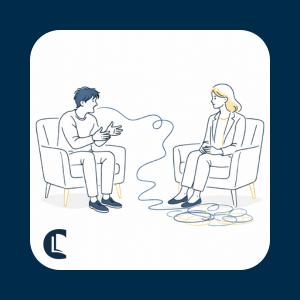
At the other end of the spectrum, a client may begin speaking immediately – rapidly, emotionally, and at length. It can feel like a champagne cork has been released.
Particularly for trainee counsellors, this may evoke performance anxiety: “I need to use a skill here.” Yet often the most therapeutic response is to allow the narrative to unfold. Active listening and containment are powerful.
Not every moment requires intervention. Sometimes, the client simply needs to be heard without interruption.
Referral information can present a clinical dilemma. Should you read it before the session? Will it create expectations?
A balanced approach is advisable.
Reading a referral may prevent a client from having to retell deeply traumatic material unnecessarily. For example, a person with a history of sexual abuse or domestic violence may ask whether you are aware of their background. To respond that you have not read it could require them to revisit painful details once more.
At the same time, avoid entering the room with a fixed agenda based on the referral. The presenting issue described by a GP or agency may not be what the client wishes to explore that day.
You might say:
“I’ve read the referral, which mentioned X. Is that what brings you today, or is there something else you’d like to focus on?”
This communicates preparedness without presumption. The client retains authority over the direction of the work.
The beginning of later sessions requires similar sensitivity.
It may be tempting to structure the session around what felt significant previously. However, clients live dynamic lives between appointments. What felt central last week may have shifted.
Returning to the same invitation maintains continuity and autonomy:
“It’s good to see you. Where would you like to begin today?”

Even if a client mentioned at the end of the previous session that they wanted to explore a specific issue next time, it is best to offer it tentatively:
“Last week, you mentioned you might want to talk about your relationship with your mother at some stage. That’s there if you’d like to return to it—but where would you like to start today?”
This approach links sessions without directing them.
Occasionally, a client may bring profoundly heavy material in the first session, only to speak about something seemingly unrelated in the next.
It is essential to bracket assumptions. The earlier disclosure may have been a test—an exploration of whether you were robust enough to hear it. Some clients explicitly voice fears such as:
“I don’t want to tell you my story because it might upset you.”
Reassurance of your capacity to hold their experience—without minimising its gravity—can be deeply containing. But timing remains theirs.
Therapeutic work often unfolds in layers. Patience is not passivity; it is disciplined trust in the client’s process.

Clients who have told their stories repeatedly may present a rehearsed account, delivered with limited visible affect. This can be a protective adaptation – a way of maintaining psychological distance from traumatic material.
Rather than confronting the lack of emotion, focus on relational depth. Over time, as safety develops, the narrative may reconnect with feeling. Your role is to receive the whole person, not just the content of their account.
In early sessions, especially, two counselling skills tend to dominate:
This involves more than paraphrasing. Mature active listening communicates, “I am fully with you.” It integrates tone, pace, facial expression, and accurate empathy. With experience, it becomes less performative and more embodied.
Silence allows integration. It conveys confidence that the client’s internal process is valuable. When held with warmth and presence, silence is not emptiness – it is space for meaning-making.
Beyond technique lies presence. Clients are exquisitely sensitive to whether they have your full attention. Being psychologically and emotionally available may be the most powerful intervention available in the opening minutes of therapy.
As research consistently suggests, the quality of the therapeutic alliance is one of the strongest predictors of outcome (Horvath & Symonds, 1991). The way you begin contributes directly to that alliance.
Accurate and thoughtful note-taking supports continuity. While you should not impose last week’s agenda on the current session, your notes demonstrate that you listened carefully.
If a client revisits earlier material, your attuned recall reinforces safety and trust. It communicates, “What you said mattered.”
How to Start a Counselling Session
At the start of a counselling session you create a psychologically safe, welcoming space and invite the client to set the agenda with gentle, open-ended invitations such as “Where would you like to begin?” or “What would you like to bring today?”, which helps ensure the work belongs to the client rather than being imposed by the therapist.
If a client is unsure what to say, a good approach is to hold respectful silence and use core listening skills like empathy and patience, allowing them time and psychological space to settle in without pressure, rather than rushing to fill gaps with more questions.
The way a session begins sets the relational and emotional tone for therapy; showing presence, trustworthiness and respect early on helps build the therapeutic alliance, which is one of the strongest predictors of positive outcomes in counselling.
There is no single correct way to begin a counselling session. Each opening is shaped by the client’s individuality, the context of their referral, and the evolving therapeutic relationship.
What remains constant is your stance:
In the end, starting a counselling session is less about finding the perfect words and more about embodying readiness to receive whatever is brought. When clients sense your presence, resilience, and respect for their autonomy, the real work of therapy can begin.
Horvath, A. O., & Symonds, B. D. (1991). Relation between working alliance and outcome in psychotherapy: A meta-analysis. Journal of Counseling Psychology, 38(2), 139–149.
Rogers, C. R. (1957). The necessary and sufficient conditions of therapeutic personality change. Journal of Consulting Psychology, 21(2), 95–103.
Mearns, D., & Thorne, B. (2013). Person-Centred Counselling in Action. Sage.
Clarkson, P. (2003). The Therapeutic Relationship. Whurr Publishers.
Transparency note
This article was written and reviewed by human contributors. AI was used as a supportive tool to assist with formatting, layout clarity, and language refinement. All content, interpretations, and ethical positions were created and checked by the authors.
Counselling Tutor provides trusted resources for counselling students and qualified practitioners. Our expert-led articles, study guides, and CPD resources are designed to support your growth, confidence, and professional development.
👉 Meet the team behind Counselling Tutor
Notice any broken link or issues with this resource? Kindly let us know by email
Email us