
Thinking about training as a supervisor? November groups enrolling now.

383 – Clinical will for Counsellors

CT Podcast Ep383

Autism and Education – Taking the Fear Out of Fitness-to-Practise Assessments

subscribe_itunes button small

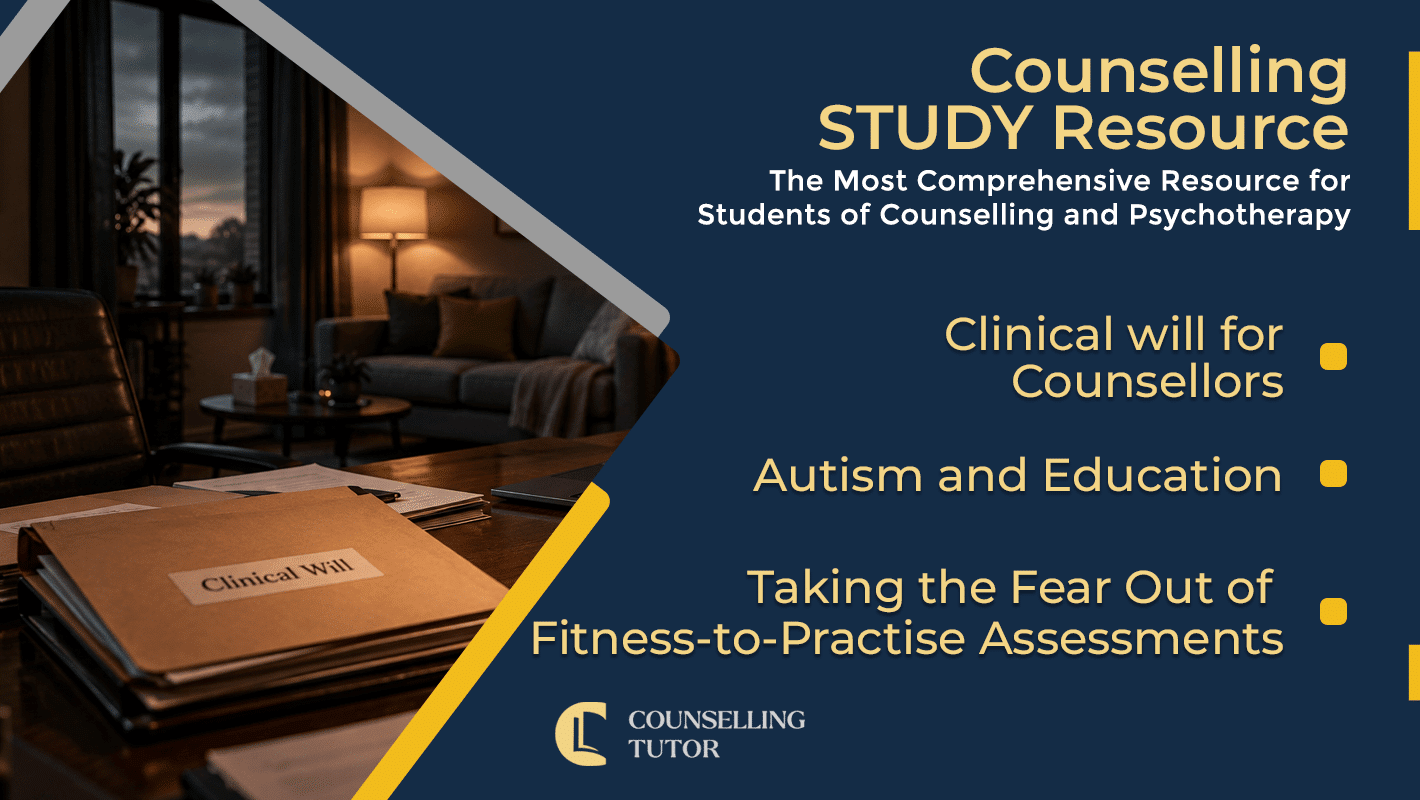
In Episode 383 of the Counselling Tutor Podcast, your hosts Rory Lees-Oakes and Ken Kelly take us through this week’s three topics:

Firstly, in ‘Ethical, Sustainable Practice‘, they explore the clinical will for counsellors — what it is, why it’s becoming mandatory under the new BACP Ethical Framework, and what it should contain.

Then in ‘Practice Matters‘, Rory speaks with Bernie Wright and Denise Corby from Nedde Training about autism and education – exploring the challenges families face and how therapists can support neurodivergent clients and their parents.

And finally, in ‘Student Services‘, Rory and Ken discuss taking the fear out of fitness-to-practise assessments – examining what the assessment involves and how students can ease the anxiety around it.

Download your free Handout: Clinical will for Counsellors

Clinical Will for Counsellors: A New Ethical Requirement [starts at 03:23 mins]

In this section, Rory and Ken explore the clinical will for counsellors — what it is, why it matters, and the new requirement making it mandatory under the BACP Ethical Framework from 3 November 2026.

Key points discussed include:

  • A clinical will names a trusted person to step in if you die or become incapacitated, so that clients can be contacted and records handled properly, and it is not a legal will but covers clinical and professional matters only.
  • From 3 November 2026 the new BACP Ethical Framework makes having a clinical will mandatory, and other bodies including the UKCP, BPS, BPC, and COSCA also require arrangements for supporting clients in the event of illness or death.
  • It is good practice to appoint two executors, a primary and a backup, ideally with clinical experience such as a supervisor or fellow therapist, obtaining their written consent and ensuring they know each other.
  • The document should cover your identity and registration details, where your current client list lives and how to access it securely, each client’s safe contact method and priority, and your records, supervisor, insurer, and referral sources.
  • Financial and digital matters also need attention, including fees owed, prepaid sessions, subscriptions to cancel, your digital footprint, and whether and how the executor is paid, checked against your main legal will.
  • Clinical wills most often fail on out-of-date contact details, so review regularly (some bodies ask for the client list to be refreshed every six months) and make sure executors are properly briefed, hold a full pack, and can access a death certificate.
TherapyLock, an encrypted vault for counsellors and psychotherapists to store session notes and client records

TherapyLock

An encrypted vault for UK counsellors and psychotherapists. Write your session notes, keep client records, and manage appointments in one secure place. Built around UK GDPR and the ethical standards of the counselling profession, by the team behind Counselling Tutor.

See Counselling Skills Used in Real Sessions by Qualified Therapist

Real Sessions – Real Presentations – Real Skills
Gain the competence and confidence to use counselling techniques effectively!

Autism and Education [starts at 30:48 mins]

In this week’s ‘Practice Matters’, Rory speaks with Bernie Wright and Denise Corby from Nedde Training about supporting neurodivergent individuals and their families as they navigate the education system.

Key points from this conversation include:

  • Parents of neurodivergent children often face a blame game, where fighting for support can lead to them being seen as the problem rather than the system being questioned.
  • Long waiting lists for assessment, in some areas two to three years, create gaps in provision because support and funding are often tied to a formal diagnosis or education plan.
  • The effort to secure a diagnosis and appropriate provision can be exhausting and all-consuming for families, and children pick up on the resulting stress within the home.
  • Therapists can help by first offering validation and being seen, listening to the parent’s story, allowing emotion, and countering labels such as ‘hysterical’ that are too often directed at mothers.
  • Practical support matters alongside emotional support, including help with form-filling, signposting to relevant agencies, finding your tribe for strength in numbers, and identifying a trusted person within the school to work with.
  • Working with neurodivergent clients means adapting the environment such as lighting, sound, and scent, and moving beyond automatic taught theory by checking with the client rather than assuming, for example, that fidgeting is calorie-burning rather than stimming.
Ethical AI Practice by Kenneth Kelly

Ethical AI Practice for Counsellors and Psychotherapists in the UK

Kenneth Kelly’s practical framework for counsellors and psychotherapists — navigate AI ethically, protect your clients and practise with clarity.

Counselling Student Library

On-demand access to a rich lecture library covering theory, skills, and professional development for counselling students—Mapped to the UK awarding body criteria

“The Student Library has been BRILLIANT, I can’t recommend it enough!
It has been a lifeline in helping me prepare for practice and my first clients. If you’re considering it, go-for-it, it’s absolutely worth it!”
Kelly – Graduated and now in practice.

Taking the Fear Out of Fitness-to-Practise Assessments [starts at 59:34 mins]

In this section, Rory and Ken discuss the fitness-to-practise assessment and practical ways students can reduce the anxiety that so often surrounds it.

Key points include:

  • A fitness-to-practise assessment is where a tutor observes a student demonstrating counselling skills with a peer and, if satisfied, issues a letter of comfort confirming the student is ready to begin working with clients on placement.
  • It is completely normal to feel very nervous about the assessment, and those nerves often simply show that the student cares about doing well.
  • The best way to reduce anxiety is to treat every skills practice as a mock assessment, so that on the day you are simply doing what you always do.
  • The assessment is more than the live interaction, as students can submit supporting written commentary, for example noting anything they meant to say but forgot in the moment.
  • Tutors want students to pass and are not there to catch them out, and the session does not need to be perfect, only to show competent contracting and engagement.
  • Not passing first time does not mean you are not good enough, as it usually means a single criterion was missed, and the feedback you receive is designed to help you succeed next time.

Free Handout Download Clinical will for Counsellors

Are you thinking about setting up your own private practice?

Download our free guide to help you get started.

Counsellor CPD Library

Get on-demand Certified CPD that is implementable in your practice

  • Over 150 hours of on-demand CPD lectures to help you stay current with your CPD ethical requirements
  • Support, and be supported, by thousands of other counsellors as a member of the exclusive online community.
  • Access your learning anytime you want … anywhere you choose … using any device type — desktop or mobile.

£100 off the WebHealer.net “Do it for me” service

  • WebHealer are the go-to provider of websites for private practitioners in the UK.
  • Established over 20 years, WebHealer offers a non-technical and fully supported service to help therapists grow their private practice.
  • Just one customer from your website each year pays 
for their service.
Use coupon code CT100 Visit webhealer.net