
Online & Telephone Counselling Course – Enrolment Open

386 – Cyber Security for Counsellors

CT Podcast Ep386

Counselling People Living with Dementia – Bringing Counselling Theory and the Client Together

subscribe_itunes button small

In Episode 386 of the Counselling Tutor Podcast, your hosts Rory Lees-Oakes and Ken Kelly take us through this week’s three topics:

Firstly, in ‘Ethical, Sustainable Practice‘, they explore cyber security for counsellors — what happens if your counselling practice is hacked, and the practical steps that protect you, your clients, and your reputation.

Then in ‘Practice Matters‘, Rory speaks with Danuta Lipinska about counselling people living with dementia – and how to offer sensitive, ethical, person-centred support.

And finally, in ‘Student Services‘, Rory and Ken discuss how to bring counselling theory and the client together – and why the work happens in reflection, not in the room.

Download your free Handout: Cyber Security for Counsellors

Cyber Security for Counsellors [starts at 03:28 mins]

In this section, Rory and Ken explore cyber security for counsellors — the growing risk of cyberattacks and data breaches, and the practical measures that help protect a practice.

Key points discussed include:

  • Cyberattacks are now a frequent reality rather than a rare event, with Rory noting recent breaches affecting a nearby airport, a police database, and health records.
  • The 2020 breach of the Finnish psychotherapy company Vastaamo saw the therapy notes of around 33,000 clients accessed, with the attacker later contacting clients directly, and the BBC reporting that at least one person took their own life in a case linked to it.
  • Phishing emails, compromised accounts, and simply sending confidential information to the wrong person are common ways that client data is exposed, so the hosts advise a habit of stopping and thinking before clicking any link.
  • Because counsellors are data controllers under UK GDPR, the liability for a client’s data can remain with the practitioner even when a third-party app or service is the one that is breached.
  • Cyber insurance is separate from professional indemnity insurance, so it is worth checking a policy carefully and asking the insurer to run through what would be covered if a breach occurred.
  • Sensible safeguards include strong and unique passwords, multi-factor authentication, keeping devices and software up to date, secure cloud storage, and regular backups, and the accompanying handout offers a checklist to take to supervision.
TherapyLock, an encrypted vault for counsellors and psychotherapists to store session notes and client records

TherapyLock

An encrypted vault for UK counsellors and psychotherapists. Write your session notes, keep client records, and manage appointments in one secure place. Built around UK GDPR and the ethical standards of the counselling profession, by the team behind Counselling Tutor.

See Counselling Skills Used in Real Sessions by Qualified Therapist

Real Sessions – Real Presentations – Real Skills
Gain the competence and confidence to use counselling techniques effectively!

Counselling People Living with Dementia [starts at 33:59 mins]

In this week’s ‘Practice Matters’, Rory speaks with Danuta Lipinska about counselling people living with dementia and how therapists can move beyond fear to offer respectful, meaningful support.

Key points from this conversation include:

  • A diagnosis of dementia does not mean the curtains close on a person’s life, as the condition usually progresses over many years, and Danuta illustrates this with the author Christine Bryden, who received a PhD long after her young onset diagnosis.
  • Dementia is an umbrella term covering many different types of cognitive change, with Alzheimer’s disease the most common form and vascular dementia the second, each affecting the brain in different ways.
  • The task is to see the person rather than the label, working with what the client brings just as with any other client, and holding to the core conditions of congruence, empathy, and acceptance.
  • Therapists should expect mental capacity unless told otherwise, remembering that capacity is conditional and that someone may lack it for one task while retaining it for a therapeutic conversation.
  • Young onset dementia can affect people under 60, which changes the concerns a client brings, such as work, family, and the future they had imagined.
  • Working sensitively means staying with the emotion when stories are repeated, contracting afresh each session, and being clear with well-meaning relatives that the therapist is not simply a friend.

Person-Centred Counselling for People with Dementia: Making Sense of Self

Danuta Lipinska’s book, Person-Centred Counselling for People with Dementia: Making Sense of Self, shows how the person-centred approach can help clients with dementia hold on to a meaningful sense of who they are. It’s a short, practical read for counsellors, healthcare professionals and families. Find it here.

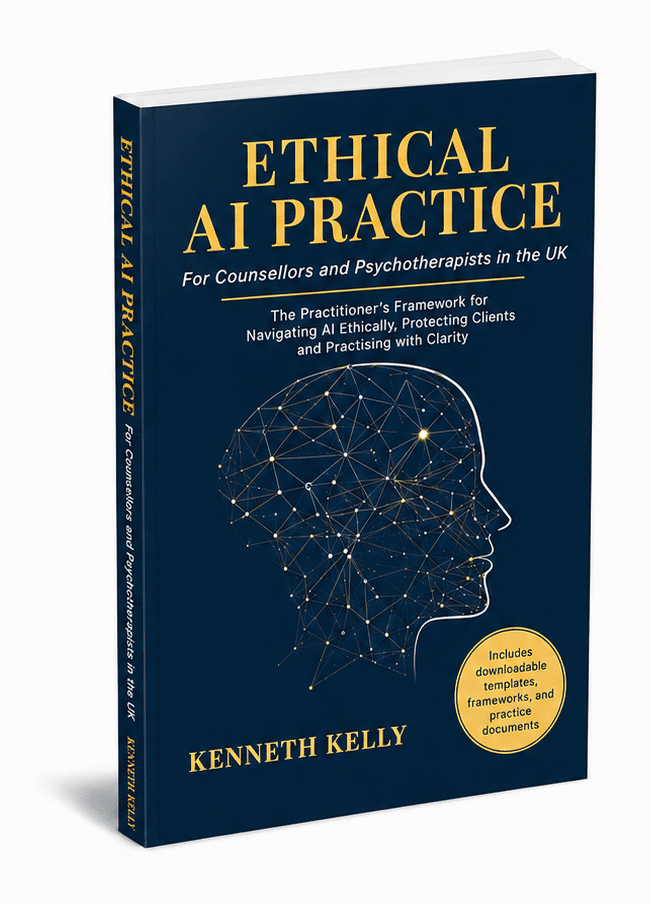
Ethical AI Practice by Kenneth Kelly

Ethical AI Practice for Counsellors and Psychotherapists in the UK

Kenneth Kelly’s practical framework for counsellors and psychotherapists — navigate AI ethically, protect your clients and practise with clarity.

Counselling Student Library

On-demand access to a rich lecture library covering theory, skills, and professional development for counselling students—Mapped to the UK awarding body criteria

“The Student Library has been BRILLIANT, I can’t recommend it enough!
It has been a lifeline in helping me prepare for practice and my first clients. If you’re considering it, go-for-it, it’s absolutely worth it!”
Kelly – Graduated and now in practice.

Bringing Counselling Theory and the Client Together [starts at 01:00:51 mins]

In this section, Rory and Ken discuss how students can connect counselling theory with real client work without trying to apply it live in the room.

Key points include:

  • Theory should not be applied while sitting with a client, because the task in the room is to be a fully present, listening human being rather than a diagnostician.
  • Counselling theory is not universal in the way gravity is, so it will not fit every client, and awarding bodies often ask for several sessions before a client is used as a case study for this reason.
  • Rory notes that Rogers himself developed his theory by recording and analysing many client sessions afterwards, not by applying it in the moment.
  • The place to connect theory and practice is in reflection and in supervision within your own modality, where a good supervisor helps name what happened and puts the mortar between the bricks.
  • With time this becomes unconscious competence, a way of understanding people that quietly informs the work without being consciously applied.
  • Mapping theory to practice belongs in a process journal and in assignments, and Ken points listeners to the Counselling Tutor student library for lectures on understanding theory and linking it to practice.

Free Handout Download Cyber Security for Counsellors

Counsellor CPD Library

Get on-demand Certified CPD that is implementable in your practice

  • Over 150 hours of on-demand CPD lectures to help you stay current with your CPD ethical requirements
  • Support, and be supported, by thousands of other counsellors as a member of the exclusive online community.
  • Access your learning anytime you want … anywhere you choose … using any device type — desktop or mobile.

£100 off the WebHealer.net “Do it for me” service

  • WebHealer are the go-to provider of websites for private practitioners in the UK.
  • Established over 20 years, WebHealer offers a non-technical and fully supported service to help therapists grow their private practice.
  • Just one customer from your website each year pays 
for their service.
Use coupon code CT100 Visit webhealer.net