

Thinking about training as a supervisor? November groups enrolling now.

387 – Choosing a Counselling Supervisor: What Changes in 2026

CT Podcast Ep387

Love in the Therapy Room – Literature Reviews and Making Sense of Counselling Research

subscribe_itunes button small

In Episode 387 of the Counselling Tutor Podcast, your hosts Rory Lees-Oakes and Ken Kelly take us through this week’s three topics:

Firstly, in ‘Ethical, Sustainable Practice‘, they explore choosing a counselling supervisor – what is changing under the 2026 BACP Ethical Framework, and how supervision and competence fit into the new requirements.

Then in ‘Practice Matters‘, Rory speaks with Joseph Harney about love in the therapy room – what therapeutic love is, and how to work with it ethically.

And finally, in ‘Student Services‘, Rory and Ken discuss literature reviews – how to make sense of counselling research.

Download your free Handout: Choosing a Counselling Supervisor: What Changes in 2026

Choosing a Counselling Supervisor: What Changes in 2026 [starts at 03:00 mins]

In this section, Rory and Ken explore choosing a counselling supervisor under the revised BACP Ethical Framework, coming into force in November 2026, and what practitioners now need to confirm about their supervisor.

Key points discussed include:

  • The revised framework, in force from 3 November 2026, keeps the long-standing requirement for adequate supervision but adds that practitioners must confirm their supervisor has the necessary qualifications, experience and competence under the BACP supervision framework.
  • This is described as a prescriptive core responsibility rather than a “would be nice”, marking a significant step change from the earlier framework.
  • Supervision is treated as a distinct role from being a therapist, with its own theory, ethics, processes and competencies set out in the BACP supervision competence framework.
  • Specialist areas of practice such as working with children and young people, trauma, neurodivergence, and online and telephone working may call for a supervisor with matching competence in that area.
  • A supervisor does not need to be an expert in everything, but should recognise the limits of their competence and know when additional consultation, CPD or specialist supervision is needed.
  • The responsibility for confirming a supervisor’s qualifications sits with the practitioner, and a supervisor does not have to be a member of the BACP as long as they have trained within a recognised framework.
TherapyLock, an encrypted vault for counsellors and psychotherapists to store session notes and client records

TherapyLock

An encrypted vault for UK counsellors and psychotherapists. Write your session notes, keep client records, and manage appointments in one secure place. Built around UK GDPR and the ethical standards of the counselling profession, by the team behind Counselling Tutor.

See Counselling Skills Used in Real Sessions by Qualified Therapist

Real Sessions – Real Presentations – Real Skills
Gain the competence and confidence to use counselling techniques effectively!

Love in the Therapy Room [starts at 28:41 mins]

In this week’s ‘Practice Matters’, Rory speaks with Joseph Harney about therapeutic love, what it means, and how therapists can recognise and work with it in an ethical, helpful and culturally attuned way.

Key points from this conversation include:

  • Joseph offers a working definition of therapeutic love as strong, emergent or enduring positive feelings for clients that go beyond routine care.
  • Drawing on Erich Fromm’s The Art of Loving, he separates the forms of love that are ethically off limits, such as sexual, erotic or romantic feelings, from those that remain appropriate, including humanistic, spiritual and parental forms.
  • Rory offers the metaphor of a “heater of love”, where the warmth a therapist brings can be turned up or down depending on the client’s attachment style and where they are in the arc of therapy.
  • Joseph links this to the pluralistic idea of the “authentic chameleon”, attributed to Lazarus, where the therapist responds genuinely to the client’s needs in the moment.
  • On whether a therapist should ever tell a client they love them, Joseph concludes that for the most part the answer is no, because of the risk of misunderstanding and blurred ethical boundaries.
  • Both agree that feelings of therapeutic love are better explored through countertransference and supervision than expressed directly to the client.
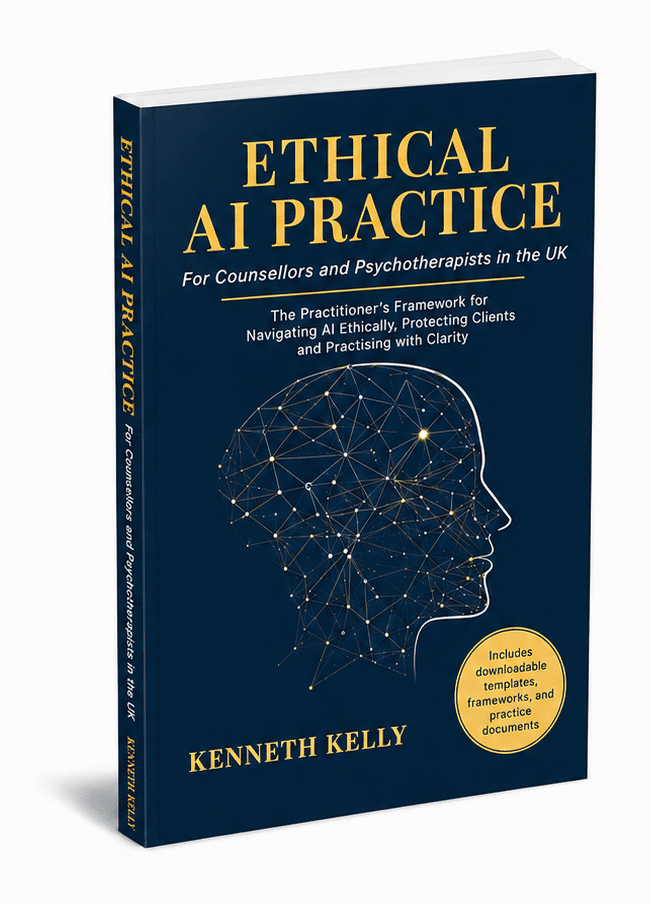
Ethical AI Practice by Kenneth Kelly

Ethical AI Practice for Counsellors and Psychotherapists in the UK

Kenneth Kelly’s practical framework for counsellors and psychotherapists — navigate AI ethically, protect your clients and practise with clarity.

Counselling Student Library

On-demand access to a rich lecture library covering theory, skills, and professional development for counselling students—Mapped to the UK awarding body criteria

“The Student Library has been BRILLIANT, I can’t recommend it enough!
It has been a lifeline in helping me prepare for practice and my first clients. If you’re considering it, go-for-it, it’s absolutely worth it!”
Kelly – Graduated and now in practice.

Literature Reviews and Making Sense of Counselling Research [starts at 53:53 mins]

In this section, Rory and Ken discuss literature reviews and why engaging with research is such an important part of a developing profession.

Key points include:

  • A literature review is described as having a conversation with existing research before adding your own voice, asking what we already know, how we know it, and what still needs exploring.
  • It helps identify important theories and debates, compare findings, evaluate the strengths and limitations of existing research, spot gaps in knowledge, and show why a research question is worth investigating.
  • The depth and scale of research grows with the level of study, from the small research project of a diploma through to the deeper work of a degree, master’s or PhD.
  • Research is an ongoing, evolving conversation, where published findings are critiqued, defended and built upon rather than treated as the final word.
  • Critique is presented as what makes academia robust, with examples of past research being pulled apart over small or biased samples and even fabricated data.
  • A useful question when weighing any research is who funded it and what their motivation might have been, illustrated by mid-century research promoting cigarettes.

Struggling with a counselling literature review?

Professor Mick Cooper shares the correct way to approach one in counselling and psychotherapy assignments. Watch it here: How to write a counselling literature review – with Professor Mick Cooper

Free Handout Download Choosing a Counselling Supervisor: What Changes in 2026

Counsellor CPD Library

Get on-demand Certified CPD that is implementable in your practice

  • Over 150 hours of on-demand CPD lectures to help you stay current with your CPD ethical requirements
  • Support, and be supported, by thousands of other counsellors as a member of the exclusive online community.
  • Access your learning anytime you want … anywhere you choose … using any device type — desktop or mobile.

£100 off the WebHealer.net “Do it for me” service

  • WebHealer are the go-to provider of websites for private practitioners in the UK.
  • Established over 20 years, WebHealer offers a non-technical and fully supported service to help therapists grow their private practice.
  • Just one customer from your website each year pays 
for their service.
Use coupon code CT100 Visit webhealer.net