
Thinking about training as a supervisor? November groups enrolling now.

388 – The Digital Counselling Room

CT Podcast Ep388

The Ross Neurodiversity Integration Framework – Managing Emotional Overload in Counselling Training

subscribe_itunes button small

In Episode 388 of the Counselling Tutor Podcast, your hosts Rory Lees-Oakes and Ken Kelly take us through this week’s three topics:

Firstly, in ‘Ethical, Sustainable Practice‘, they explore the digital counselling room – confidentiality and data security in a connected, digital world.

Then in ‘Practice Matters‘, Rory speaks with Bianca Marie Ross about the Ross Neurodiversity Integration Framework – bridging the gap between insight in therapy and real-world change for neurodivergent clients.

And finally, in ‘Student Services‘, Rory and Ken discuss managing emotional overload in counselling training – the emotional journey of personal development and how to stay grounded through it.

Download your free Handout: The Digital Counselling Room

The Digital Counselling Room [starts at 03:28 mins]

In this section, Rory and Ken explore confidentiality in the digital counselling room – what it now means in a connected age, and the practical steps practitioners can take to protect client information across the many places it is stored.

Key points discussed include:

  • Where setting up a counselling room once meant checking the walls, windows and a locked filing cabinet, client information now lives across email, phones, text messages, calendars, notes, invoices, video platforms, cloud backups and AI transcription tools.
  • A useful exercise is to carry out a digital audit of your practice, imagining following a client through each of your digital systems to see everywhere their information is held.
  • Every practitioner needs a catastrophe plan for what happens if a phone, tablet or laptop is lost, stolen or broken, including how client records would still be accessed and how a device could be wiped.
  • Strong passwords, two-factor or multi-factor authentication, automatic screen locks, and awareness of who else can access a shared family device are straightforward ways to reduce the risk of a breach.
  • Encryption matters because it means that even if data is accessed, it cannot be read without the key, and the hosts note that most breaches come from everyday human error rather than hackers.
  • Thought should be given to email subject lines and lock-screen notifications, to what clients are told in the contract about how you communicate, and to practice point 55 of the new BACP ethical framework on protecting client information.
TherapyLock, an encrypted vault for counsellors and psychotherapists to store session notes and client records

TherapyLock

An encrypted vault for UK counsellors and psychotherapists. Write your session notes, keep client records, and manage appointments in one secure place. Built around UK GDPR and the ethical standards of the counselling profession, by the team behind Counselling Tutor.

See Counselling Skills Used in Real Sessions by Qualified Therapist

Real Sessions – Real Presentations – Real Skills
Gain the competence and confidence to use counselling techniques effectively!

The Ross Neurodiversity Integration Framework [starts at 26:28 mins]

In this week’s ‘Practice Matters’, Rory speaks with Bianca Marie Ross about the Ross Neurodiversity Integration Framework and her book on bridging the gap between insight in therapy and real-world change for neurodivergent clients.

Key points from this conversation include:

  • Bianca describes an integration gap, the space between what a client understands about themselves in therapy and what they can actually put into practice in everyday life.
  • The framework grew from a neurodivergent client who reached a place of insight after more than a year of work but felt nothing had actually changed, prompting Bianca to add elements of coaching to support real-world change.
  • The RNIF is a nine-pillar, circular structure that sits on top of a practitioner’s existing modality and training, allowing clients to return to the centre and revisit earlier pillars as their capacity changes.
  • A core value of the framework is context before character, looking at what is getting in a client’s way rather than assuming they are unmotivated, resistant or not trying hard enough.
  • Many difficulties come from reduced capacity, masking, executive functioning demands and sensory overload, so the problem is often the environment rather than the person.
  • The model extends counselling boundaries in structured ways with workbook templates, plans for relapse without shame, and support such as advocating alongside clients, so that a therapy ending is not the same as a support ending.
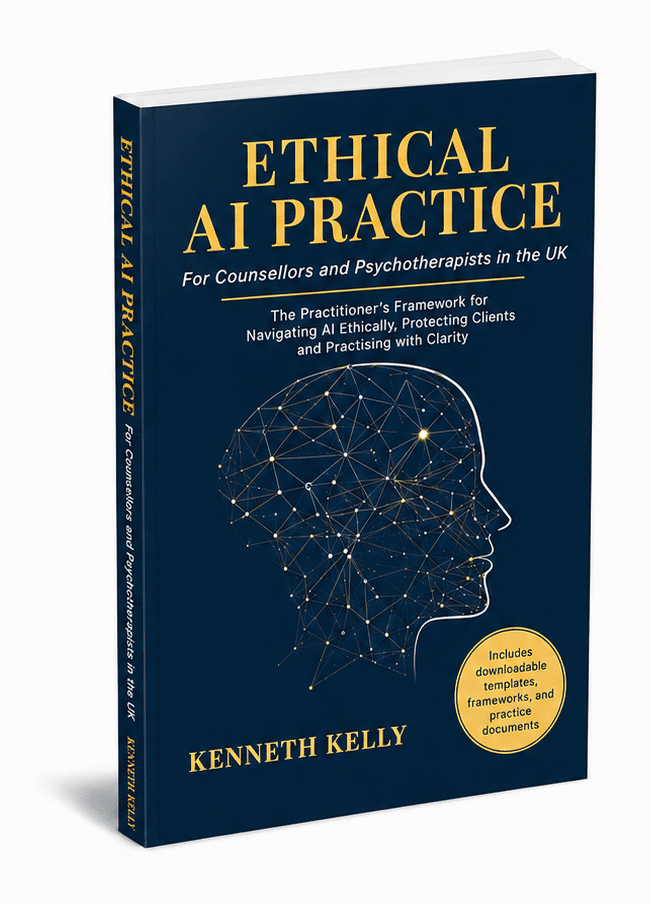
Ethical AI Practice by Kenneth Kelly

Ethical AI Practice for Counsellors and Psychotherapists in the UK

Kenneth Kelly’s practical framework for counsellors and psychotherapists — navigate AI ethically, protect your clients and practise with clarity.

Counselling Student Library

On-demand access to a rich lecture library covering theory, skills, and professional development for counselling students—Mapped to the UK awarding body criteria

“The Student Library has been BRILLIANT, I can’t recommend it enough!
It has been a lifeline in helping me prepare for practice and my first clients. If you’re considering it, go-for-it, it’s absolutely worth it!”
Kelly – Graduated and now in practice.

Managing Emotional Overload in Counselling Training [starts at 52:09 mins]

In this section, Rory and Ken discuss the emotional overload that can arise during counselling training and the strategies that help students stay grounded through the personal development journey.

Key points include:

  • The biggest change in training is to the self, and for some students that process can feel overwhelming or even life-changing as they delve deeply into their own material.
  • Emotional overload is to be expected and should be normalised, as it affects many trainees even though it does not happen to everyone, and it can become a powerful moment of growth.
  • Training can affect life outside the course, including relationships, friendships and work, as students change and grow while those around them may not.
  • Both hosts share how their own training led them to leave careers that no longer felt congruent with their true selves, reassuring listeners that such upheaval is a common part of becoming.
  • Helpful strategies include diversifying your identity beyond counselling, building in decompression time after intense sessions, and learning what recharges and re-energises you.
  • Shining a light on difficult emotions in skills sessions, personal development groups or personal therapy can take away their power, and journaling offers both relief in the moment and valuable material for later personal development assignments.

Free Handout Download The Digital Counselling Room

Counsellor CPD Library

Get on-demand Certified CPD that is implementable in your practice

  • Over 150 hours of on-demand CPD lectures to help you stay current with your CPD ethical requirements
  • Support, and be supported, by thousands of other counsellors as a member of the exclusive online community.
  • Access your learning anytime you want … anywhere you choose … using any device type — desktop or mobile.

£100 off the WebHealer.net “Do it for me” service

  • WebHealer are the go-to provider of websites for private practitioners in the UK.
  • Established over 20 years, WebHealer offers a non-technical and fully supported service to help therapists grow their private practice.
  • Just one customer from your website each year pays 
for their service.
Use coupon code CT100 Visit webhealer.net