
Thinking about training as a supervisor in 2027?

390 – Counselling CPD: Why Current Ethical Standards Matter

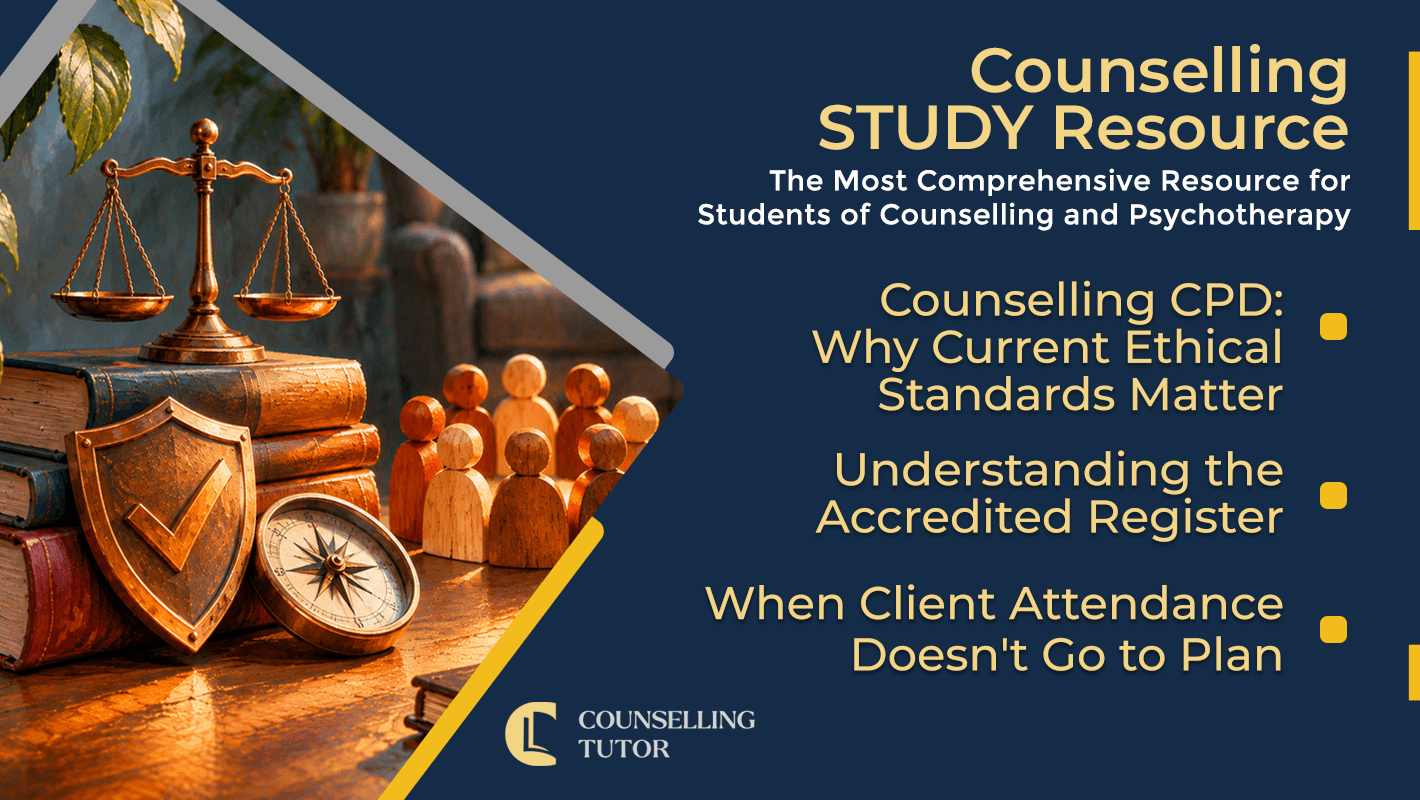
CT Podcast Ep390 featured image: Topics Discussed: Counselling CPD: Why Current Ethical Standards Matter - Understanding the Accredited Register - When Client Attendance Doesn't Go to Plan

Understanding the Accredited Register – When Client Attendance Doesn’t Go to Plan

subscribe_itunes button small

In Episode 390 of the Counselling Tutor Podcast, your hosts Rory Lees-Oakes and Ken Kelly take us through this week’s three topics:

Firstly, in ‘Ethical, Sustainable Practice’, they explore counselling CPD – why current ethical standards matter, and why training and professional standards can no longer be separated.

Then in ‘Practice Matters‘, Rory speaks with Meg Moss about the accredited register – what it is, who oversees it, and why it matters to the public.

And finally, in ‘Student Services‘, Rory and Ken discuss what to do when client attendance doesn’t go to plan – managing no-shows and the feelings they bring up.

Download your free Handout: Counselling CPD: Why Current Ethical Standards Matter

Counselling CPD: Why Current Ethical Standards Matter [starts at 02:36 mins]

In this section, Rory and Ken explore counselling CPD – why current ethical standards matter and now sit at the heart of professional development, and how they should be woven into training rather than treated as a separate add-on.

Key points discussed include:

  • Ethical frameworks have shifted from being documents of reference to documents of action, with the latest BACP framework asking practitioners to actively do something rather than simply read guidance.
  • Collaboration is now central to ethical practice, which means clients should be within decision-making wherever possible and the six-question model of ethical problem solving is likely to be used across the profession.
  • CPD is no longer a box-ticking exercise to evidence a set number of hours, but a way to enrich practice, work at a deeper level, and bring the latest research, law, and guidance into the room.
  • Training providers carry a responsibility to bake current ethical standards, legislation, up-to-date research, and clear competence frameworks into their courses rather than bolting ethics on separately.
  • Good training should be honest about the limitations of a qualification and should encourage critical thinking, reflection, and the development of professional judgment, sometimes known as wisdom.
  • Ultimately the responsibility sits with the individual practitioner, and Rory’s free handout includes an ‘Is My Training Up to Date?’ checklist and five questions to ask before enrolling on any course.
TherapyLock, an encrypted vault for counsellors and psychotherapists to store session notes and client records

TherapyLock

An encrypted vault for UK counsellors and psychotherapists. Write your session notes, keep client records, and manage appointments in one secure place. Built around UK GDPR and the ethical standards of the counselling profession, by the team behind Counselling Tutor.

See Counselling Skills Used in Real Sessions by Qualified Therapist

Real Sessions – Real Presentations – Real Skills
Gain the competence and confidence to use counselling techniques effectively!

Understanding the Accredited Register [starts at 25:50 mins]

In this week’s ‘Practice Matters’, Rory speaks with Meg Moss about what a PSA accredited register is, how it protects the public, and why the quality mark matters when clients are choosing a therapist.

Key points from this conversation include:

  • The Accredited Register programme began in 2012 and is a form of right-touch, voluntary regulation covering health and care roles, including counselling, that are not statutorily regulated.
  • The PSA accredits the register or organisation rather than the individual, so bodies like the NCPS must meet standards on conduct, competence, and complaints to hold the quality mark.
  • A key public protection feature is that someone removed from one accredited register cannot simply hop to another, closing a loophole that once allowed people to move between bodies.
  • Being on an accredited register signals that a practitioner’s training has been checked, with a minimum of two years of study, at least 100 hours of placement, ongoing supervision, 30 hours of annual CPD, and valid insurance.
  • From July 2026 the standards for accredited registers and statutory regulators became fully aligned, so the two now work to the same requirements.
  • The NHS now recognises the PSA accredited register, meaning NCPS membership and other accredited bodies are acceptable for NHS counselling and psychotherapy roles where a single body was once specified.

Ethical AI Practice by Kenneth Kelly

Ethical AI Practice for Counsellors and Psychotherapists in the UK

Kenneth Kelly’s practical framework for counsellors and psychotherapists — navigate AI ethically, protect your clients and practise with clarity.

Counselling Student Library

On-demand access to a rich lecture library covering theory, skills, and professional development for counselling students—Mapped to the UK awarding body criteria

“The Student Library has been BRILLIANT, I can’t recommend it enough!
It has been a lifeline in helping me prepare for practice and my first clients. If you’re considering it, go-for-it, it’s absolutely worth it!”
Kelly – Graduated and now in practice.

When Client Attendance Doesn’t Go to Plan [starts at 55:24 mins]

In this section, Rory and Ken discuss the reality of no-shows and did-not-attends in placement, why they happen, and how students can manage both their hours and their feelings.

Key points include:

  • Missed appointments are a normal part of practice rather than a personal failing, and they tend to be more common in free or low-cost placement settings where clients have less invested.
  • Rory describes how a practice manager cut referrals by half by introducing a two-week wait before allocating a counsellor, which left those who still wanted therapy more likely to attend.
  • Much of what stops clients attending sits outside the room, which Rory links to Michael Lambert’s common factors and the large share attributed to client extra-therapeutic factors.
  • Students can use unexpected gaps constructively by writing assignments, reading, reviewing lectures, doing CPD, or listening to the podcast rather than sitting idle.
  • A compassionate stance helps, since reaching out and attending can be genuinely difficult for clients facing anxiety, transport, childcare, cost, or ill health.
  • No-shows are valuable personal development material, worth noticing, sitting with, and bringing to professional discussion rather than taking personally.

Free Handout Download Counselling CPD: Why Current Ethical Standards Matter

Counsellor CPD Library

Get on-demand Certified CPD that is implementable in your practice

  • Over 150 hours of on-demand CPD lectures to help you stay current with your CPD ethical requirements
  • Support, and be supported, by thousands of other counsellors as a member of the exclusive online community.
  • Access your learning anytime you want … anywhere you choose … using any device type — desktop or mobile.

£100 off the WebHealer.net “Do it for me” service

  • WebHealer are the go-to provider of websites for private practitioners in the UK.
  • Established over 20 years, WebHealer offers a non-technical and fully supported service to help therapists grow their private practice.
  • Just one customer from your website each year pays 
for their service.
Use coupon code CT100 Visit webhealer.net