Online and Telephone Counselling Course – Enrolment OPEN

364 – Will AI Replace Counsellors and Psychotherapists?

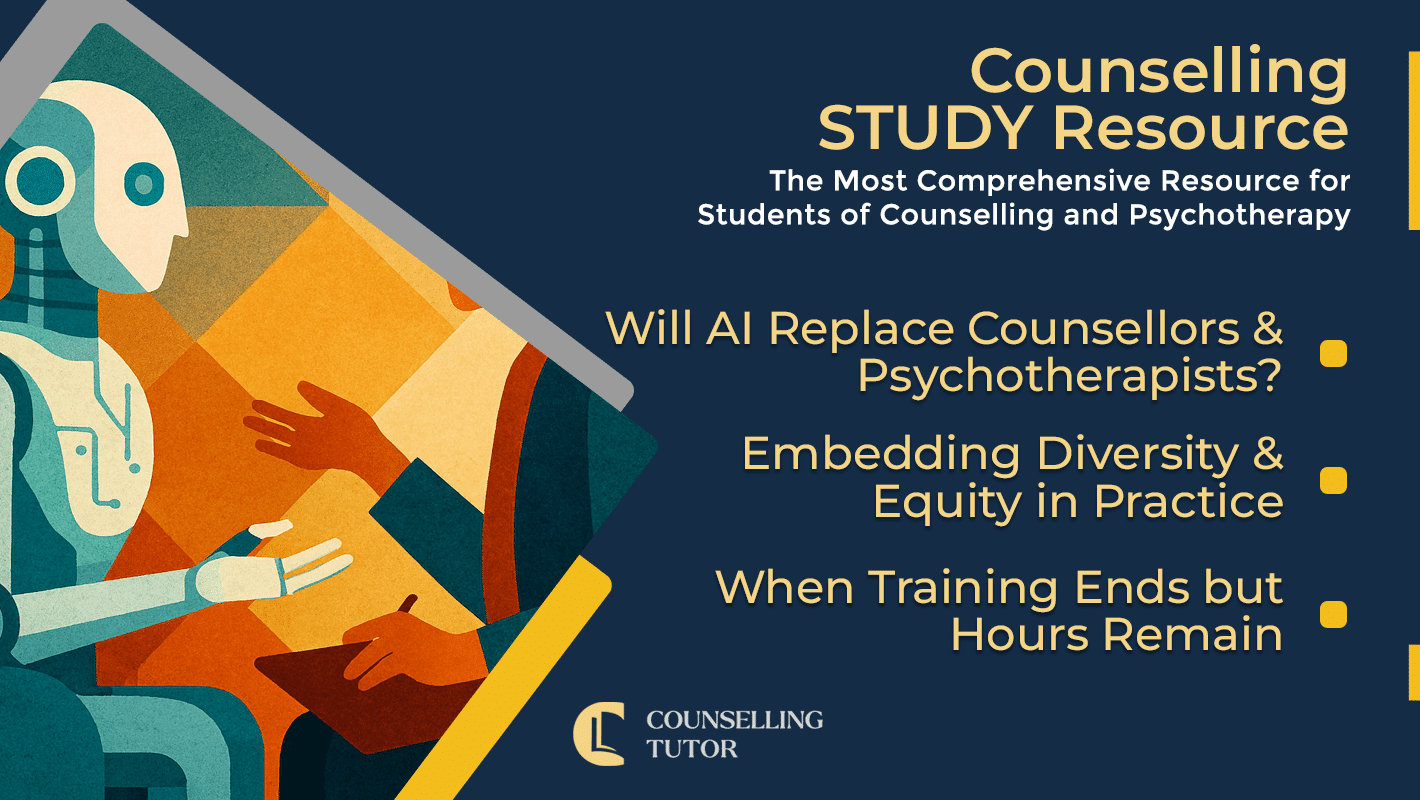
CT Podcast Ep364 featured image - Topics Discussed: Will AI Replace Counsellors and Psychotherapists? - Embedding Diversity and Equity in Practice - When Training Ends but Hours Remain

Embedding Diversity and Equity in Practice – When Training Ends but Hours Remain

subscribe_itunes button small

In Episode 364 of the Counselling Tutor Podcast, your hosts Rory Lees-Oakes and Ken Kelly take us through this week’s three topics:

Firstly, in ‘Ethical, Sustainable Practice’, we explore the question ‘Will AI Replace Counsellors and Psychotherapists?, examining how AI is currently used in mental health care and what this might mean for the future of the profession.

Then in ‘Practice Matters’, Rory speaks with Mamood Ahmad about his newly published book A New Introduction to Counselling and Psychotherapy, which calls for embedding diversity, equity, and context at the heart of practice.

And finally, in ‘Student Services’, Rory and Ken explore what happens when your counselling course ends but your placement hours are incomplete – offering guidance on how to stay motivated and complete the journey.

Download your free Handout: AI and Therapy

Will AI Replace Counsellors and Psychotherapists? [starts at 03:33 mins]

In this section, Rory and Ken explore the question ‘Will AI Replace Counsellors and Psychotherapists?’, addressing a growing concern about whether artificial intelligence could one day replace human therapists.

Key points discussed include:

  • AI is already being used to support mental health in areas such as assessment, triage, and CBT-based coaching, but not as a replacement for human connection.
  • The therapeutic relationship – empathy, intuition, and shared presence – remains central and cannot be replicated by machines.
  • AI can be used ethically by counsellors to streamline tasks, improve assessments, and support practice without replacing core therapeutic roles.
  • The rise of AI highlights the importance of counsellors developing digital literacy and understanding the ethical use of technology.
  • Future therapists will benefit from embracing AI as a tool rather than fearing it as a threat.
  • As job displacement due to AI increases in other sectors, therapists may become key support figures for those affected by these societal shifts.

See Counselling Skills Used in Real Sessions by Qualified Therapist

Real Sessions – Real Presentations – Real Skills
Gain the competence and confidence to use counselling techniques effectively!

Embedding Diversity and Equity in Practice [starts at 33:12 mins]

In this week’s ‘Practice Matters’, Rory speaks with Mamood Ahmad about his latest book, A New Introduction to Counselling and Psychotherapy and the need for systemic change in training and practice to include equity, context, and diversity as core elements.

Key points from this conversation include:

  • Traditional counselling models often overlook the contextual, cultural, and systemic influences on mental health.
  • Mahmoud proposes a new baseline model where diversity, embodiment, and lived experience are embedded – not treated as optional extras.
  • This approach enriches practice for all, recognising that every client (and therapist) brings their own cultural, social, and personal history into the room.
  • Therapists must reflect on their own normativity and differences to meet clients with authenticity and depth.
  • The book acts as a manifesto for change, advocating for a curriculum that prepares therapists for real-world complexity and inclusivity.
  • It is relevant to both trainees and qualified practitioners committed to ethical and effective practice.

Counselling Student Library

On-demand access to a rich lecture library covering theory, skills, and professional development for counselling students—Mapped to the UK awarding body criteria

“The Student Library has been BRILLIANT, I can’t recommend it enough!
It has been a lifeline in helping me prepare for practice and my first clients. If you’re considering it, go-for-it, it’s absolutely worth it!”
Kelly – Graduated and now in practice.

When Training Ends but Hours Remain [starts at 59:05 mins]

In this section, Rory and Ken discuss the common situation where a counselling course finishes, but a student still has placement hours outstanding.

Key points include:

  • It is common – and perfectly acceptable – for trainees to need extra time post-course to complete their client hours.
  • Knowing the deadline and formal policy of your training provider is essential; always get this information in writing.
  • Motivation can drop sharply after training ends, so it’s important to build support networks through placements, peer groups, supervisors, or online forums.
  • Visual motivators (like hour tokens in a jar) can help sustain momentum during this post-course phase.
  • Stay engaged with CPD and peer connection to keep your confidence and learning alive.
  • Remember: this is just one part of your journey, and with steady effort, the finish line is within reach.

Free Handout Download

AI and Therapy

Counsellor CPD Library

Get on-demand Certified CPD that is implementable in your practice

  • Over 150 hours of on-demand CPD lectures to help you stay current with your CPD ethical requirements
  • Support, and be supported, by thousands of other counsellors as a member of the exclusive online community.
  • Access your learning anytime you want … anywhere you choose … using any device type — desktop or mobile.

£100 off the WebHealer.net “Do it for me” service

  • WebHealer are the go-to provider of websites for private practitioners in the UK.
  • Established over 20 years, WebHealer offers a non-technical and fully supported service to help therapists grow their private practice.
  • Just one customer from your website each year pays 
for their service.
Use coupon code CT100 Visit webhealer.net