Your Free Private Practice Setup Checklist
A 7-step checklist covering everything you need to set up your private practice – registration, insurance, tax, data protection, premises, finding clients and supervision. Tick it off as you go.
Qualifying as a counsellor and setting up a private counselling practice are two different achievements. Once your training ends, the questions turn practical. How do you register? Do you need insurance? What do you have to tell HMRC? Where will you see clients, and how will they find you? These questions come up again and again from newly qualified practitioners, and they rarely get answered all in one place.
This guide brings the essentials together for practitioners working in the UK. It walks through the decisions you face when you go into private practice: professional registration, choosing a business structure, tax and record-keeping, insurance, where you work, setting your fees, protecting client data, and finding your first clients. Each section points to a more detailed resource where one exists, so you can go deeper on the parts that matter most to you.
One thing shapes everything that follows. Counselling and psychotherapy are not regulated by law in the UK. There is no single licence you apply for and no statutory body that signs you off. Instead, responsibility for practising safely and accountably rests with you and with the professional body whose register you join. That freedom is genuine, and so is the obligation that comes with it.
After reading this article, you will be able to:
A 7-step checklist covering everything you need to set up your private practice – registration, insurance, tax, data protection, premises, finding clients and supervision. Tick it off as you go.
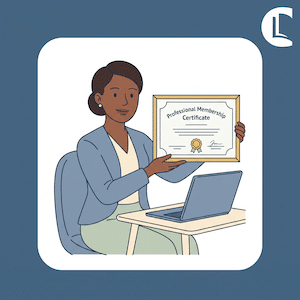
Readiness is partly about training and practice hours, and partly about membership. Because there is no statutory register for counsellors in the UK, the public are guided instead towards registers accredited by the Professional Standards Authority (PSA). The PSA accredits registers for professions that are not regulated by law, as a way of assuring the public that a register is well run and holds its members to recognised standards. Joining one of these registers is how you show clients, and other professionals, that you meet those standards.
The two largest accredited registers for counsellors are held by the British Association for Counselling and Psychotherapy (BACP) and the National Counselling and Psychotherapy Society (NCPS). Both registers are PSA-accredited, and membership of one of them is often required for listing on the major client-facing directories.
For BACP, the main category for a practising counsellor is Registered Member MBACP. You qualify for it by graduating from a BACP-accredited course, or by passing BACP’s Certificate of Proficiency, a standardised assessment of the knowledge and skills expected of a professional counsellor. All practising members must either be registered or working towards registration. Registration gives you a free listing on the BACP Register of Counsellors and Psychotherapists.
Accreditation is a further, voluntary step that shows your practice meets the standards of Column B of BACP’s SCoPEd framework, which maps competences across registered, accredited and senior accredited membership. Since February 2026 there are several accreditation routes, and the exact criteria depend on the route you take. In general they involve substantial supervised practice built up over a number of years and an ongoing, regular supervision arrangement. Many practitioners register first and work towards accreditation later.
NCPS offers registrant categories that rise from Accredited Registrant, through Accredited Professional Registrant, to Senior Accredited Registrant, with training, supervised-practice and CPD requirements increasing at each level. Being a registrant means being listed on the NCPS Accredited Register, which the PSA has assessed against its standards for qualifications, supervision, insurance and complaints handling.
Most counsellors starting out set up as a sole trader. It is the simplest structure to establish and to keep records for, and you can begin trading straight away. The trade-off is unlimited liability, meaning you are personally responsible for any debts the business runs up.
A limited company is the main alternative. Its owners have limited liability, so they are responsible for business debts only up to the value of what they have put in. That protection comes with more administration: you register the company at Companies House before trading, the company pays Corporation Tax on its profits, and you file annual accounts. Even if you hire an accountant, you remain legally responsible for the company’s records and returns. For a solo practitioner seeing clients, the sole trader route is usually the natural starting point, and you can always change structure later as your practice grows.
Whichever you choose, put your numbers on paper first. Our podcast episode on making a counselling business plan walks through the basics.
As soon as your practice earns more than a small tax-free trading allowance, you need to register with HMRC and declare your income. Most counsellors do this as a sole trader through Self Assessment. You can start seeing clients before you register, but there are deadlines both for telling HMRC and for filing your return, so register in good time to avoid a penalty.
Through Self Assessment you pay Income Tax and National Insurance on your profits, meaning your income after allowable business expenses. Tax rates, thresholds and allowances change from year to year, often at the government’s Budget, so rather than rely on a figure here, check the current rates, allowances and deadlines on GOV.UK before you file. If numbers are not your strength, many practitioners work with an accountant, especially in their first year.
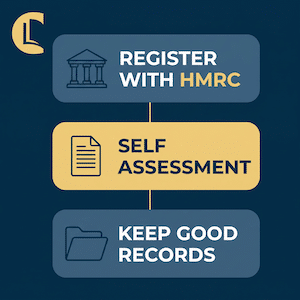
Keep records of your business income and expenses, with supporting evidence such as invoices and bank statements, and keep them for the minimum period HMRC requires. VAT is unlikely to affect you early on, as it only applies once your turnover reaches a fairly high threshold. If you do reach that point, counselling and psychotherapy are standard-rated rather than exempt, because these professions are not held on a statutory register. Our podcast episode on tax for therapists covers day-to-day record-keeping in more detail.
Both BACP and NCPS require their members to hold current professional indemnity insurance, and you will need to confirm you have it when you join and at any audit of your practice. In private practice you arrange this cover yourself rather than relying on an employer’s policy.
Professional indemnity and public liability are not the same thing. Professional indemnity covers you if a client claims you were negligent in your work. Public liability, or third-party cover, deals with something different, such as a client being injured while visiting your premises. If clients will come to a room you work from, check whether you need both. Our podcast episode on insurance for counsellors talks through the options.
Two options are common when starting out: working from home, or renting a room. Each carries practical and legal considerations.

If you plan to see clients at home, check your position first. You may need permission from your mortgage provider or landlord to run a business from the property. You might have to pay business rates on the part of your home used for the business, particularly if you have adapted a room specifically for client work or receive clients there, and the Valuation Office Agency can confirm whether this applies. Standard home insurance often does not cover business use or visitors coming for appointments, so confirm what your policy allows and arrange additional cover if you need it. Our podcast episode on counselling from home explores the day-to-day realities.
Renting gives you a clearer boundary between work and home. When you compare rooms, weigh up cost against your expected number of clients, how easy the location is to reach by public transport or car, step-free access for clients with mobility needs, and whether the space keeps conversations genuinely private. Our podcast episode on how to set up a therapy room covers what to look for.
Seeing clients on your own brings a lone-working responsibility. The Health and Safety Executive’s guidance on protecting lone workers applies to self-employed people, and asks you to think through and manage any risks before you work alone, including how you stay in contact and how you handle the possibility of aggression. A simple check-in arrangement and a considered approach to your first meetings with new clients go a long way.
Deciding what to charge is one of the parts of private practice that new counsellors find hardest. A fee has to be sustainable for you, cover your costs, and sit sensibly alongside what others in your area charge. Looking at local rates gives you a realistic range to work within.
Many practitioners also decide in advance how they will handle lower-income clients, whether through a small number of reduced-fee or sliding-scale places, and set out a clear cancellation policy from the start. Being able to talk about money openly, without apology, is part of the work. Our podcast episode on discussing payment with therapy clients looks at how to have those conversations, and a counselling business plan helps you see whether your fees add up over a year.
A clear working agreement underpins ethical practice. Your contract with each client sets out practical arrangements and the limits of confidentiality, so both of you understand what is agreed before the work begins.
Data protection sits alongside this. As soon as you hold personal information about clients, you are a data controller under UK GDPR and the Data Protection Act 2018. Client records count as special category data, the sensitive category that needs more protection, so you must identify a lawful basis for holding it and apply a high level of security. The ICO sets out seven principles for handling personal data: lawfulness, fairness and transparency; purpose limitation; data minimisation; accuracy; storage limitation; integrity and confidentiality; and accountability. Our podcast episode on GDPR for therapists translates these into everyday habits.
Most organisations that process personal data must pay an annual data protection fee to the ICO unless they qualify for an exemption. Keeping client records electronically usually means the fee applies. The amount depends on the size of your practice, and most small practices fall into the lowest tier. The ICO provides a short self-assessment to check whether you need to pay, how much the current fee is, and whether an exemption applies. Complete it before you see your first client.
The framework is being updated by the Data (Use and Access) Act 2025, which amends parts of UK GDPR and the Data Protection Act 2018. You can read what it means for counsellors in our guide to the Data (Use and Access) Act 2025.
A practice needs clients, and most start to arrive through a mix of directories, an online presence and referrals. None of these works on its own, and it usually takes time for a caseload to build.
Directories are where many clients begin their search. The main options for UK practitioners are:
A simple, clear website lets clients find you directly and see whether you might be a good fit before they make contact. Our podcast episodes on building a therapist website and SEO for therapy websites cover how to set one up and help the right people find it.
Word of mouth remains one of the strongest sources of new clients. Building relationships with GPs, other therapists, local organisations and former clients who recommend you tends to grow steadily over time, and often becomes the mainstay of an established practice.
Supervision is a requirement of staying on an accredited register, not an optional extra. BACP and NCPS both expect practitioners to have regular, ongoing supervision, and set out a minimum monthly commitment for accredited or registered practice. Check your professional body’s current guidance for the exact amount expected of you, and your supervisor will confirm your arrangements at audit.
Beyond meeting the requirement, good-quality supervision protects both your clients and you. Private practice can be isolating, and the financial pressure to keep taking clients can quietly push a caseload beyond what is sustainable. Paying attention to your own wellbeing from the start is part of practising responsibly, and our guide to burnout in counselling looks at how to protect your practice over the long term.
A 7-step checklist covering everything you need to set up your private practice – registration, insurance, tax, data protection, premises, finding clients and supervision. Tick it off as you go.
Counselling is not regulated by law, so there is no legal requirement to register. In practice, though, membership of a PSA-accredited register such as BACP or NCPS is expected: it reassures clients, is usually required to list on directories, and comes with obligations like holding insurance. Accreditation is a further, optional step you can work towards later.
Yes, once your income passes the small tax-free trading allowance. You register with HMRC as a sole trader and declare your income through Self Assessment, paying Income Tax and National Insurance on your profits. There are deadlines for registering and for filing, so check the current dates and rates on GOV.UK and register in good time.
Yes. Both BACP and NCPS require members to hold current professional indemnity insurance, which covers claims of negligence. If clients visit your premises, consider public liability cover as well. You arrange this cover yourself in private practice.
Usually, yes. If you keep client records electronically you are generally required to pay the ICO data protection fee unless you qualify for an exemption. Most small practices fall into the lowest fee tier. The ICO has a short self-assessment to confirm whether it applies to you and what the current fee is.
Most new practitioners use a combination of professional directories, a clear website, and referrals. Word of mouth from GPs, other therapists and former clients tends to become the steadiest source over time, though a caseload usually takes a while to build.
Setting up a private counselling practice asks you to become a small business owner as well as a therapist, and the two roles take time to settle together. The practical steps are manageable once they are laid out: register with an accredited body, decide how you will trade and tell HMRC, arrange insurance, sort out where you will work and how you will protect client data, set fees you can live on, and give clients ways to find you.
None of it has to happen at once. Most practitioners start small, keep good support around them through supervision, and let the practice grow as their confidence does. If you are weighing it up because the questions keep coming up in conversation with peers, that curiosity is a good sign you are closer to ready than you think.
The information in this article is correct at the time of publishing (August 2026). Regulations, fees and professional body requirements change over time, so please check the linked official sources for the latest details before acting on them.
Transparency note
This article was written and reviewed by human contributors. AI was used as a supportive tool to assist with formatting, layout clarity, and language refinement. All content, interpretations, and ethical positions were created and checked by the authors.
Counselling Tutor provides trusted resources for counselling students and qualified practitioners. Our expert-led articles, study guides, and CPD resources are designed to support your growth, confidence, and professional development.
👉 Meet the team behind Counselling Tutor
Notice any broken link or issues with this resource? Kindly let us know by email
Email us