Counselling Students — Free live Skills lecture this Sunday

371 – AI in Counselling – Have Therapists Been Left Behind?

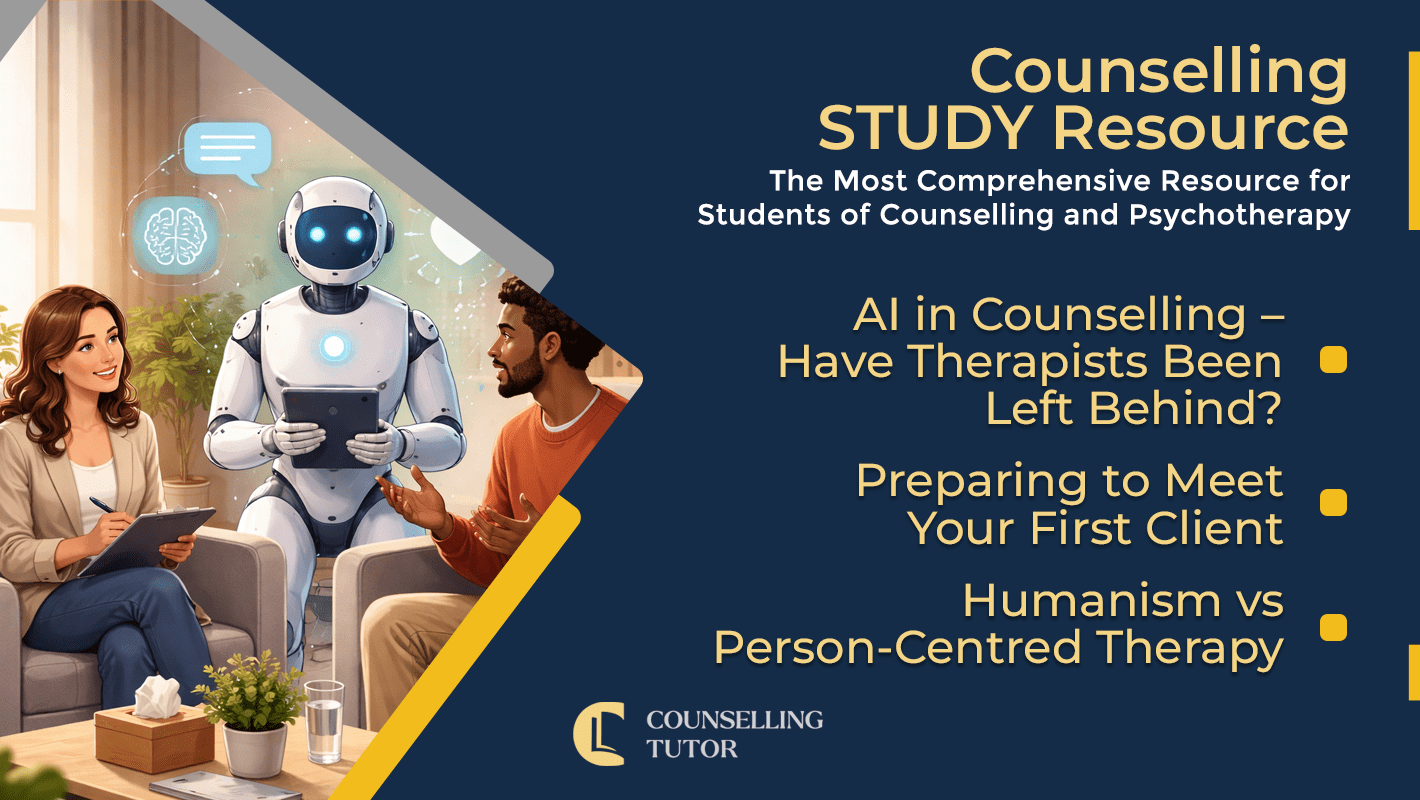
CT Podcast Ep371 featured image - Topics Discussed: AI in Counselling – Have Therapists Been Left Behind? - Preparing to Meet Your First Client - Humanism vs Person-Centred Therapy

Preparing to Meet Your First Client – Humanism vs Person-Centred Therapy

subscribe_itunes button small

In Episode 371 of the Counselling Tutor Podcast, your hosts Rory Lees-Oakes and Ken Kelly explore three key topics relevant to counsellors and counselling students.

Firstly, in ‘Ethical, Sustainable Practice’, they introduce the emerging conversation around AI in counselling, exploring whether therapists are being left behind and how practitioners can engage with AI ethically.

Then in ‘Practice Matters’, Rory speaks with Jessica Wing about preparing to meet your very first client, sharing insights to help students transition from classroom practice to real therapeutic work.

And finally, in ‘Student Services’, Rory and Ken clarify the difference between humanism and person-centred therapy, a common area of confusion for counselling students studying theoretical models.

Download your free Handout: AI in Counselling: You Haven’t Been Left Behind

AI in Counselling – Have Therapists Been Left Behind? [starts at 03:07 mins]

In this section, Rory and Ken explore the growing role of AI in counselling and why therapists cannot afford to ignore the conversation.

Key points discussed include:

  • AI is already embedded in many tools therapists use daily (email systems, video platforms, and software), even if practitioners do not actively use AI themselves.
  • Counsellors don’t need to become technology experts, but they do need to understand the ethical implications of AI in practice.
  • Clients are increasingly using AI tools themselves, sometimes discussing personal struggles with chatbots and bringing those experiences into therapy.
  • Therapists can respond with curiosity rather than resistance, exploring how AI interactions affect a client’s experience and meaning-making.
  • Practitioners may fall into different camps regarding AI: the enthusiast, the resistor, the anxious middle, or the pragmatist.
  • Ethical frameworks and professional bodies in the UK (such as BACP and NCPS) are already beginning to address AI in guidance and policy.

See Counselling Skills Used in Real Sessions by Qualified Therapist

Real Sessions – Real Presentations – Real Skills
Gain the competence and confidence to use counselling techniques effectively!

Preparing to Meet Your First Client [starts at 27:55 mins]

In this week’s Practice Matters, Rory speaks with counsellor and trainer Jessica Wing about preparing to see your first client as a counselling student.

Key points from this conversation include:

  • The transition from classroom triads to working with real clients can feel daunting because real clients bring richer and more complex stories.
  • First-session anxiety is normal; leaning on support from supervisors and placement teams can help ground and reassure students.
  • The first session is not about solving everything – it is about building trust, establishing rapport, and beginning the therapeutic relationship.
  • Focusing on relational presence rather than getting everything “right” allows counsellors to be more authentic and effective.
  • Maintaining self-regulation before sessions (for example through breathing exercises or grounding techniques) helps create a calm therapeutic space.
  • Supervision plays a vital role in early practice, offering reassurance, reflection, and professional support as students begin their client work.

Counselling Student Library

On-demand access to a rich lecture library covering theory, skills, and professional development for counselling students—Mapped to the UK awarding body criteria

“The Student Library has been BRILLIANT, I can’t recommend it enough!
It has been a lifeline in helping me prepare for practice and my first clients. If you’re considering it, go-for-it, it’s absolutely worth it!”
Kelly – Graduated and now in practice.

Humanism vs Person-Centred Therapy [starts at 49:34 mins]

In this section, Rory and Ken unpack the difference between humanism and person-centred therapy (PCT), a distinction that often confuses counselling students.

Key points include:

  • Humanistic psychology is a broad philosophical approach to understanding people, emphasising growth, free will, and personal meaning.
  • It emerged as the “third force” in psychology, alongside psychoanalysis and behaviourism, influenced by thinkers like Abraham Maslow and Carl Rogers.
  • Person-centred therapy is a specific therapeutic model that applies humanistic principles in practice.
  • PCT is built on the belief in the actualising tendency – the idea that people naturally move toward growth and fulfilment when the right conditions are present.
  • Rogers identified the core conditions (empathy, congruence, and unconditional positive regard) as essential elements for therapeutic change.
  • While many modern therapies incorporate humanistic values, person-centred therapy places the therapeutic relationship and client-led growth at the very centre of the approach.

Free Handout Download AI in Counselling: You Haven’t Been Left Behind

Here is a full handout on this topic:

Humanistic Psychology vs Person-Centred Therapy

The terms humanistic psychology and person-centred therapy (PCT) are often used interchangeably, but they refer to different levels of theory and practice.

Humanistic Psychology (Humanism)

Humanistic psychology emerged in the mid-20th century, associated with figures such as Abraham Maslow, Carl Rogers and Rollo May. It became known as the “third force” in psychology, following psychoanalysis and behaviourism.

Humanism proposes that people are fundamentally oriented toward growth, meaning and creativity when the right conditions are present.

Key Ideas

  • People have an innate drive toward growth and self-actualisation
  • Subjective experience is central to understanding the person
  • Individuals have free will and personal responsibility
  • Therapy focuses on the whole person, not only symptoms

In therapy, humanism is an umbrella term that includes several approaches, such as:

  • Person-centred therapy
  • Gestalt therapy
  • Existential therapy
  • Transactional analysis

These approaches share a focus on human potential, authenticity and lived experience.

Person-Centred Therapy (PCT)

Person-centred therapy was developed by Carl Rogers as a specific approach within the humanistic tradition.

Central to Rogers’ theory is the actualising tendency – the natural human drive toward growth and psychological health.

Rogers described several conditions necessary for therapeutic change. Three key therapist attitudes are:

  • Congruence – genuineness and authenticity
  • Unconditional positive regard – acceptance without judgement
  • Empathic understanding – sensing the client’s internal frame of reference

Person-centred therapy is intentionally non-directive. The client leads the process while the therapist provides the facilitative relational climate for change.

Key Differences

Level

Humanistic psychology
A broad philosophy about human nature and helping.

Person-centred therapy
A specific therapeutic model developed by Rogers.

Scope

Humanism influences therapy, education, organisational work and personal development.

Person-centred therapy describes a specific way of practising counselling, centred on the relationship and the core conditions.

Practice

Humanistic practitioners may integrate techniques while maintaining a humanistic philosophy.

Classical person-centred therapists prioritise the relational conditions and tend to avoid structured techniques or therapist-led agendas.

A Simple Way to Remember

Humanistic psychology

The broad philosophy that sees people as growth-oriented and best understood through their subjective experience.

Person-centred therapy

Carl Rogers’ specific, non-directive therapeutic approach built around empathy, unconditional positive regard and congruence.

Counsellor CPD Library

Get on-demand Certified CPD that is implementable in your practice

  • Over 150 hours of on-demand CPD lectures to help you stay current with your CPD ethical requirements
  • Support, and be supported, by thousands of other counsellors as a member of the exclusive online community.
  • Access your learning anytime you want … anywhere you choose … using any device type — desktop or mobile.

£100 off the WebHealer.net “Do it for me” service

  • WebHealer are the go-to provider of websites for private practitioners in the UK.
  • Established over 20 years, WebHealer offers a non-technical and fully supported service to help therapists grow their private practice.
  • Just one customer from your website each year pays 
for their service.
Use coupon code CT100 Visit webhealer.net