
Clinical Supervision Course – October & November Intakes Open

385 – The Six-Question Rationale in the 2026 BACP Ethical Framework

CT Podcast Ep385

What Is Relational Psychotherapy – Reflective Journals in Counselling Training

subscribe_itunes button small

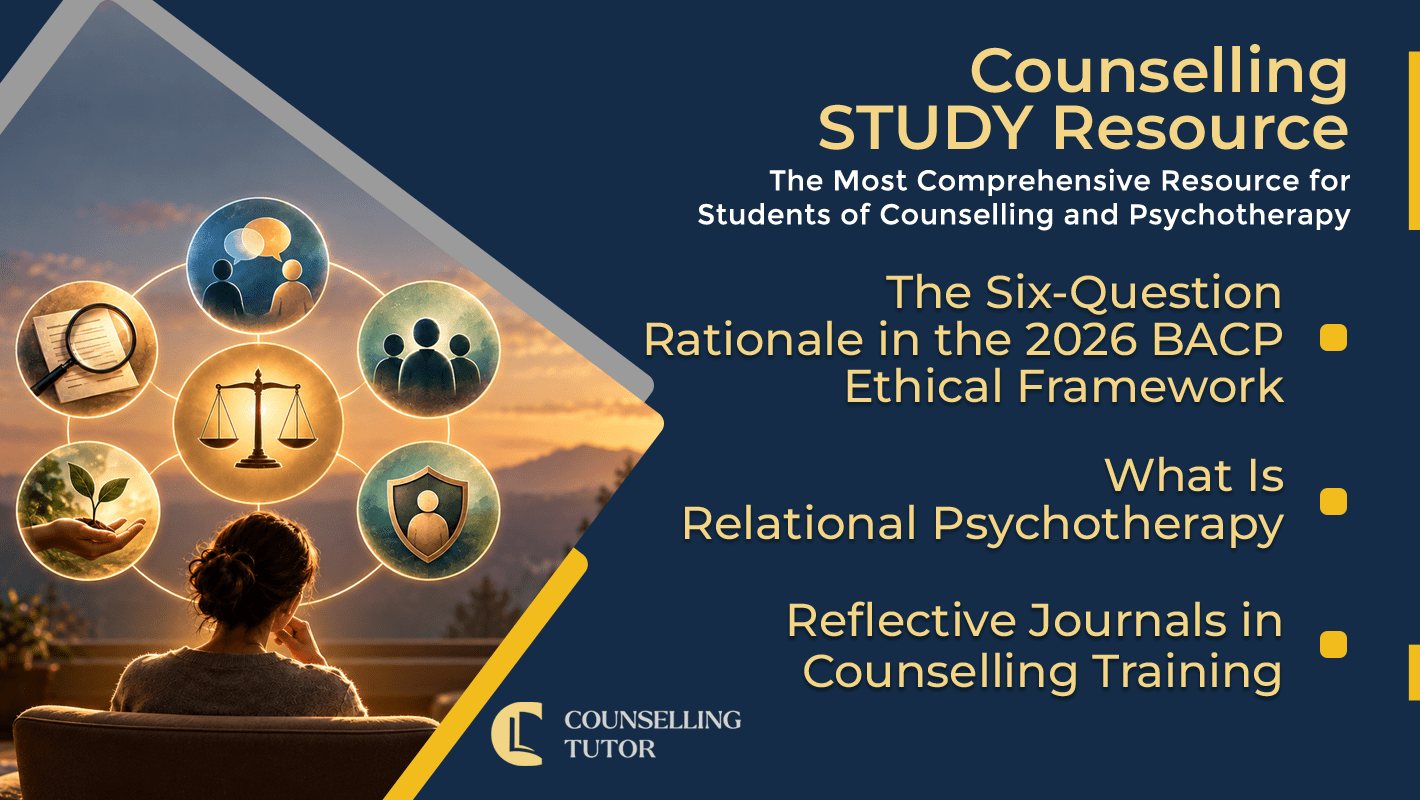
In Episode 385 of the Counselling Tutor Podcast, your hosts Rory Lees-Oakes and Ken Kelly take us through this week’s three topics:

Firstly, in ‘Ethical, Sustainable Practice‘, they explore ethical decision-making – the six-question rationale in the 2026 BACP Ethical Framework.

Then in ‘Practice Matters‘, Rory speaks with Clare Ratcliffe about relational psychotherapy – how the therapist’s presence and use of self shape therapeutic change.

And finally, in ‘Student Services‘, Rory and Ken discuss reflective journals in counselling training – why they matter and how to keep them well.

Download your free Handout: The Six-Question Rationale in the 2026 BACP Ethical Framework

The Six-Question Rationale in the 2026 BACP Ethical Framework [starts at 02:33 mins]

In this section, Rory and Ken explore the six-question rationale in the 2026 BACP Ethical Framework and what it means for everyday decision-making.

Key points discussed include:

  • The new BACP Ethical Framework comes into force in November 2026, and from that date every BACP member must work to it, with collaboration running as a theme throughout.
  • The six-question rationale will be mandatory and forms the basis of defensible decision-making, recording not just what a practitioner decided but the thinking behind how they reached that decision.
  • The first question asks the practitioner to identify the ethical issues and describe the challenge in clear, neutral and factual language, which is harder than it sounds and underpins everything that follows.
  • The middle questions focus on engaging the person affected by the decision, and on weighing internal factors such as identity, contract and the therapist’s own responses alongside external factors such as law, safeguarding duties and organisational policy.
  • The final questions cover what decisions and actions were taken and why, and how the process was reviewed and with whom, bringing the rationale full circle back to collaboration.
  • Rory and Ken encourage practitioners to take this to supervision, keep the ethical framework close at hand as a living document, and read any accompanying good practice documents for the detail.
TherapyLock, an encrypted vault for counsellors and psychotherapists to store session notes and client records

TherapyLock

An encrypted vault for UK counsellors and psychotherapists. Write your session notes, keep client records, and manage appointments in one secure place. Built around UK GDPR and the ethical standards of the counselling profession, by the team behind Counselling Tutor.

See Counselling Skills Used in Real Sessions by Qualified Therapist

Real Sessions – Real Presentations – Real Skills
Gain the competence and confidence to use counselling techniques effectively!

What Is Relational Psychotherapy [starts at 40:51 mins]

In this week’s ‘Practice Matters’, Rory speaks with Clare Ratcliffe about relational psychotherapy and how the therapist’s presence, attunement and use of self support positive change.

Key points from this conversation include:

  • The therapist’s presence is a huge part of the work, as clients experience therapy differently depending on how well the therapist knows and uses themselves in the room.
  • Attunement to the client shapes pace, tone and response, brings safety to the relationship, and is quickly felt when it is missing, which itself becomes something to explore.
  • Transference happens all the time, and noticing who a therapist may represent to a client, rather than simply reacting, allows old wounds to be healed through a new relational experience.
  • Countertransference is inevitable and useful information rather than a failing, but it needs to be managed so the therapist’s own story does not bleed into the work.
  • Self-disclosure should be used mindfully, since disclosing can place unspoken restrictions on the client, and the urge to disclose is itself worth taking to supervision.
  • Good personal therapy and supervision are essential to looking after the therapist, and Clare encourages therapists to bring even shame-laden material, including erotic transference, to their supervisor.

Online Group Supervision

Claire runs online group supervision for counsellors and psychotherapists working with couples and relationship therapists, offering a space to reflect on practice, share experiences and explore the challenges of relationship work.

For more information, visit Claire Ratcliffe Psychotherapy

Ethical AI Practice by Kenneth Kelly

Ethical AI Practice for Counsellors and Psychotherapists in the UK

Kenneth Kelly’s practical framework for counsellors and psychotherapists — navigate AI ethically, protect your clients and practise with clarity.

Counselling Student Library

On-demand access to a rich lecture library covering theory, skills, and professional development for counselling students—Mapped to the UK awarding body criteria

“The Student Library has been BRILLIANT, I can’t recommend it enough!
It has been a lifeline in helping me prepare for practice and my first clients. If you’re considering it, go-for-it, it’s absolutely worth it!”
Kelly – Graduated and now in practice.

Reflective Journals in Counselling Training [starts at 01:04:39 mins]

In this section, Rory and Ken discuss the value of reflective journals in counselling training and how to keep them safely and well.

Key points include:

  • Counselling training is as much about learning yourself as learning theory, and a reflective journal is a powerful way to capture that personal change across the arc of a course.
  • There is no right or wrong way to journal, and the aim is an unedited flow of self, so students should find whatever medium lets them write most freely without stopping to self-correct.
  • A reflective journal must never contain client information, which belongs in a secure, structured note system, as journals can be called for in court and are increasingly handed in as part of a course.
  • Journalling helps students connect theory to lived experience, such as recognising an introjected value in an everyday advert, which makes later reflective assignments far richer.
  • Because journals may be seen by a tutor or moderator, students can practise selective transparency and even keep a fuller private version alongside the one they submit.
  • Reflective journals should be kept somewhere safe from prying eyes, as personal material shared in a journal can be misused, and the journey of self-reflection continues well beyond training.

Free Handout Download The Six-Question Rationale in the 2026 BACP Ethical Framework

Counsellor CPD Library

Get on-demand Certified CPD that is implementable in your practice

  • Over 150 hours of on-demand CPD lectures to help you stay current with your CPD ethical requirements
  • Support, and be supported, by thousands of other counsellors as a member of the exclusive online community.
  • Access your learning anytime you want … anywhere you choose … using any device type — desktop or mobile.

£100 off the WebHealer.net “Do it for me” service

  • WebHealer are the go-to provider of websites for private practitioners in the UK.
  • Established over 20 years, WebHealer offers a non-technical and fully supported service to help therapists grow their private practice.
  • Just one customer from your website each year pays 
for their service.
Use coupon code CT100 Visit webhealer.net