Try the Student Library Risk-FREE for 7 Days (Students Only)

362 – Working with Clients Who Have a Psychiatric Diagnosis

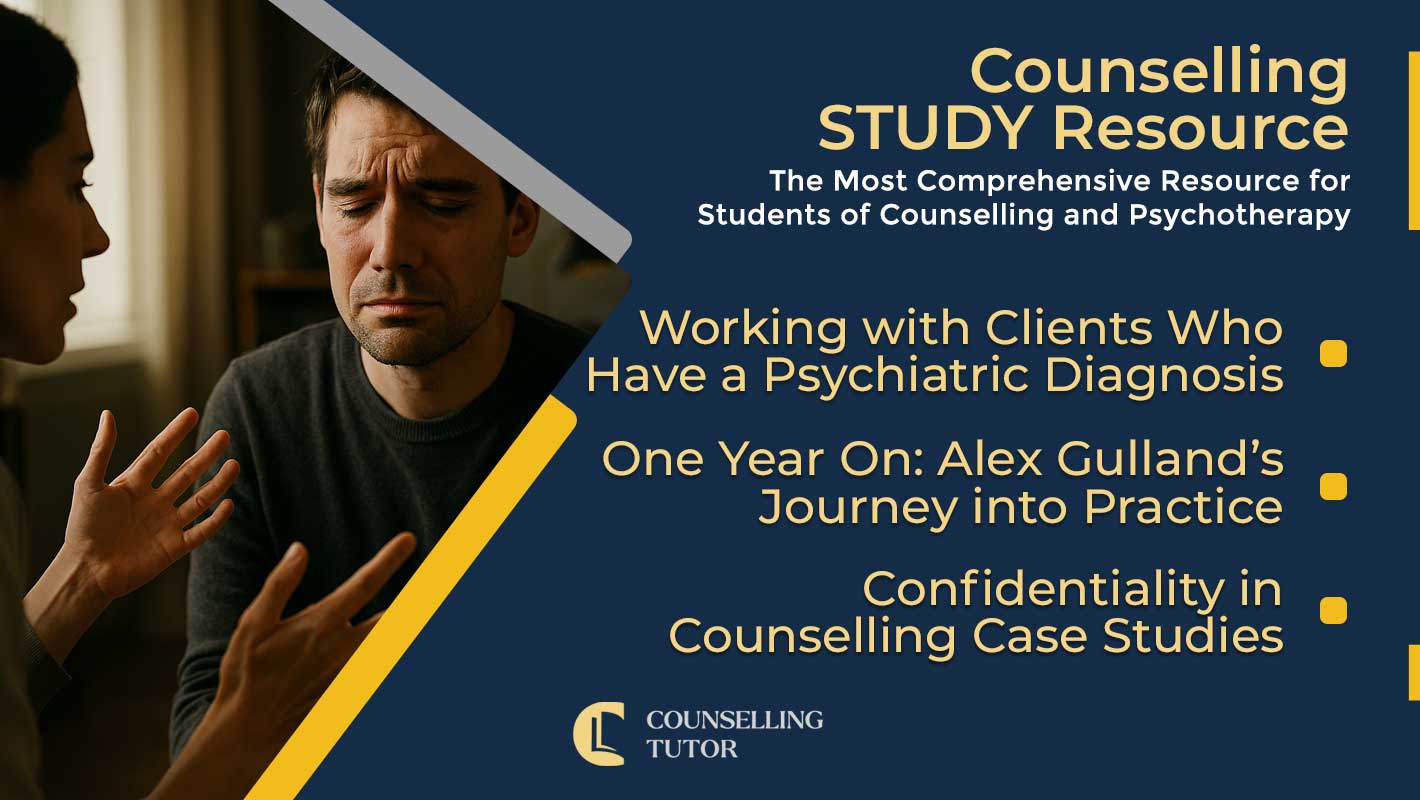
CT-Podcast-Ep362 featured image: Topics Discussed: Working with Clients Who Have a Psychiatric Diagnosis – One Year On: Alex Gulland’s Journey into Practice – Confidentiality in Counselling Case Studies

One Year On: Alex Gulland’s Journey into Practice – Confidentiality in Counselling Case Studies

subscribe_itunes button small

In Episode 362 of the Counselling Tutor Podcast, your hosts Rory Lees-Oakes and Ken Kelly take us through this week’s three topics:

Firstly, in ‘Ethical, Sustainable Practice’, we explore working with clients who have a psychiatric diagnosis, considering how to approach this work ethically, including navigating risk, understanding medication, and maintaining person-centred care.

Then in ‘Practice Matters’, Rory catches up with Alex Gulland, a year after she qualified, to hear what the transition from student to practitioner has really been like – from building a client base to discovering a passion for equine-assisted therapy.

And finally in ‘Student Services’, Ken and Rory explore how to protect client confidentiality when writing case studies – including anonymisation techniques and data protection guidance. Sarah Henry joins to share her frontline insights into balancing academic and ethical responsibilities.

Download your free Handout: Working with Clients Who Have a Psychiatric Diagnosis

Working with Clients Who Have a Psychiatric Diagnosis [starts at 03:17 mins]

In this section, Rory and Ken explore working with clients who have a psychiatric diagnosis, unpacking the complexities of staying within professional competence while offering relational, therapeutic support.

Key points discussed include:

  • Understanding diagnoses like bipolar disorder or schizophrenia helps reduce fear and supports ethical, informed practice.
  • Therapists must see the person first – not the label or diagnosis – and listen to what the client needs from therapy.
  • Medication, risk, and involvement with community mental health teams should be explored during initial assessments.
  • Supervision is essential when working with clients who have complex mental health needs, especially during episodes of active distress or psychosis.
  • Counsellors should seek CPD to increase confidence and competence in this area, and avoid making assumptions about diagnosis severity.

See Counselling Skills Used in Real Sessions by Qualified Therapist

Real Sessions – Real Presentations – Real Skills
Gain the competence and confidence to use counselling techniques effectively!

One Year On: Alex Gulland’s Journey into Practice [starts at 26:53 mins]

In this week’s ‘Practice Matters’, Rory reconnects with Alex Gulland to hear how her first year as a qualified counsellor has unfolded – from business decisions to developing her niche.

Key points from this conversation include:

  • Building a client base takes time and persistence; marketing and directory presence matter.
  • Accreditation and professional registration offer reassurance but are not always decisive factors for clients.
  • Combining freelance roles in training with private practice has provided income and valuable experience.
  • Alex shares how equine-assisted therapy has become a core part of her practice, offering creative, non-verbal connection.
  • Continued learning, especially in areas like attachment theory and shadow work, has been central to her growth.

Counselling Student Library

On-demand access to a rich lecture library covering theory, skills, and professional development for counselling students—Mapped to the UK awarding body criteria

“The Student Library has been BRILLIANT, I can’t recommend it enough!
It has been a lifeline in helping me prepare for practice and my first clients. If you’re considering it, go-for-it, it’s absolutely worth it!”
Kelly – Graduated and now in practice.

Confidentiality in Counselling Case Studies [starts at 55:18 mins]

In this section, Rory and Ken provide a detailed guide on how to write case studies while protecting client identity – a key consideration in counselling education.

Key points include:

  • Use anonymisation techniques such as pseudonyms, vague job titles, and generalised locations to remove identifying details.
  • Only include information directly relevant to the assignment question – avoid unnecessary specifics or rare events.
  • Gain informed consent where possible, and understand awarding body and agency policies on client data use.
  • Refer to BACP guidance, ICO anonymisation principles, and supervisor support to ensure ethical compliance.
  • Sarah Henry emphasises how students can reflect on their motivations and ensure they write responsibly while still demonstrating learning.

Free Handout Download

Working with Clients Who Have a Psychiatric Diagnosis

Counsellor CPD Library

Get on-demand Certified CPD that is implementable in your practice

  • Over 150 hours of on-demand CPD lectures to help you stay current with your CPD ethical requirements
  • Support, and be supported, by thousands of other counsellors as a member of the exclusive online community.
  • Access your learning anytime you want … anywhere you choose … using any device type — desktop or mobile.

£100 off the WebHealer.net “Do it for me” service

  • WebHealer are the go-to provider of websites for private practitioners in the UK.
  • Established over 20 years, WebHealer offers a non-technical and fully supported service to help therapists grow their private practice.
  • Just one customer from your website each year pays 
for their service.
Use coupon code CT100 Visit webhealer.net