
New CPD Bundle: Working with Addiction. 7 lectures by 3 specialists. £24.99.

391 – Choosing Your Clinical Will Executor

CT Podcast Ep391 featured image: Topics Discussed: Choosing Your Clinical Will Executor - Online and Telephone Placements - Is It Something I Did?

Online and Telephone Placements – Is It Something I Did?

subscribe_itunes button small

In Episode 391 of the Counselling Tutor Podcast, your hosts Rory Lees-Oakes and Ken Kelly take us through this week’s three topics:

Firstly, in ‘Ethical, Sustainable Practice‘, they explore choosing your clinical will executor – who is suitable for the role and where a clinical will can fail.

Then in ‘Practice Matters‘, Rory speaks with Dee Phillips-Duncan about online and telephone placement requirements – and whether they reflect what the public and students actually need.

And finally, in ‘Student Services‘, Rory and Ken discuss the self-doubt that surfaces when a client does not return – the familiar question of ‘is it something I did?’

Download your free Handout: Choosing Your Clinical Will Executor

Choosing Your Clinical Will Executor [starts at 03:48 mins]

In this section, Rory and Ken explore choosing your clinical will executor – who is suitable for the role – and the common points where a clinical will can fail.

Key points discussed include:

  • A clinical will lets a trusted therapist, rather than a grieving family member, compassionately contact clients if the practitioner becomes seriously unwell or dies.
  • The executor should be an experienced counsellor or psychotherapist who understands the practitioner’s confidentiality agreement and can hold client distress, not a student or novice.
  • Options include an experienced colleague, a clinical supervisor, a professional outside the practice, or a practice organisation, each carrying its own strengths and weaknesses around impartiality, capacity and access to information.
  • A clinical will is an ethical document rather than a legal one, so it needs no set template and should be tailored to the practitioner’s own clients, modality and boundaries.
  • Common failure points include storing client data on personal devices that fail or are replaced, changed passwords, outdated software, and the executor never being told the will needs activating.
  • The role involves real work and should be discussed, agreed and reasonably paid for in advance, with the will revisited annually to check everything is still current.
TherapyLock, an encrypted vault for counsellors and psychotherapists to store session notes and client records

TherapyLock

An encrypted vault for UK counsellors and psychotherapists. Write your session notes, keep client records, and manage appointments in one secure place. Built around UK GDPR and the ethical standards of the counselling profession, by the team behind Counselling Tutor.

See Counselling Skills Used in Real Sessions by Qualified Therapist

Real Sessions – Real Presentations – Real Skills
Gain the competence and confidence to use counselling techniques effectively!

Online and Telephone Placements [starts at 36:12 mins]

In this week’s ‘Practice Matters’, Rory speaks with Dee Phillips-Duncan about whether current placement requirements reflect what clients and students actually need.

Key points from this conversation include:

  • Personal Bridge is a non-profit counselling charity in Bradford offering pay-what-you-can-afford counselling, with face-to-face work locally and remote counselling across the UK.
  • Current requirements let adult placement students complete up to 49% of their 100 hours online or by telephone, with the remaining hours face-to-face, while work with children and young people must be face-to-face.
  • Dee’s informal survey of Facebook groups found students struggling emotionally, financially and practically, with some holding hundreds of supervised hours yet unable to qualify because of the face-to-face split.
  • She highlights an accessibility concern, including a visually impaired student unable to drive who spent two years trying to find a reachable placement, raising questions under the Equality Act.
  • Her service saw 26 of 30 enquiries over eight weeks request online counselling, reflecting a growing public preference for remote therapy as other services such as GP appointments also move online.
  • Dee calls on professional bodies to review whether current rules unintentionally create barriers, stressing this is about accessibility and shared responsibility, not lowering standards.

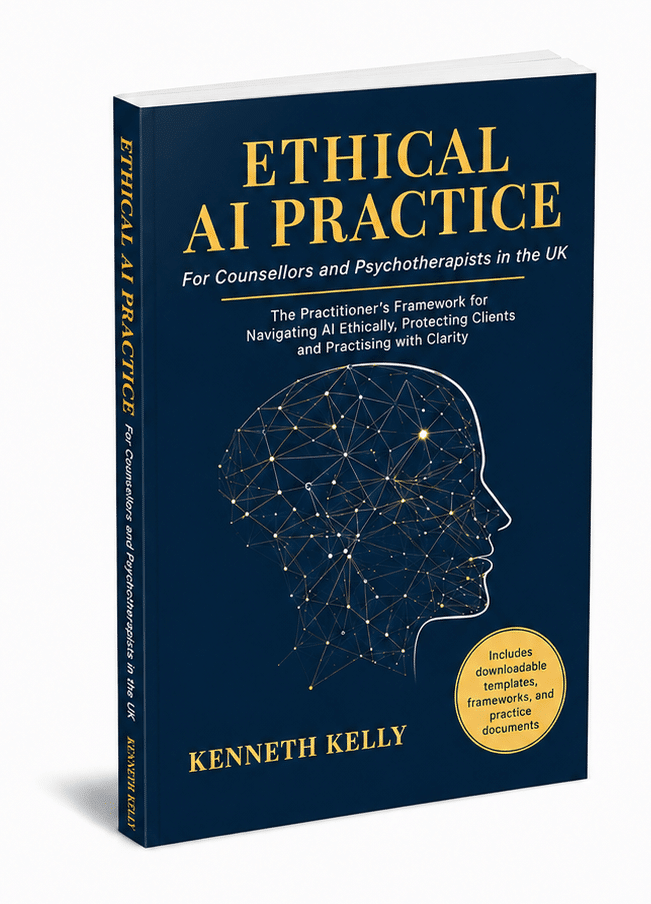
Ethical AI Practice by Kenneth Kelly

Ethical AI Practice for Counsellors and Psychotherapists in the UK

Kenneth Kelly’s practical framework for counsellors and psychotherapists — navigate AI ethically, protect your clients and practise with clarity.

Counselling Student Library

On-demand access to a rich lecture library covering theory, skills, and professional development for counselling students—Mapped to the UK awarding body criteria

“The Student Library has been BRILLIANT, I can’t recommend it enough!
It has been a lifeline in helping me prepare for practice and my first clients. If you’re considering it, go-for-it, it’s absolutely worth it!”
Kelly – Graduated and now in practice.

Is It Something I Did? Managing Self-Doubt When a Client Does Not Return [starts at 55:52 mins]

In this section, Rory and Ken discuss the self-doubt that arises when a placement client does not attend or does not return after a first session.

Key points include:

  • The worry of ‘is it me?’ is common for students and persists for many therapists throughout their careers, and is closely linked to imposter syndrome.
  • Supervision is the ideal place to take these feelings, and the client who did not return is exactly the one worth bringing rather than quietly dropping.
  • Therapy is the client’s journey, and respecting client autonomy means accepting their right not to return, for reasons that are theirs and often nothing to do with the therapist.
  • Clients may simply not be a fit, may have found therapy different from what they expected, or may have taken what they needed from a single session and moved on.
  • Honest, reflective self-examination has value, but it should not tip into self-criticism that becomes self-destructive or makes someone want to give up.
  • Practitioners should learn their agency’s processes around a did-not-attend, including who is responsible for following up and how many contact attempts are made before a client is classed as not returning.

Free Handout Download Choosing Your Clinical Will Executor

Counsellor CPD Library

Get on-demand Certified CPD that is implementable in your practice

  • Over 150 hours of on-demand CPD lectures to help you stay current with your CPD ethical requirements
  • Support, and be supported, by thousands of other counsellors as a member of the exclusive online community.
  • Access your learning anytime you want … anywhere you choose … using any device type — desktop or mobile.

£100 off the WebHealer.net “Do it for me” service

  • WebHealer are the go-to provider of websites for private practitioners in the UK.
  • Established over 20 years, WebHealer offers a non-technical and fully supported service to help therapists grow their private practice.
  • Just one customer from your website each year pays 
for their service.
Use coupon code CT100 Visit webhealer.net